DNC Incident Shows Local Values in Uneasy Transition
A Hawaii delegate who made an obscene gesture on national television should have expressed her indignation in other ways.
Politics has a way of bringing out the best and worst in people. It requires us to think about — and work with — other people. The death of Congressman K. Mark Takai reminds us that local politicians can conduct fiercely competitive campaigns — and themselves as responsible public servants.
The behavior of a Hawaii delegate to the Democratic National Convention shows how politics, at its worst, can degenerate into personal self expression.
Chelsea Lyons Kent’s raised middle finger didn’t so much discredit the Democratic Party of Hawaii as it did the movement launched by Bernie Sanders. Having felt the Bern, I voted for Sanders, who ran a clean, high-minded campaign, and was as disappointed as any of his supporters when he didn’t win the nomination.
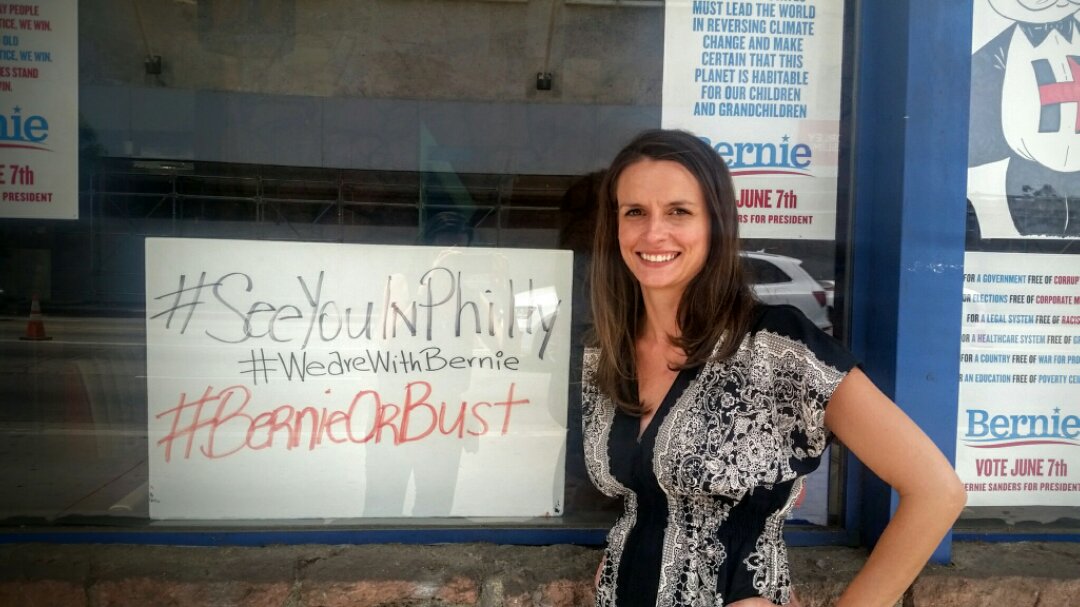
Revelations that the Democratic National Committee tilted in favor of Hillary Clinton confirmed what many of us suspected: that the committee decided not to give the popular challenger an even break.
Outraged as I was, I could not have done what Kent did. Local people don’t behave like that.
When news of the incident arrived via an email from Tim Vandeveer, the newly elected chair of the Democratic Party of Hawaii, I jumped to the conclusion that the unnamed person involved was a malihini haole. News reports confirmed both my bias — wholly unsupported by evidence — and my understanding of local culture.
Local people have their weak points. In a recent piece on the moldering natatorium, Honolulu Star-Advertiser columnist David Shapiro called attention to our “futlessness.”
Shapiro is better at labeling than at explaining. Let me explain.
Futlessness might mean we’re bumblers. We botch things up. Or it might mean that we’re not decisive. Unlike Mayor Frank F. Fasi, we can’t get it done. We’re held back by our principles and culture unlike Honolulu’s best mayor, who thumbed his nose at convention and the law and barely escaped going to jail.
Americans of Japanese ancestry acquired a number of values from their immigrant forebears. These values can be seen in our often restrained behavior.
Restraint arises from “enryo.” We’re taught from an early age not to speak out and to keep ourselves in check, to hold back. I used to think that enryo was a value that, as Americans living in a competitive society, we had to outgrow. I now think it’s a trait that civil society needs, especially in an age that rewards unleashed behavior with instant media attention.
The Usefulness Of Traditional Values
Traditional values can be trivialized and exploited. “Kodomo no tame ni” (“For the sake of the children”) is often repeated and rarely acted upon. (Really, public-school classrooms can’t be cooled, even for the sake of the children? Our precious keiki?)
Local values are threatened by politicians who turn them into slogans. They’re also threatened by newly arrived haoles who are quite ignorant of them and who believe that mainland behavior is now the universal norm.
I’m glad Vandeveer acted on behalf of Hawaii and the Sanders campaign. He took away Kent’s floor credentials. His decision affirmed the importance of decorum in public proceedings: that politics is not an anything-goes solo performance.
Bart Dame, another Sanders delegate, defended Kent by saying in a media account, “There is a righteous indignation that is justified behind her awkward and inappropriate expression of anger.”
But Kent’s gesture was not merely awkward, it was an obscenity. What message exactly, I’d like to ask Dame, does the raised middle finger communicate? And indignation, if righteous, could have been expressed in other ways.
If Kent believes that Clinton does not deserve Sanders’ endorsement, she could stay home and not vote.
Or she could vote for Jill Stein, the Green Party’s estimable presidential candidate. Stein, like Sanders, represents change, revolutionary change, not the incremental change that papers over the ills that confront American society today.
Tradition and change are both important.
Traditional values are important and should not be discarded whole hog. Some, maybe even most, are useful, and perhaps essential, to ensure that civil society remains civil. What traditional values should be kept, and in what form, deserves discussion.
 GET IN-DEPTH
REPORTING ON HAWAII’S BIGGEST ISSUES
GET IN-DEPTH
REPORTING ON HAWAII’S BIGGEST ISSUES
Community Voices aims to encourage broad discussion on many topics of community interest. It’s kind of a cross between Letters to the Editor and op-eds. This is your space to talk about important issues or interesting people who are making a difference in our world. Column lengths should be no more than 800 words and we need a current photo of the author and a bio. We welcome video commentary and other multimedia formats. Send to news@civilbeat.org. The opinions and information expressed in Community Voices are solely those of the authors and not Civil Beat.