Superintendent’s Leadership Style Justifies Top-Down Accountability
Kathryn Matayoshi’s reign has been considerably less than collaborative with teachers and principals.
Ironically, when talking about what ails education in Hawaii, it is all supposed to be about accountability. After all, isn’t accountability what Race to the Top and No Child Left Behind were supposed to be all about?
The irony is the weight of accountability now should not be about the teachers. Nor should it be about the principals. Not about the schools, where high-stakes testing scores don’t make the grade. It has to be about the accountability of the superintendent, and the bureaucratic lieutenants who do her bidding.
This would be the assumption about the action taken by the Hawaii Board of Education, when it announced that a search committee would convene to find a replacement for Superintendent Kathryn Matayoshi when her contract expires in June.
Matayoshi and administration have campaigned to convince the BOE to keep her employed. Her job is not finished, she tearfully implored the board, after being notified that she would not be retained.
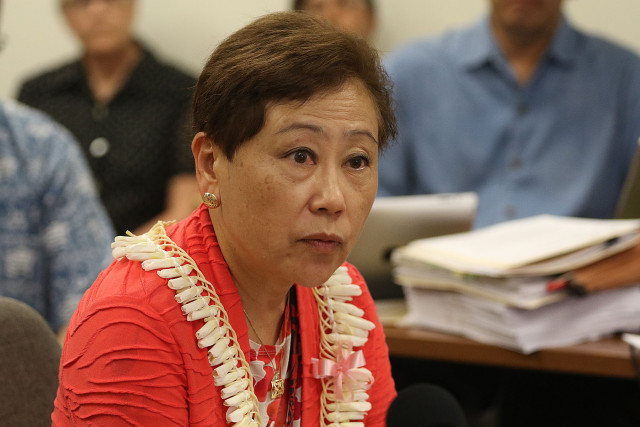
She could not get to the board, but Matayoshi apparently has gotten to some of the leaders in the Legislature.
BOE members were grilled Jan. 17 about why they would fire a person they had previously awarded high marks. Rep. Sylvia Luke, chairwoman of the House Finance Committee, questioned why the board decided not renew her contract and fire her.
In replying, BOE Vice Chairman Brian De Lima, acknowledged that Matayoshi has been an “exceptional superintendent,” but “we wanted to search for an education leader that will look at things with a different set of eyes and a different energy level to the point where we believe we can move together … in a way that we can build on the momentum that we have been able to achieve thus far.”
Matayoshi’s defense rests with the DOE’s new Strategic Plan to guide education policy and practice for the next three academic years. Funny thing; it is distinctly similar to Hawaii’s Blueprint for Public Education that has been collaboratively designed via a series of community meetings led by a team of educators and administrators recruited by Gov. David Ige.
When Ige was in the process of assembling a team that would work together on this plan, Matayoshi’s name was conspicuously and purposefully missing from it. Ige and his wife Dawn Amano-Ige, a former teacher and vice principal, had listened to a chorus of dissent both from teachers and principals about Matayoshi’s heavy-handed, top-down administration. So if the superintendent’s reign was considerably less than collaborative, why would he want to include her in this effort?
To listen to Matayoshi say now that she has redirected her administration to work collaboratively with schools seems disingenuous at best. In a survey of 144 principals completed last year by the Hawaii Education Institute, an independent think tank, only 21 percent responded that DOE leadership treats them like a partner. Less than one in three disagreed that, “DOE leadership sometimes treats me and other members of my school community like servants.” Only 32 percent expressed confidence in the superintendent. Only one in five had confidence in the assistant superintendents.
DeLima likely chose his words carefully during his testimony to legislators, knowing how politically charged public education has come to be as an issue. He was polite and politically correct, but between the lines, it was all about accountability.
Two plans contradict her actions of the past six years since she took over. They speak volumes in regard to her leadership. The superintendent has to be held accountable.
 GET IN-DEPTH
REPORTING ON HAWAII’S BIGGEST ISSUES
GET IN-DEPTH
REPORTING ON HAWAII’S BIGGEST ISSUES
Community Voices aims to encourage broad discussion on many topics of community interest. It’s kind of a cross between Letters to the Editor and op-eds. This is your space to talk about important issues or interesting people who are making a difference in our world. Column lengths should be no more than 800 words and we need a current photo of the author and a bio. We welcome video commentary and other multimedia formats. Send to news@civilbeat.org. The opinions and information expressed in Community Voices are solely those of the authors and not Civil Beat.