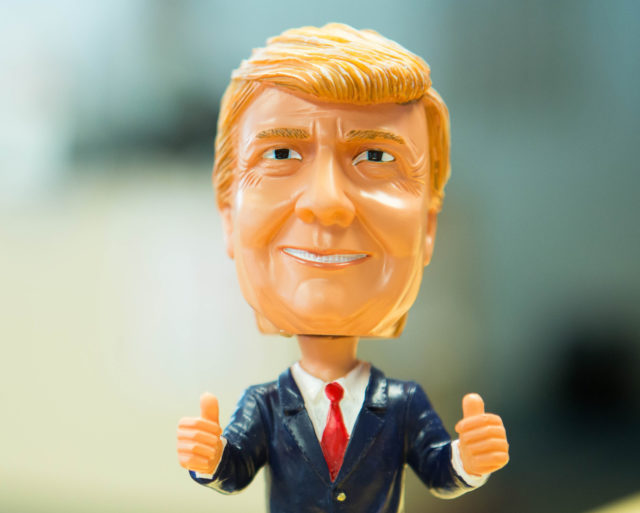
Donald Trump: Zen Master
It is no surprise that the American people are struggling to understand the paradoxical statements of Master Trump.
“What is the sound of one hand clapping?”
“It cannot get wet. It cannot get dry. What is it?”
“How can you make a mirror by polishing a brick?”
“What is the color of wind?”
“When you can do nothing, what can you do?
These are examples of paradoxes that zen masters use to expand the thinking of their students. Donald Trump uses paradoxes to expand the thinking of the American people.
For example, in his recent speech to Congress, Trump said, “My administration wants to work with members of both parties … to promote clean air and clean water.”
Americans might have thought that he meant encouraging the development of solar power and discouraging the use of oil, coal, and other “dirty” fuels. Americans might have thought that he meant protecting the environment. Masterfully, however, Trump also said the opposite.
He said that he has cleared the way for the Keystone XL Pipeline and the Dakota Access Pipeline, which will transport billions of barrels of oil from new wells. He also said he has reduced the regulation of coal mining to increase the production and use of coal. In addition, he has appointed Scott Pruitt, an opponent of environmental regulation, to head the Environmental Protection Agency.
Based on these seemingly paradoxical statements and decisions, it would be easy to imagine Master Trump asking, “When is dirty air clean air? When is dirty water clean water?”
In his speech to Congress, Trump also said, “I am also calling on this Congress to repeal and replace Obamacare with reforms that expand choice, increase access, lower costs, and at the same time, provide better health care.”
Everyone knows that health care in the U.S. is expensive, as it comprises 18 percent of the gross domestic product. Yet Trump said he would increase access to health care, provide better health care, and at the same time reduce costs.
Relatedly, Trump said he would reduce taxes, which would reduce federal income, and yet he would substantially increase military spending. The military represents by far the largest portion of federal discretionary spending. It would seem that spending would have to be reduced somewhere else by large amounts. Yet Trump said he will not reduce spending on large entitlement programs like Medicare and Social Security.
Trump seems to thrive on paradox. It would be easy to imagine Master Trump asking, “When can income be reduced and spending be increased at the same time?”
It is no surprise that the American people are struggling to understand the paradoxical statements of Master Trump. Understanding him would require learning a new kind of thinking that defies logic. Only time will tell whether the American people accept the politics of paradox.
At this time, perhaps the most relevant paradox is, “When is the president not the president?”
 GET IN-DEPTH
REPORTING ON HAWAII’S BIGGEST ISSUES
GET IN-DEPTH
REPORTING ON HAWAII’S BIGGEST ISSUES
Community Voices aims to encourage broad discussion on many topics of community interest. It’s kind of a cross between Letters to the Editor and op-eds. This is your space to talk about important issues or interesting people who are making a difference in our world. Column lengths should be no more than 800 words and we need a current photo of the author and a bio. We welcome video commentary and other multimedia formats. Send to news@civilbeat.org. The opinions and information expressed in Community Voices are solely those of the authors and not Civil Beat.