

Resilience In The Face Of Lava And An Uncertain Future
Evacuees don’t know when they’ll be able to go home — or if they’ll still have homes at all.
PAHOA, Hawaii Island – Forced to flee their homes and unable to determine when they might return, residents of two lower Puna subdivisions on the world’s most-active volcano displayed their resilience Friday.
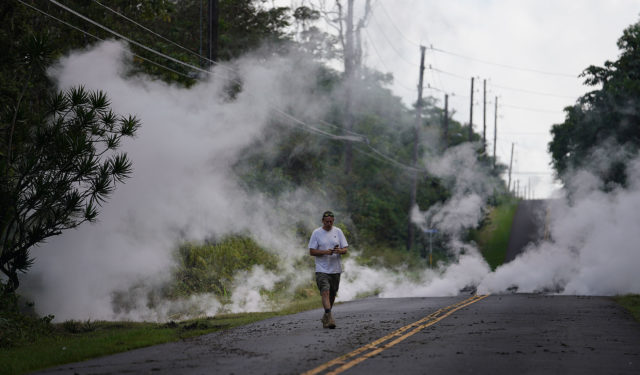
Kilauea lava outbreaks that started Thursday evening triggered the mandatory evacuation of the Leilani Estates and Lanipuna Gardens subdivisions, sending dozens of residents to this town’s gym-turned-shelter.
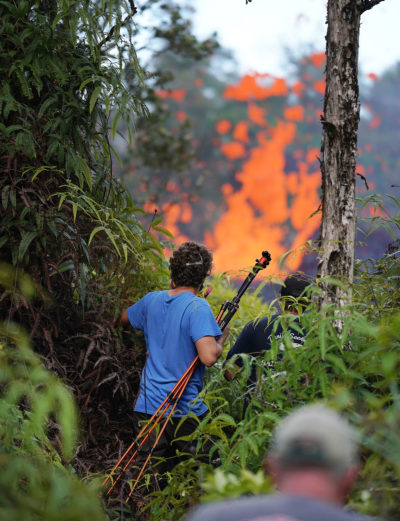
“I held out as long as I could, and then I witnessed a really large eruption,” Leilani resident Clive Cardoza said of a lava outbreak that he estimated shot molten rock 400 feet into the air near his home shortly before dawn Friday. “And then a shitload of police came down and ordered me out.”
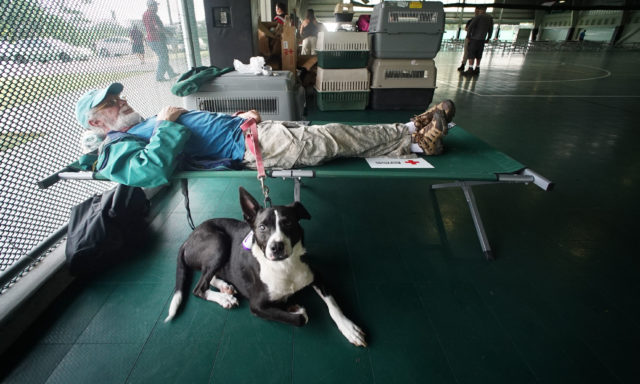
He departed with only his dog, Jax, important papers, some clothes, a computer and drones he uses for work.
The five-year resident said living on a ridge gave him the impression of being safe from lava inundation.
That changed quickly.
“I mean the ground was constantly moving under me. I have PTSD, and my PTSD started going out of control, and I’m still nervous,” Cardoza said while at Hawaii County’s designated shelter later Friday morning.
He has no long-term plan.
“My family is in Scotland, so my plan is to just play it by ear,” he said.
Despite a crack in his property and one potential path he said would bring lava onto his land, Cardoza said he’s optimistic he’ll be able to go home.
“I’m very hopeful, you know, that Madame Pele is going to spare us again and stop erupting,” he said of the Hawaiian fire goddess and a lava flow that reached the outskirts of Pahoa, the main city in a district the size of Oahu, in late 2014.

Motivated by warm weather and a need for a change following the death of his mother, Dan Jacobs said he left northern Kentucky 14 months ago and moved to Leilani Estates, where he’s been building a 30-foot yurt with hardwood flooring he shipped from the mainland.
He may not get a chance to finish it.
Within an hour of Thursday’s initial outbreak, lava had surrounded three sides of Jacobs’ property, cutting off his evacuation route and forcing an hour-long detour around the subdivision to reach the Pahoa shelter.
Leaving at 6:30 p.m. provided only time enough to gather his two dogs and several of the colorful bead necklaces his late mother made for him, said Jacobs, his voice cracking at the mention of his mom.
“Without the necessities of life, like a stove and containers to store water in, I’m screwed,” Jacobs said.
Out of concern for his dogs, he spent his first night as an evacuee sleeping under the awning of a concession building in the county park that includes the gymnasium where most people stayed.
He hopes to camp on a friend’s property, but is committed to staying in Puna.
“This place is beautiful – and deadly,” Jacobs said.
Volunteer help was plentiful at the shelter, as residents living upslope of the eruption came to offer their assistance.
Andrew Brewer, president of the Pahoa-based Indigenous Charities Group, said he’s been soliciting money to help lava victims.
“We’re hoping to raise at least $1,000. We’re at 10 percent of that,” Brewer said soon after launching the campaign and arriving at the shelter to learn what’s needed.
Evacuees have been requesting towels and pet food, said shelter volunteer Chassidy Del Toro, who moved to Pahoa soon after the 2014 lava threat ended.
“This is my first big lava event. I feel for the people who are really being affected,” she said.
Del Toro said she planned to spend much of Friday helping evacuees.
“Everybody can use a friend at a time like this,” she said.
Federal Emergency Management Agency personnel are on Hawaii Island assisting county and state emergency officials, Gov. David Ige said while at the Pahoa shelter Friday afternoon.
Additional help was provided by 12 Hawaii National Guard troops staffing area roadblocks and working to prevent looting, with another 50 soldiers set to arrive soon, Ige said.
Police officers operating two roadblocks said they’ve not received any reports of looting or vandalism to vacant homes.
“It’s going to be hard (to identify) because nobody’s really home to report it,” said police Sgt. Charrise Wakita, at the intersection of Highway 132 and Pohoiki Road.
Ige estimated 1,700 residents are affected by the mandatory evacuations.
The governor said he’s been impressed by the local volunteers and the coordination between government agencies.
“It’s inspiring to see the community come together,” he said.

But all that cooperation couldn’t fill Sara Steiner’s gas can.
“If you leave, you can’t come back. It’s a sad reality,” Steiner said while waiting inside a roadblock police set up at the bottom of Pohoiki Road, about a mile makai of her 5-acre animal farm.
Although she doesn’t live within either of the two subdivisions under mandatory evacuation, Steiner was temporarily trapped by roadblocks at both ends of the only road accessing her property.
Just as her friend arrived from the other side of the roadblock to take Steiner’s gas can and propane tank to Pahoa for refilling, police reversed their earlier position and told her she could come and go if she wanted.
The friend still gathered up the can and tank, and cash to fill them, after waiting for the situation to be clarified.
“It’s just the price you pay,” Steiner said of that inconvenience and other impacts of living in an active lava zone.
Thoughts on this or any other story? Write a Letter to the Editor. Send to news@civilbeat.org and put Letter in the subject line. 200 words max. You need to use your name and city and include a contact phone for verification purposes. And you can still comment on stories on our Facebook page.

