Do We Create Our Own Fake News?
Don’t be too quick to judge or dismiss those who don’t agree with you.
As the moral divide has widened over the last year, the truly polarized nature of it has gotten out of control.
Instead of opposing viewpoints stimulating positive discourse, it has become an all out battle royal of, “You’re either with us or against us.” Stoked by the media, people have become even more closed-minded and unwilling to concede any move toward middle ground.
That’s not me, you might say. It’s those other people, the crazy ones. It’s like that old one-in-every-three-people adage where if the person on your left don’t look crazy and the person on your right don’t look crazy, well then, you get the point.
The perfect example of this polarizing craziness is Trump. He’s either a soulless idiot destroying the country or a true defender of the downtrodden wronged by the biased liberal media. There is no middle ground; you either love him or hate him.
That’s where the fake news comes in. And to be clear, I’m not talking about fake as in made up news.
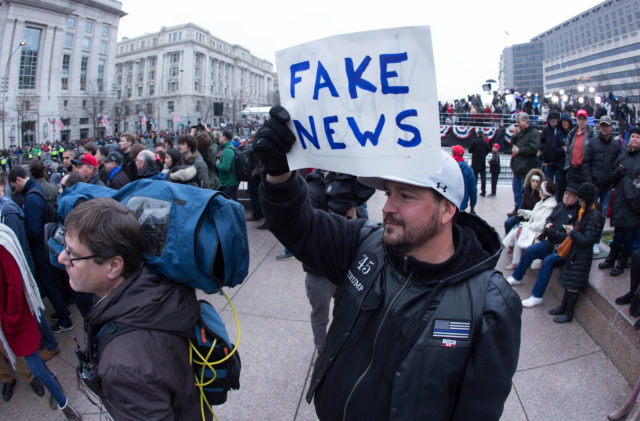
The problem with the internet is that there is too much information available. No matter what you ascribe to, be it neo-Nazism, conspiracy theory or foot fetishes, you will find information and opinion on the internet that validates your brand of craziness. This of course holds true for more conventional topics like gun control, abortion and all things Trump.
The problem is, we have gotten into the habit of picking and choosing only the facts that reinforce our views and prejudices rather than explore the bigger picture. This in turn entrenches rather than broadens our understandings. Trump haters only see the negative aspects of what he does and vice versa. No one issue is black or white (or in Trump’s case orange), but we are losing our ability to discern that.
Compounding this is the imbedding of computer algorithms into our daily existence. By mining our “likes,” views and preferences, algorithms filter us to specific sites, ads and news. It all creates inherent bias and lack of objectivity. This then plays on our subconscious: “See, the news is reinforcing what I thought. Look at everyone else who agrees. I am actually right about this.”
The point is not who’s right or wrong. People are going to disagree on a myriad of issues, and that’s okay. As a country (and state) of varied immigrants, we are built of the principle of sharing opposing viewpoints. This though, is meant to stimulate positive not negative discourse. It should bring us together at the table, not separate us at different ends of the table.
So don’t be lulled or seduced into the trap of creating your own fake news. Be open-minded and pride yourself on grasping both sides of an issue. Don’t be too quick to judge or dismiss those who don’t agree with you. Being passionate about issues is important, but being compassionate is more important.
Thoughts on this or any other story? Write a Letter to the Editor. Send to news@civilbeat.org and put Letter in the subject line. 200 words max. You need to use your name and city and include a contact phone for verification purposes. And you can still comment on stories on our Facebook page.
 GET IN-DEPTH
REPORTING ON HAWAII’S BIGGEST ISSUES
GET IN-DEPTH
REPORTING ON HAWAII’S BIGGEST ISSUES
Community Voices aims to encourage broad discussion on many topics of community interest. It’s kind of a cross between Letters to the Editor and op-eds. This is your space to talk about important issues or interesting people who are making a difference in our world. Column lengths should be no more than 800 words and we need a current photo of the author and a bio. We welcome video commentary and other multimedia formats. Send to news@civilbeat.org. The opinions and information expressed in Community Voices are solely those of the authors and not Civil Beat.