

Ige Begins Second Term With Call To ‘Move Forward, Together’
UPDATED: The governor said he is “eager and excited about the prospect of tackling all that is before us” after being sworn in for another four years.
Hawaii Gov. David Ige issued a call for unity after he was sworn in Monday at the Capitol for a second four-year term.
“I know it sounds like a given — that we all work together,” Ige said. “But that is often easier said than done. Moreover, without that collaboration — as we’ve seen in our nation’s capital — it can easily lead to gridlock. And so, let us move forward, together. Oni like kakou.”
Ige’s statement seemed a nod to the fact that top leaders in the Hawaii state Senate and House of Representatives openly campaigned for his 2018 Democratic primary opponent, U.S. Rep. Colleen Hanabusa.
But Ige, a little-known state senator just four years ago, handily defeated Hanabusa and went on to crush Republican Andria Tupola by a landslide in the general election.
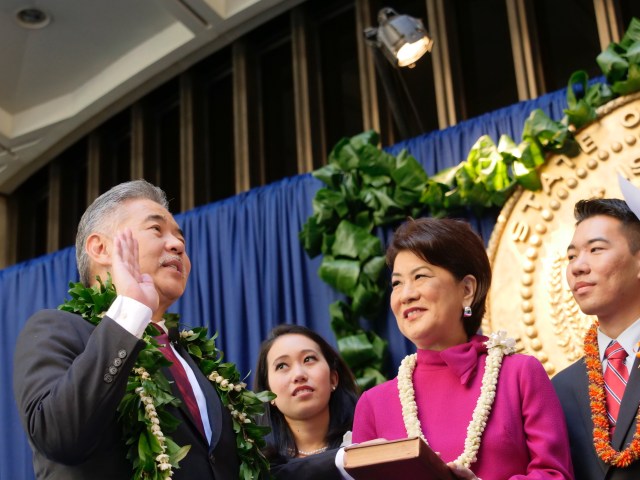
He has a mandate to govern, and he said he was “eager and excited about the prospect of tackling all that is before us.”
Ige was sworn in by Hawaii Supreme Court Chief Justice Mark Recktenwald, who also administered the oath of office to Josh Green, a former state senator who is now lieutenant governor.
Ige said his priorities include the economy, which he described as already in the process of transforming because of high technology.
“I believe the next great economic transition for Hawaii will be driven by innovations enabled by technology,” he said. “Technology has not only created new industries, but also infused new life into more traditional local businesses, such as food production and fashion. Moreover, it is transforming almost every corner of our lives.”
“I am asking that we debate openly and, yes, passionately, but with respect for each other.” — Gov. David Ige
To ensure Hawaii’s economic transformation, the state must provide adequate, affordable housing and have an educated workforce, he said.
“In a changing world, we need more than a one-size-fits-all model,” said Ige. “That’s why we are implementing a new blueprint for public education, empowering schools and investing in educational leaders who can transform the way they teach their students.”

Other issues for the Ige-Green administration include sustainability and self-sufficiency.
The governor said little about specific policy proposals, explaining that he will elaborate in his State of the State address in January when the Legislature convenes.
But the governor of a small state in the middle of the Pacific Ocean also has his eyes on national events.
“When did it become OK to tear gas women and children for wanting a better future for themselves?” he said, referring to the Trump administration’s immigration crackdown on the Mexican border. “Hawaii offers a better alternative to the direction being set by our leaders in Washington.”
Ige also returned several times in his speech to his unity message.
“I am asking that we debate openly and, yes, passionately, but with respect for each other,” he said. “Real leadership does not emanate from just one individual, but from many hands joining together. It’s really about each of us embracing the responsibility for our own fate and for our collective future.
Free Health Clinics?
In his speech, Green identified homelessness, opioid addiction, untreated mental illness, affordable housing and “a livable wage” as his priorities as lieutenant governor. The local values of aloha and ohana, he said, would inform his work.
Green, a medical doctor, said he would be exploring the possibility of free clinics and promised to get out into the community to directly engage with people in need.
“This will be my mission,” he said.

At a brief press conference with reporters in his fifth floor office after the inauguration, the governor did not provide financial figures for the clinics. He was also noncommittal on how much more money for education he might seek from the Legislature.
But the governor did say he expected increased revenue from better tax collection would influence budget spending. And he said he was happy that his children — Lauren, Amy and Matthew — could attend the inauguration. That was not the case in 2014, as all three were attending college on the mainland.
Cabinet and other staffing changes will be forthcoming, Ige said. He already faces vacancies with Randy Iwase leaving his chair position on the state Public Utilities Commission and Luis Salaveria stepping down as director of the state Department of Business, Economic Development and Tourism.
‘Hawaii Ponoi’
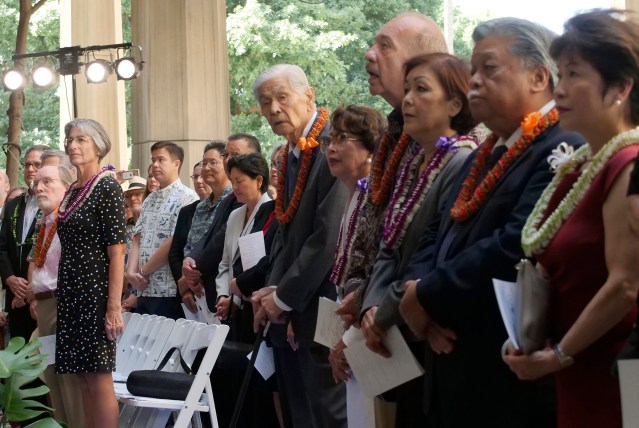
Former governors George Ariyoshi, John Waihee, Ben Cayetano, Linda Lingle and Neil Abercrombie sat in the front row of the ceremony. House Speaker Scott Saiki, Senate Majority Leader J. Kalani English, Honolulu Mayor Kirk Caldwell and U.S. Congressman-elect Ed Case were also among the dignitaries.
The inaugural included the singing of the national anthem and “Hawaii Ponoi,” as is customary. Danny Akaka Jr. read the Queen’s Prayer and invocation, while Bishop Eric Matsumoto gave the benediction.
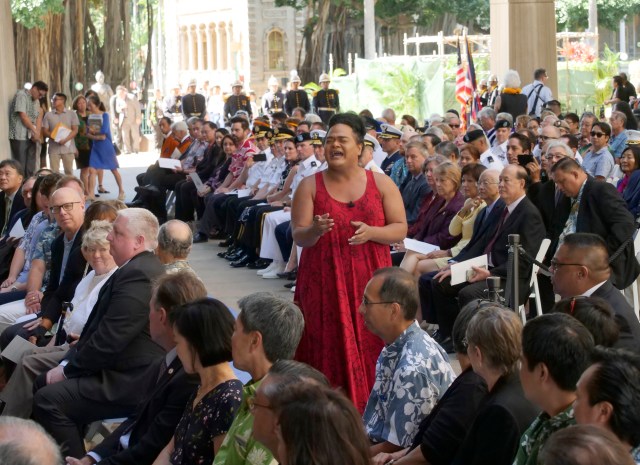
A 19-cannon salute from the 1st Battalion, 487th Field Artillery Regiment, Hawaii Army National Guard, was so loud that some in the audience almost jumped out of their seats.
A humorous moment came when emcee Ryan Kalei Tsuji, who formerly worked for Ige, asked the audience to wait patiently for two minutes until the clock struck noon. That’s because the chief justice could not legally administer the oath of office until then.
Inaugural celebrations were scheduled to continue for the governor Monday night at the Hilton Hawaiian Village Waikiki Beach Resort.

