

Denby Fawcett: A Death Trap At The Entrance To Diamond Head
Visitors love Honolulu’s iconic state monument — perhaps too much. Now there are plans to move pedestrian traffic to a different tunnel and possibly restrict vehicle access.
It is only a matter of time before a pedestrian is killed or critically injured walking into or out of the Diamond Head crater.
The State Parks Division has acknowledged that for years.
Hundreds of pedestrians visiting the wildly popular tourist attraction each day squeeze onto a narrow pathway at one side of the Kahala Tunnel — the only public entrance. They pick their way in the semi-darkness on a 5-foot-wide path with only plastic flex stakes separating them from passing vehicles.
When a large group crowds the pedestrian path, sometimes a couple of people will edge out into the tunnel’s narrow, two-way road, dangerously close to cars, mini-buses, taxis and wide tourist trolleys.

The speed limit in the tunnel is 5 mph but drivers regularly ignore it.
A man was injured when he was hit by a car in the tunnel on Veterans Day in November 2016, according to the Parks Division. He had stepped into the road hoping to get around the masses of people on the pedestrian path.
When I walked into Diamond Head crater Saturday, a trolley car came so close to me and a woman in front of me that we both reacted by flattening our backs against the tunnel wall.

She told me her name was Gwen Daub and that she was from British Columbia. She apologized for bumping into me when we were trying to back away from the trolley.
“They need to make the path bigger or allow only one-way traffic in the tunnel,” she said.
The state has a more permanent and sweeping solution. It wants to make the congested Kahala Tunnel off-limits to pedestrians and instead allow people to walk into and out of the crater through another tunnel.
Kapahulu Tunnel is on the northern slopes of Diamond Head, across from Makapuu Avenue. Closed to the public now, it is the only other entrance.
The State Department of Defense says it no longer needs the historic Battery Harlow — built from 1907 to 1910 so its big guns could reach invaders at sea — or the Kapahulu Tunnel and is planning to transfer them to the Parks Division soon.
Even though a date for the transfer has not been set, support to reduce pedestrian danger at Diamond Head is also coming from other parts of state government.
Gov. David Ige’s proposed budget includes $980,00 for design and construction for that very purpose.
It can’t come soon enough. On Saturday I watched two tourists walk into the traffic lanes to take photos. It happens all the time.
“I want to yell at people to tell them to keep away from the cars in the tunnel; it’s dangerous,” said Cassandra Springer, an interpretive intern at Diamond Head. “I want to keep everyone safe but with more than 3,000 visitors coming in here a day it’s impossible to try to warn everyone.”

Safety is a more pressing concern than ever with the number of visitors to Diamond Head soaring. On Christmas Day, a record 4,507 visitors entered the crater by foot and in 1,200 vehicles.
“That’s an overwhelming number when the average has been 3,000 people a day,” said Yara Lamadrid-Rose, the Diamond Head State Monument coordinator. “Just trying to get so many more people into the crater safely is a challenge. You want them to have a positive experience.”
In 2001, the year the state began charging a fee to enter the crater, it counted 566,137 visitors. Last year, the count was 1,067,048.
More and more people are walking into the crater now because there are not enough parking spaces for their cars.
Rosalina Rabago, the lead parking attendant for ProPark, Diamond Head’s private parking contractor, says by 6:20 a.m., the 64-stall parking lot is usually full.
PBR Hawaii, a planning firm contracted by the Department of Land and Natural Resources, has created a three-phase plan to improve the visitor experience by making use of the soon-to-be-acquired military sites.

Phase One is the shifting of all pedestrian traffic from the Kahala Tunnel to the Kapahulu Tunnel.
Pedestrians coming into Diamond Head through the Kapahulu Tunnel would have an additional new benefit of being able to stop for an interpretive experience at Battery Harlow. It is the first permanent battery of the U.S. Army’s coastal defense system in Hawaii.
Phase Two would be to create a drop-off area for pedestrians outside of the crater near the intersection of Diamond Head Road and Makapuu Avenue. Many hikers today are dropped off at Diamond Head by vehicles. A space outside the crater for dropping off pedestrians would reduce the number of vehicles now crowding the crater floor.
Phase Three would be to move all parking for Diamond Head visitors to the exterior of the crater. Parking in the interior of the crater would be reserved for Diamond Head staff and visitors with disabilities.
Visitors who parked outside of Diamond Head would be transported into the crater through the Kapahulu Tunnel in open-air shuttle trams the planners call “people movers.” After their hike, they would be shuttled back to their cars in the trams exiting the crater through the Kahala Tunnel.
The proposed exterior parking area for Diamond Head visitors would be on a flat section of land on the lower slopes of Diamond Head across from Makapuu Avenue.
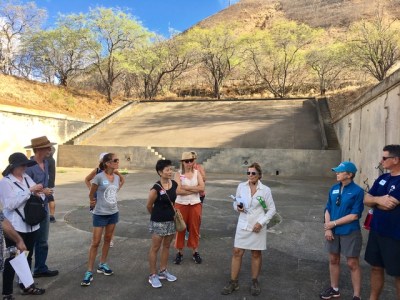
“Reducing the private parking inside the crater will decrease traffic as well as improve the air quality and reduce the glare reflecting off the vehicles,” said Vincent Shigekuni, PBR’s principal planner on the project. “It will make a better, more natural experience.”
And while the State Parks Division pursues its plan to move all pedestrian traffic to the Kapahulu tunnel, it is working on a project to install a traffic signal system in the Kahala Tunnel to make vehicular traffic in and out of the crater less chaotic in the short term.
On Feb. 5, PBR released the results of an online survey it asked people to take beginning Dec. 21. PBR says 12,000 people viewed the webpage that showed the planned improvements at Diamond Head and included the survey.
Five-hundred people took the survey, with 73 percent responding that “separation from vehicular traffic” would be the most beneficial improvement at Diamond Head.
Respondents also said they would appreciate more hiking trails in the crater and more access to historic features.
Most of them – 73 percent – were local residents.
Locals “have a vested interest in Diamond Head,” said Lamadrid-Rose. “It is in their backyard. It is their kuleana.”
And they deserve to be safe.

