

Neal Milner: HART’s ‘Bump In The Road’ Is Code For ‘We’re In Deep S#%* Here’
Slacktivism has taken over for transparency when it comes to important yet troubling public issues.
Here’s how Honolulu rail CEO Andrew Robbins responded to the U.S. Justice Department’s recent subpoena of thousands of pages of documents as part of a grand jury investigation while the federal agency that is still holding on to a half-billion bucks of our rail money watches this and wonders.
Robbins: “Any time you run into a large, complicated infrastructure project, wherever it is in the world, there’s usually bumps in the road.”
Bumps in the road, eh? You mean like when you got a C+ on a chem midterm but then studied really really hard the rest of the semester and finished with an A?
If they gave an Oscar for euphemisms, Robbins would be at the podium in a tux and a haircut thanking all the politicians and administrators who made it possible.
But I don’t want to be too hard on Robbins. He inherited the mess.

And when it comes to rail’s future, Robbins is far less bright eyed and bushy tailed than Mayor Kirk Caldwell, who was a really gifted and talented bumps in the road rail man even before he officially took office.
In 2012 when he was still just mayor-elect, a reporter asked Caldwell how a recent negative court ruling would affect rail’s future.
“This is a bump in the road, “he said. “I assume there can be more lawsuits filed. We’ll address them as they come.”
They’ve come.
But here’s the main reason why we shouldn’t be too hard on Robbins. His statement creates a teaching moment for all of us citizens.
Cliches ‘R Us
And Robbins’s use of “bumps in the road” is so graphically inaccurate that it highlights the familiarity, power and danger of the term itself.
“Bump in the road” is a main-man utensil in policymakers’ tool kits of metaphors that are supposed to make us don’t-worry-be-happy.
The term is meant to minimize the problem. Things may seem bad, but it’s only temporary. We shall overcome real soon.
Underlings hide documents and otherwise conceal bad news because they worry about how the public will respond. How sad is that?
So the term “bumps in the road” is pablum, a cliché that works when it triggers those remaining nodes of optimism in our hearts and minds.
That makes the term useful to the user but insidious to the rest of us.
“Bumps in the road” is the “thoughts and prayers” of public administration.
Because the mass shooting tragedies are so closely intertwined with the use of “thoughts and prayers” people have become much more critical and cynical about that term than they have about metaphorical jolts on some metaphorical highway.
Bumps deserves just as much skepticism. Here’s why.
The term bumps in the road is not used to analyze or apologize. No, it’s used to inspire. When you walk through a storm, hold your head up high and don’t be afraid of the dark. Then you will never walk alone.
Though the person walking with you may be a federal marshal.
“Never,” says a greeting card, “let a stumble in the road be the end of your journey.”
One card could be the Honolulu Authority for Rapid Transportation big shots’ mantra for getting past Middle Street: “Remember when you hit a bump in the road, it is a bump, not a mountain. Go over it, go around it, but don’t stop moving forward.”
Considering the upsy-daisy, downsy-daisy road conditions here, it’s not surprising that in Honolulu we have bumps in the road about actual bumps in the road.
The Pali Highway landslide is the most recent example. “We’ll have those boulders out of the way by the weekend” has turned into a landslide mitigation project, an engineering term of art for “see you next year.”
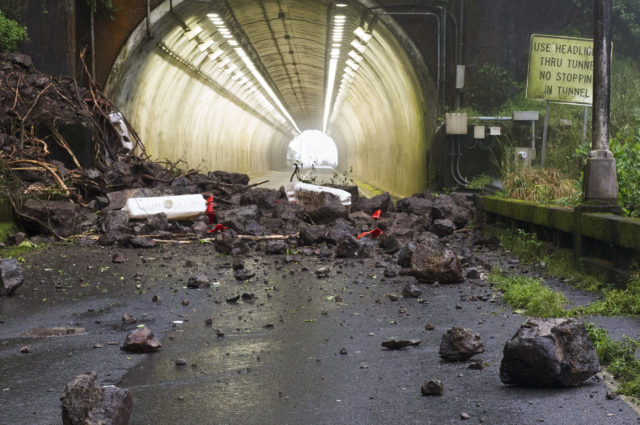
Or the less famous but, it appears, even more complicated non-repair of the whopping, car-busting, been-there-forever bump on Waimano Street in Palolo.
But why should “bumps in the road” become just as illegitimate a term as “thoughts and prayers” has?
The term “thoughts and prayers” has gone through a sad but deserving transition from an expression of good will and empathy to, as the Urban Dictionary now describes it, an expression of indifference to tragedy that merely intends to be empathetic.
It encourages “slacktivism,” which is an action taken to bring about social change that requires a very minimal commitment like, say, simply signing a petition.
Or — and this is where the term has really lost its legitimacy — as a slack-inducing way to respond to mass shootings on the part of those who don’t want to consider gun control.
Both thoughts and road are minimizing terms. Both are meant to be reassuring and inspirational. Both substitute words for deeds and hope the rest of us do the same.
Like, “thoughts,” politicians use “bumps” to get their constituents to cut them some slack.
So “bumps” may be a less emotional term, but it is just as cunning and disingenuous.
So here are some suggestions to policymakers about the term “bumps in the road.”
Don’t use it at all. Ever. Quit blanketing us with such nonsensical metaphorical reassurance when the expression the situation really calls for is “oy vey.”
Second, if it’s oy vey, then it’s oy vey. Deal with it. Recognize that your first job is not to inspire. It is to inform. Transparency, dudes.
Underlings hide documents and otherwise conceal bad news because they worry about how the public will respond. How sad is that? It’s also a violation of democratic and accountability norms.
So be candid. Leave the inspirational metaphors to the Hallmark greeting card writers.
And as for us commoners? Well, if you find the HART CEO’s recent statement reassuring, what can I say?
Rail is an extremely easy target, though. More generally, if we citizens want more candor and less bullshit, we also need to be more patient, less simplistic, and more realistic about quick fixes. Policymaking is hard work, especially the implementation part.
A good place to start is this: think of “bumps in the road” as a coverup that indicates not how small a problem is but rather how big.

