

Big Island: Hawaii’s New Generation Of Women Canoe Carvers
Thanks to a grant, 22 women are constructing a replica of an outrigger canoe that Queen Kapiolani donated to the Smithsonian in 1888.
HILO, Hawaii Island – Women are learning traditional Hawaiian culture through a contemporary connection to Queen Kapiolani, and they’re using a lowly regarded invasive species to do it.
A weeklong program that introduced student volunteers to the art of canoe carving was held in Hilo last week as part of the 56th Annual Merrie Monarch Hula Festival.
It was funded through a $26,000 grant the Smithsonian Institution awarded under its American Women’s History Initiative, said Kalewa Correa, curator of Hawaii and Pacific America at the Smithsonian Asian Pacific American Center.
The unique hands-on opportunity attracted 22 women, ages 17 to 65, who built a replica of the outrigger canoe Queen Kapiolani gave to the Smithsonian in 1888, he said.
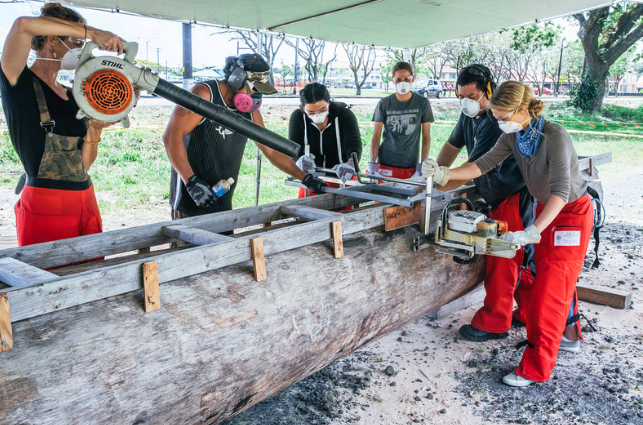
“I was just really stoked to foster a generation of women carvers,” said Correa, who applied for and obtained the funding. “I see the interest and energy is there.”
When he and other experts were examining the historic canoe last year, they learned that Smithsonian caretakers were mistakenly classifying as historical artifacts the protective packing material included when it was shipped to Washington, D.C., more than a century ago.
“It’s bringing together history, and it corrects the Smithsonian’s records,” Correa said of the project.
It costs too much money to send the replica to the Smithsonian and for the museum to maintain it, Correa said. So he will offer it to the Big Island charter school that best demonstrates its desire to use the canoe and the ability to care for it.
Female Carvers A Rarity
While many women have captained Hawaiian outrigger sailing canoes, few have learned of the canoe’s origins and how to create one, Correa said.
“There’s two women carvers in the Pacific right now who are apprentices,” Correa said.
One is Alexis Ching, who served as project manager.
“It’s the first event teaching women, so it’s a pretty big deal because women didn’t carve,” Ching said.
She called it a “prototype.”
“It’s the first time that most of these ladies have touched a chainsaw,” Ching said, adding that participants were required to wear protective shoes and other safety gear.
Besides the replica, two larger outrigger canoes were built so the student carvers could work on the various phases of construction, she said.
About a third of the participants want to continue learning to carve canoes, and additional classes are planned.
“This is beyond what I expected as far as the retention rate,” Correa said. “For me, it was a total win.”
Student Alexis Cullen said she has paddled canoes for years, but never carved one.
“Women like power tools, too,” Cullen said.
Also unusual was the choice of tree used to build the canoes.
Traditional outrigger canoes are made from koa, a prized hardwood that is expensive and hard to find. Few koa trees from which a 25-foot or longer canoe can be made still grow in Hawaii, and most of those are on protected government lands.
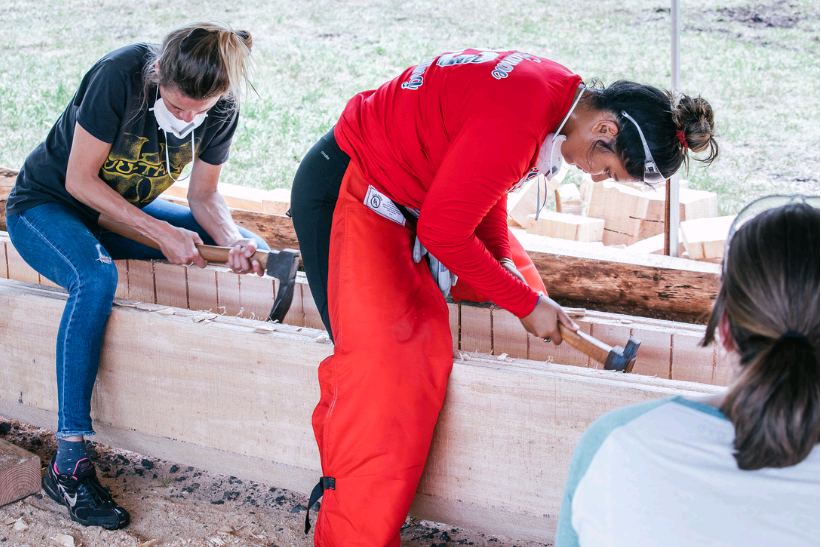
But one tree that is plenty big, accessible and of little value is the invasive albizia that’s caused widespread damage in Puna and poses growing threats statewide.
“This is the perfect tree for what we teach people,” master carver Doug Bumatay said.
Along with being cheap to obtain, albizia is also a soft wood that master Hawaiian canoe carvers, known as kalai wa‘a, say works great both as a teaching medium and on the ocean as a finished vessel.
“With koa, you don’t want them to make a mistake,” said master carver Ray Bumatay, who is mentoring Ching and helped teach the new women students. “With albizia, you want them to make a mistake so you can show them how to fix it.”
The resulting canoe “is just as good as any canoe,” said Bumatay, who founded the Paddlers of Laka Canoe Club and has gone to Japan to carve canoes.
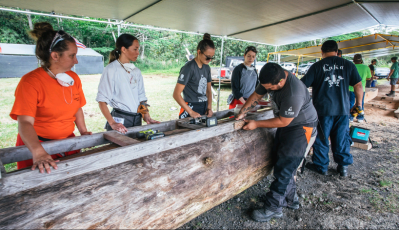
To artisans like Bumatay – he has numerous miniature canoes displayed throughout his home – a canoe is more than just a vessel for travel or fishing.
“It’s like my sister, my brother,” he said. “It was once a living thing, and once it dies, you bring it back to life.”
Bumatay said he started using albizia in 2001 when he became the first Hawaiian carver invited to the International Festival of Canoes held on Maui. Given 14 days to complete a canoe, Bumatay said he was done in just seven.
The use of curved jigs, false walls and other specialized building techniques his family invented along with the soft albizia expedited the task, he said.
“You can’t beat this,” Bumatay said of the wood.
Selecting the proper koa tree was a process that Bumatay said started with him staring, sometimes with a cold beverage around, at a particular tree until he was able to envision the canoe within it.
“As soon as I saw that red line, I was on my way,” he said. “From then on, it was easy.”
Bumatay said he hopes he’ll be able to envision his next albizia tree as a replica of the Hawaiian canoe used in the 2016 Disney hit “Moana.”

