

Ige Veto Means Some Eligible Patients Still Can’t Get Medical Cannabis Legally
The bill to allow interisland transport of the medicine would have been especially helpful for patients on Molokai and Lanai, which have no dispensaries.
For the 300-plus medical marijuana patients on Molokai and Lanai — islands without dispensaries — the Legislature’s passage of a bill allowing registered cardholders and caregivers to carry cannabis on interisland flights seemed to finally create a way for them to legally obtain their medicine and bring it home.
But Gov. David Ige vetoed House Bill 290, despite strong support in the Senate and House.
In his statement of objections, Ige said he feared the state would not be able to protect patients from prosecution because marijuana is still classified as an illegal substance federally and interisland flights travel over federal waters.
Advocates and dispensary workers say Ige’s decision not only perpetuates an inconvenience for all medical cannabis patients who travel interisland, it also leaves some with no feasible way to get their medicine legally. This may push them to break the law by buying on the black market or smuggling marijuana products home from neighbor island dispensaries.

There are currently no plans to open a dispensary on Molokai or Lanai, as the state often requires a zip code area to have at least 500 cardholders before it can qualify for a dispensary, said Michele Nakata, supervisor of the Hawaii Department of Health’s Medical Cannabis Dispensary Licensing Program.
Molokai had 265 registered users as of June 30 while Lanai had 48, the DOH said.
The only way for these patients to legally obtain medical marijuana is to grow it themselves (up to 10 plants are allowed) or have a caregiver grow it at home, Nakata said.
For Some, Growing Isn’t an Option
But that doesn’t work for all patients, said Pedro Haro, executive director of the Hawaii Education Association for Licensed Therapeutic Healthcare, Hawaii’s medical cannabis trade association.
“It takes time, effort, resources to be able to grow your own,” said Haro, whose organization testified in support of the bill. “So that’s the idea of the dispensaries, is that you don’t have to have an agriculture background. You don’t have to go and buy soil and lamps and etcetera.”
Most patients do not have caregivers they can depend on to grow their medicine. As of June 30, the state had only 2,056 registered caregivers for 26,391 registered cardholders — or just over one caregiver for every 13 patients, according to the most recent DOH statistics.

To be eligible for medical marijuana cards, patients must suffer from a qualifying debilitating condition such as multiple sclerosis or chronic severe pain. The labor involved in growing marijuana plants may worsen some patients’ symptoms, Haro said.
“The idea of medical cannabis is to make their lives easier and their pain less, and any activity that aggravates that is going to be a deterrent,” he said.
Beyond the physical obstacles to growing at home, buying from a dispensary is safer, especially for older patients or those with weakened immune systems, said Teri Gorman, director of community relations at the Maui Grown Therapies dispensary.
“Patients who shop in a dispensary have peace of mind knowing that there’s no heavy metals, there’s no pesticides in it,” Gorman said.

“Hawaii is a great environment for growing, there’s no doubt about that,” Gorman said. “But, unfortunately, it’s also a great environment for growing microtoxins: mold, mildew, things like that, and people who are ill should not be putting that in their body.”
The state enforces strict health and safety guidelines for products sold at dispensaries, Gorman said, requiring them to lab-test their medication and oversee every step of production, from planting to processing.
Many patients simply prefer to procure their marijuana from dispensaries because they offer a wide variety of products to treat different medical conditions, she said.
“Many of (the patients) are dealing with serious health conditions and … prefer smoke-free products,” Gorman said. “So they come into a dispensary to purchase tinctures, capsules, topical products, oils that can be vaporized and so forth.”
Haro said the absence of a legal avenue for cardholders to access a dispensary may push patients toward the black market, which lacks many of the safeguards offered by licensed dispensaries.

Forced To Break The Law
Some patients on Molokai and Lanai have found a way to avoid the black market by flying to another island’s dispensary, but they’re still technically breaking the law.
Despite interisland transport of medical marijuana still being illegal, they can take advantage of a lack of airport security at Maui’s Kahului Airport to secretly bring dispensary-bought marijuana products home with them.
Gorman estimates about 2% of Maui Grown Therapies’ customers are residents of Molokai and Lanai. They can board return flights because passengers on commuter flights to Molokai or Lanai from Kahului Airport do not have to pass through TSA screening.
Some of them have been regular customers since the dispensary opened two years ago, Gorman said.

Nakata said she was not surprised that patients resort to breaking the law to access a dispensary, but that the health department does not condone it because it might place them at risk.
“It’s true, there’s a lot of things that you can do and probably get away with,” she said. “But if you’re that unfortunate person that gets caught …”
Nakata said she could not think of a legal alternative for patients who are unable to grow their own marijuana on Lanai or Molokai.
“Dispensaries and cannabis users want to live in the light.” — Pedro Haro, executive director of a cannabis trade association
While some patients may have found a loophole to avoid possible prosecution, it’s still important for the state to pass a law officially legalizing interisland transport of medical marijuana, Haro said.
“The medical cannabis dispensary system (and) the Department of Health, would like to operate within laws as much as possible,” Haro said. “It’s an industry that, once we have decided that this is a legal and safe medical intervention, it shouldn’t have to live in the shadows anymore.”
“Dispensaries and cannabis users want to live in the light,” he said.
Passing laws to reinforce the legitimacy and legality of medical marijuana would help remove the stigma surrounding medical cannabis, Haro said.
“Somebody who is in their 70s, treating pain associated with cancer treatment, doesn’t have to feel like they have to hide their medical intervention, doesn’t have to feel like they’re doing something that is negative, or prohibited.”
Was The Bill Legal?
In vetoing the HB 290, Ige opposed the will of both the state Senate, which supported it 24 to 1, and the House of Representatives, on a vote of 39 to 12.
Ige wrote in his statement of objections that, because interisland flights travel over federal waters, it would have given patients “false comfort” that they would be safe from federal law outlawing marijuana.
Currently, federal law classifies marijuana — medical and recreational — as a Schedule 1 drug, alongside heroin and LSD.
But much of the decision whether or not to allow marijuana on interisland flights rests with Hawaii authorities, not the federal government. At least one state already allows marijuana on flights within its borders.
Oregon law permits passengers flying out of Portland International Airport bound for airports within the state to bring marijuana on board. Many of these flights do pass over federal land, as the U.S. government owns over 50 percent of the land in Oregon, which has legalized recreational use of marijuana.
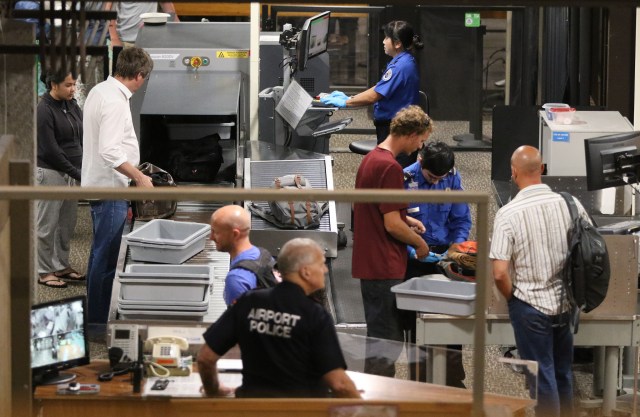
As for federal airport security, Lorie Dankers, a spokeswoman for the Transportation Security Administration, wrote in an email that the TSA focuses its efforts on finding flight risks and not marijuana. But if marijuana is found, it’s left to local law enforcement to decide what to do.
Dankers wrote that if local authorities decide to allow passengers to keep their marijuana, then TSA will allow them to board the plane with their cannabis.
“I really need to stress that it is a law enforcement, not TSA, decision,” Dankers wrote.
Meanwhile, patients on Molokai and Lanai might not have to wait much longer before they can legally access medical marijuana dispensaries.
State Rep. John Mizuno, who co-sponsored the interisland transport bill, wrote in an email that there are plans to reintroduce the law next year, and that this time he will work with the state attorney general and the health department to address Ige’s legality concerns.
“Patients who are under our state law certified to use Medical Cannabis should have access to their medicine,” Mizuno wrote. “Why is it that we allow the travel of narcotics — opioids which kills thousands of people every year free access to travel our islands but yet criminalize a patient needing his or her Medical Cannabis?”

