

Trisha Kehaulani Watson: ‘Kapu Aloha Is Holding Everyone Together’
Long-held divisions are melting away. Hawaiians are healing, not only as individuals, but as a community.
When I wrote about aloha two weeks ago, I could not have predicted, or even imagined, the events that have transpired over the last week.
I am a staunch believer in the Hawaiian people, in the lāhui (nation). I have never wavered in my belief that a thriving, strong, independent Hawaiian nation was possible and even inevitable. I cannot fully explain my conviction, as it has often been met with strong resistance, even from other Hawaiians who have long believed that the best way forward would require significant compromise and concessions.
Most know I have long worked at the side of Uncle Walter Ritte, but few know that it was not Uncle Walter who drew me into the movement – it was his wife, Aunty Loretta. It was a short clip of her in the documentary “Kaho‘olawe Aloha ‘Āina” in which she gave the following testimony against the continued bombing of Kahoolawe.
Here is what she said:
One thing I’ve learned from my kūpunas as a Hawaiian is the great respect for the `āina, for the `āina is the giver of life, of life. And if we do not respect the land, then where would we be? How do we take care of Papa, our earth? By filling her pores with concrete, her beauty, so she cannot breathe? By digging into her, drilling into her, bombing her, to leave wounds and scars on this earth. Is that how we take care of our land?
I remember being completely struck by her perfect merging of conviction and love. It was unlike anything I had ever seen and certainly unlike what I was seeing among Hawaiians in those days, which was often rhetoric wrought with searing anger.

What she displayed then and continues to display to this day is aloha in its purest, most powerful form. Aloha as an extraordinary force of love. Love like water, with its many forms. Solid and impassable when it needs to be. Fluid and thirst-quenching when it wants to be. And sometimes, like the mist, it was just everywhere.
I have to admit that I scrunched my nose the first time I heard the phrase “kapu aloha.” I’m a bit of a traditionalist, and it isn’t a traditional phrase I was familiar with nor was it a phrase many other people seemed to be familiar with, but as time wore on, I began to appreciate that it was a new phrase for the oldest of our values.
The aloha of our kupuna.
Talk to Uncle Walter and Aunty Loretta and they will tell you it was the leadership of the kupuna and the power of aloha that won the battle for Kahoolawe.
Aloha that is serene and vast. Aloha that demands self-restraint, in the manner of our most revered and respected kupuna, who held themselves with a grace that is too often missing in today’s world.
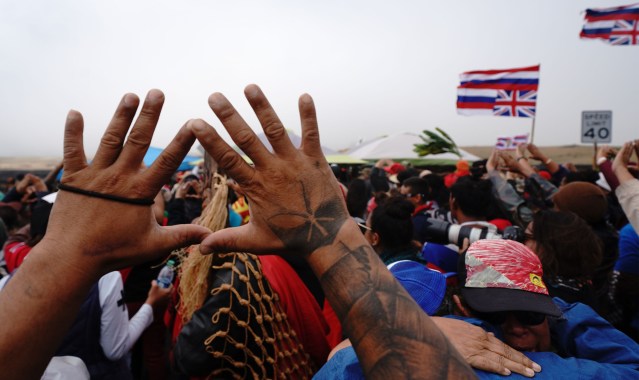
Kapu, not as in forbidden, but sacred and closely regulated. This is what we are witnessing on the mauna. This is what we are witnessing everywhere. Something sacred. A form of regulation long unpracticed in these lands, but native to them nonetheless.

Something truly extraordinary happened that morning the kupuna were arrested. In telling all the younger people around them to sit, to lower themselves to the ground, in silence, it was a physical manifestation of ho‘oha‘a – to lower oneself and in turn, humble oneself. It was an incredible mass display of Hawaiian humility, when in a moment that very easily could have turned violent, every Hawaiian present needed to absorb their own anger, hurt, and rage to create an environment that was peaceful.
It is one of the most incredible things I have ever seen, and I have no doubt that in that moment, when an entire people were forced to humble themselves before the sacrifice of those 35 kupuna, a nation began to rise up.
They rose up not only at Mauna Kea, but they rose up everywhere.
Hawaiians and their allies are wholeheartedly embracing the spiritual edict from the protectors of the mauna who have asked all of us to act always, in honor of kapu aloha. To act with self-discipline and hold ourselves to the highest standards of behavior, not just at the mauna or in the pu‘uhonua, but everywhere, always.
The growing power of kapu aloha is being widely discussed among Hawaiians. In this time of great sadness and strife, we all marvel at how good and even powerful this recommitment to aloha feels. I recently spoke to Loea Hula and Haku Mele Kawaikapuokalani Hewett, award winning composer, particularly of mele about Mauna Kea. He noted, “Kapu aloha is holding everyone together.”
It truly is. Long-held divisions are melting away. Hawaiians are healing, not only as individuals, but as a community. Kapu aloha is not only holding everyone together, it is bringing everyone together.

