New $161 Million Hawaii State Hospital Facility On Track To Open In 2021
Patients and staff are expected to move into the new forensic facility by 2021. The new 144-bed building will relieve long over-crowded and dilapidated facilities.
In the television lobby of a secure wing at the Hawaii State Hospital, a woman recognized hospital administrator Run Heidelberg as he walked by.
“We going to be over there?” she asked, gesturing out the window to the four-story concrete building taking shape outside.
“Pretty soon,” Heidelberg said. “Probably in a year and a half.”

Construction of a new forensic psychiatric facility for the hospital’s most at-risk patients is estimated to complete by the end of next year. Staff and patients will begin to move in by 2021.
Heidelberg said the new state-funded $160.5 million facility will be safer, more secure and include new therapeutic elements that staff helped to design. The design and construction contract was awarded to Hansel Phelps.
The Hawaii State Hospital in Kaneohe on Oahu is the state’s only psychiatric facility for forensic patients, many of whom are deemed by a judge unfit to stand trial. It has long been overcrowded, with the number of court-ordered patients often exceeding its capacity of 202 beds.
“Right now it’s kind of a Rubik’s Cube to put people where they best fit because there’s not much space,” said Heidelberg, who took the reins as Hawaii State Hospital administrator this summer.

“This configuration is much better because there are no blind spots,” he added, while standing at the site of a future nurses’ watch that will have visibility of three corridors.
The new Goddard Building facility will have 144 beds dedicated for patients who are deemed to pose a risk to themselves or to others.
Officials are still reviewing the 103-acre campus plan to determine how to repurpose the older buildings. They’re also considering the addition of tiny modular homes on five acres of empty lawn outside for patients who qualify for independent living.
The state currently contracts out with a private facility to hold patients when there is overflow.

According to the Associated Press, more than a dozen escapes have occurred from the old hospital facilities over the past decade, with the most notorious escape in 2017 by a patient named Randall Saito.
Saito’s ability to slip out of the hospital, catch a taxi and board a charter plane heading to Maui then another plane to California generated outrage about lax security.
Hawaii Department of Health Spokeswoman Janice Okubo said the new facility will include a controlled zone or sally port for vehicles to drive straight into the building, providing “heightened security the moment a patient arrives.”
“Although we are not a prison, the new building will be a secured facility,” she said. “All of the activities for at-risk patients will be done within the confines of the new building.”
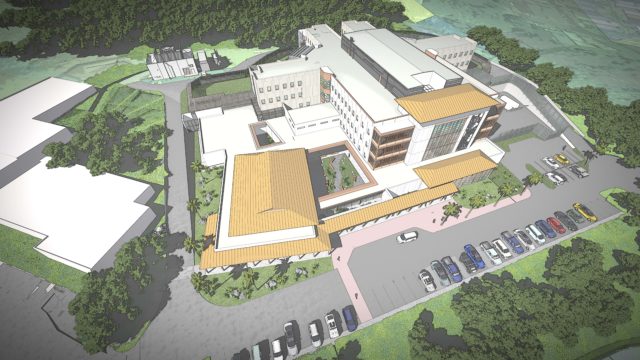
The new Hawaii State Hospital facility will also include a courtroom; fitness, occupational and recreational therapy spaces; and group therapy rooms for anger management, substance use and social skills training. It will also be equipped with Wi-Fi and allow the hospital to adopt an electronic records system.
The new building will need 230 to 250 staff to operate it. Last year, the state Legislature approved 127 positions and the health department is beginning to fill them, according to Okubo.
Heidelberg estimated nearly 90% of the hospital’s current 216 patients have experienced homelessness at some point prior to being admitted.
He said the hospital staff played an active role in providing feedback on the design of the building and the configuration of the rooms.
“Pretty much every discipline had input on the design,” he said. “We are using an umbrella approach to care. We want to catch people before they hit rock bottom.”