

Kauai Candidate Took Illegal Contributions, State Commission Says
The Campaign Spending Commission has taken the rare step of referring a case of false name contributions to the Attorney General’s Office.
A Honolulu attorney has put himself and several of his associates on a path to potential legal consequences over donations made to former Kauai County Councilman Mel Rapozo’s failed campaign for mayor in 2018.
The Campaign Spending Commission voted last week to send the case to the Attorney General’s Office to review the allegations against Richard Wilson, one of Wilson’s friends and several associates at a Honolulu law firm who allegedly used Wilson’s money to donate to Rapozo’s campaign.
The complaint stems from about $7,000 worth of contributions made in the name of several employees at the law firm Perkin & Faria as well as a friend of Wilson’s. Those contributions were a part of the $19,000 Rapozo got in the last two weeks before the 2018 primary election. He raised $136,000 during the two-year election period.
Of the contributions identified in the complaint, $3,000 came from Wilson’s now-deceased mother. Her money paid for fundraising tickets in the names of the law firm employees, the commission alleges. Another $4,000 came from Wilson himself, which he gave to his friend, according to the commission.

Campaign Spending Commission Executive Director Kristin Izumi-Nitao alleges four counts of false name contributions in the complaint. Under Hawaii’s campaign finance law, those are Class C felonies punishable by up to five years in prison and $10,000 in fines.
“It’s on me,” Wilson told the commission Wednesday. “If there is some consequence, I’m your man. Not them.”
It all began one day in 2018, when Wilson walked into the law offices of Perkin & Faria and asked if anyone wanted to go to a campaign fundraiser for Rapozo.
Most of the staff laughed him off when they heard ticket prices were $1,000 a head, attorneys for the accused told the commission Wednesday. But Wilson told them he’d pay for the tickets.
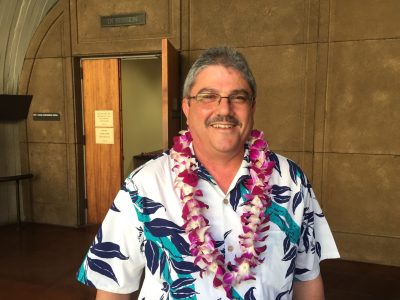
He told several of the employees as well as John Perkin, a partner in the law firm, that Rapozo assured him that it would be OK to pay for the tickets with Wilson’s mother’s money. She had decided not to attend.
The commission found checks from Mary Wilson, the mother, deposited into Perkin’s and his two employees’ bank accounts days before they each wrote $1,000 checks to Rapozo’s campaign.
Attorneys made their case for why their clients took Wilson’s money, and all said it’s because Wilson told them he heard from Rapozo that it would be OK.
Rapozo did not respond to requests for comment.
Perkin’s attorney Howard Luke said that his client was an aging lawyer in deteriorating health. Had he known what they were about to do could be illegal, he never would have gone through with it, Luke said.
Perkin also wanted to take the blame for his employees, Sandra Haskell, now a clerk for a federal judge, and James Wade, an associate in the law firm.
“Whatever slack you could cut (Haskell), I would ask you do so. I don’t care about me, what the hell? I’m old,” Perkin told the commission.
“Sandra’s innocent, she has no stake in this, no role in terms of somehow evading the law,” he said. “She was doing a favor for someone she thought was a friend.”
Rick Sing, Haskell’s attorney, also pleaded for leniency, noting her position as a government law clerk. Sing said his client didn’t intentionally violate the law.
“From her perspective, this was more she was invited to a fancy dinner,” Sing said. “It wasn’t represented as ‘Hey, donate money so I can avoid putting my name on it.’”
Wade’s attorney, David Hayakawa, made a similar argument, saying he couldn’t imagine going to an event where plates cost $1,000. Hayakawa also said that Wilson thought it would be OK.
Hayakawa then spent much of his time before the commission attacking the character of Wade’s ex-wife, who originally filed the complaint alleging false name contributions. At the time, Hayakawa said, the two were going through a divorce.
The attorney went on, delving into details of their custody dispute, even after Commissioner Maryellen Markley asked if the divorce case was related at all to the complaint.

Also at issue in the false names case was a $4,000 donation to Rapozo’s campaign made by Thurston Wong, Wilson’s friend.
Mike Sakai, Wong’s attorney, told the commission that Wilson paid Wong for “services rendered” but didn’t go into details. Wong tried to refuse the money, but turned around and donated it to Rapozo’s campaign, according to the attorney.
Candace Park, a deputy attorney general, asked Wilson about his conversations with Rapozo regarding the contributions.
Wilson said it was his understanding that you can’t donate in the name of a child, or force employees to give to a candidate.
“Had I known for a second what I was doing wasn’t OK, I never would have done it,” Wilson said.
The commission notes in the complaint that none of the respondents are prolific donors.
A search of the state’s campaign finance database shows Haskell and Wade have made no contributions other than those to Rapozo. Perkin and Wong made donations of $500 each in 2018 to former Kauai Mayor Bernhard Carvalho’s failed run to be lieutenant governor.
Wilson donated $1,000 to Carvalho in 2018 and former Honolulu Mayor Peter Carlisle in 2012. He also contributed $1,500 to Gov. David Ige’s reelection.
The AG’s office will now conduct its own investigation and decide whether to bring a case against the respondents.
Gary Kam, the commission’s general counsel, told Civil Beat that those types of referrals from the commission to the AG are rare. Only about four or five cases have gone that far since he took his position in 2011, he said.
He also said the situation involving the tickets wouldn’t have been problematic if Wilson’s mother had just purchased them herself and then given them to whoever she felt like.
“Our concern with the statute is a contribution made in the name of another,” Kam said.
Wilson said he thought giving his associates the money to buy the tickets would be more transparent since they would be the ones showing up at the fundraiser.
“People don’t want to be considered crashers,” Wilson said. “That’s not local style.”

