Lūʻau And Lawmakers: Early Junkets To Hawaiʻi Brought Many Rewards
Prince Kūhiō became a master at leading congressional delegations to Hawaiʻi, winning converts to the causes he championed for the islands
Editor’s Note: The articles in this series are the result of months of research in state and national archives, on Kauaʻi, on the Big Island and in Honolulu, and within the Washingtoniana collection at Martin Luther King Jr. Library and the Library of Congress in Washington, D.C. Key resources include congressional testimony, hearings and historical newspaper collections.
On a sunny morning in May 1915, Prince Jonah Kūhiō Kalanianaʻole waited expectantly in Honolulu as the ocean liner S.S. Sierra approached the shore. Then he climbed aboard a launch and went out to meet the larger vessel.
Kūhiō scanned the crowd lining the ship’s rails, looking for a particular familiar face. When he spotted his bewhiskered 79-year-old friend, he exuberantly waved in greeting.
“Hello there, Uncle Joe, aloha ʻoe,” the 44-year-old prince shouted up to the upper deck.
Recognizing him, Kūhiō’s friend beamed down to him, calling out a reply, “Hello Cupid!”
In that way, Prince Kūhiō offered a big Hawaiian welcome to U.S. Rep. Joe Cannon, the iron-willed speaker of the House of Representatives, the man who dominated the nation’s legislative agenda, and the individual with the most power over the appropriations that mattered to Hawaiʻi.
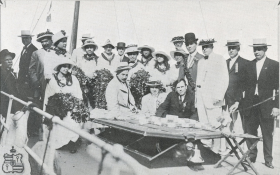
The Illinois politician whose nickname in Washington, D.C., was “Czar Cannon” was arriving in Hawaiʻi as part of a massive 49-member congressional delegation.
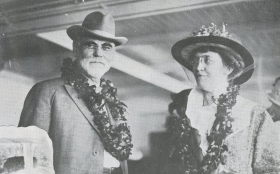
With the Royal Hawaiian Band playing a merry tune, Kūhiō — Hawaiʻi’s delegate to Congress — along with the mayor of Honolulu and territorial leaders, rushed from the launch to board the larger ship, draping lei on their lawmaker guests and introducing them to the warm and lavish hospitality that is a hallmark of the Hawaiian islands.
This memorable 1915 arrival involved just one of at least four such mass congressional delegations to visit Hawaiʻi during Kūhiō’s tenure, each of them part of a strategic plan he devised to bring attention to the territory and its needs.
Between 1907 and 1917, Kūhiō brought more than 170 senators and representatives, many of them top-ranking lawmakers, the chairs of major committees, on month-long introductory visits to Hawaiʻi. The lawmakers were wined and dined all over the islands but also spent many carefully orchestrated hours taking tours and being tutored about local conditions. Their itineraries were packed.
These kinds of congressional visits remain essential to political life in Hawaiʻi today. The state’s delegation still uses them as educational tools and ways to influence colleagues, according to U.S. Rep. Ed Case.
“Just as in Kūhiō’s time, it remains very important for a small and remote state like Hawaiʻi to host colleagues whenever and however possible,” Case said in an email. “Relationships in Congress are invaluable especially for a small delegation like Hawaiʻi, just four out of 535 voting members.”
Case said he has hosted congressional delegations to Hawaiʻi at least six times, including members from the appropriations committee and others working on Indo-Pacific issues, with an additional visit expected soon by Rep. Chris Stewart of Utah to discuss national defense.
“A direct example is Red Hill,” Case added. “I’ve taken colleagues through Red Hill and that personal understanding has helped us obtain more than $2 billion in funding to date to defuel it and close it.”
On Kūhiō’s trips, lawmakers from very different backgrounds were exposed to Hawaiʻi’s remarkable assets — its beauty, strategic location and agricultural diversity.
In a time of racial segregation, they were also given the chance to interact with a vital and energetic mixed-race population. They learned there were tensions, to be sure, but the visits opened a window for them on America’s multi-racial future.
These excursions also provided lawmakers with ample opportunity to see the weaknesses in Hawaiʻi’s infrastructure — places where lighthouses could prevent shipwrecks, where roads needed to be built or needed repair, where harbors had potential but that required dredging or breakwaters to be usable for commerce.
They witnessed for themselves the potential for a national park in the volcano region of the Big Island.
They also saw the inadequacy of Hawaiʻi’s defenses in case of attack by a foreign power. Thanks to the funding Kūhiō had secured for Pearl Harbor, work there was well underway, but much more needed to be done to make it a functional military base.
These elaborate visits were arranged and coordinated by Kūhiō himself, with the help of a handful of congressional aides. They organized lawmakers’ train travel across the country, their ship travel to Hawaiʻi and their hotels and other accommodations along the way.
Twelve years before Joe Cannon landed in Hawaiʻi, Kūhiō had arrived in Washington knowing no one and needing to learn the ropes. A territorial delegate who had floor privileges in the U.S. House of Representatives but no vote, Kūhiō had quickly learned that personal ties would make the difference in advancing the interests of his people in Hawaiʻi.
He soon realized people on the mainland were clueless about Hawaiʻi and could barely locate the islands on a map. He had to ask a local business group to provide some maps and photographs of Hawaiʻi and its physical features so he could show his colleagues and help them visualize the islands as a real place inhabited by people with real needs.
This would also help keep Hawaiʻi from being lumped in with Puerto Rico and the Philippines, as places without the full legal rights granted to territories destined for statehood like Arizona or Oklahoma, Kūhiō told friends back home.

So Kūhiō had to find ways to reach and teach his colleagues. He soon became known as a peerless host in Washington.
In time he came to realize that this was not enough, however. People on the mainland needed to see things for themselves. But someone needed to pay for their travel, and that would be expensive.
“In downtown D.C., Kūhiō hosted lavish dinners where he charmed, lobbied and educated his fellow Members of Congress on issues vital to Hawaiʻi,” wrote historians for the U.S. House of Representatives in 2018. “Sponsored trips like these to Hawaiʻi, however, promised to give Kūhiō a captive audience and an even larger source of leverage for his legislative agenda.”
Kūhiō decided to ask Hawaiʻi’s territorial legislature for money to make this happen. With considerable enthusiasm for the effort, they agreed to foot the bill, and many vied to be part of the welcoming party as well.
For the 1909 trip, for example, Kūhiō asked the territorial government for an appropriation of $20,000 to pay for the trip, hoping to keep the expense to $15,000, according to records in the state archives. In 1915, the trip was expected to cost $30,000 but so many people wanted to come that it cost $50,000.
Kūhiō tried to save money by using military transports where possible. He also invited regional chambers of commerce on the Pacific Coast to share access to the VIPs, in exchange for them ponying up for food and lodging.
The participants were asked to pay for some of their own costs, although this appears in the surviving archival records to have been less than a third of the total expense.
It wasn’t clear at first how many lawmakers would agree to go. Hawaiʻi has always been a legendary destination, so in a sense these trips were viewed as pleasure junkets.
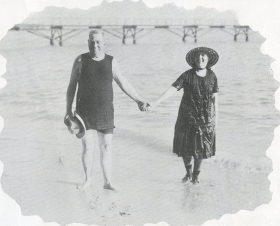
But in the early 20th century, it took up to two weeks to get to Hawaiʻi from the East Coast and two weeks back, so coming to the islands required a significant commitment of time. The trips also posed a political risk that opponents would pounce or criticize when the incumbent was away.
In 1907, the first trip drew 24 lawmakers. Word got around that it had been a great experience. When Kūhiō began passing out invitations again for a similar trip in 1909, he expected to host 12 guests but ultimately had to limit the number to 40. By 1915, Kūhiō had been flooded with so many positive responses that 49 lawmakers made the month-long journey to the islands. In 1917, 60 clamored to attend.
Many of them already held or were likely to get, positions that made them particularly useful to Hawaiʻi. Rep. John Adair of Indiana, who went to Hawaiʻi in 1907, soon became chairman of the committee on expenditures in the War Department. In 1909, when Kūhiō was pushing hard for more money for Pearl Harbor, seven members of the House naval affairs committee joined the group, according to records in the Hawaiʻi State Archives.
Many of these men and their wives tended to be self-important, so the invitation process required careful diplomacy and studied congeniality.
Rep. Carter Glass, a congressman from Virginia who chaired the House banking committee in 1915, was told he could bring his wife, and then he asked if he could bring his daughter, too. The answer was yes. In the end Glass brought his wife, his daughter, his son and his half-sister.
Glass was influential at the time. He had just helped draft the Federal Reserve Act, which created the Federal Reserve Banks, and later, when he was a senator, he would sponsor legislation that created the Federal Deposit Insurance Corp.
Sen. Thomas Hardwick, a married senator from Georgia, said he would only come if someone he called his “special friend,” a Mr. Blalock, was invited as well.
“Mr. Blalock and I desire to room together on the steamer, and we would like to have a room with a bath,” Hardwick wrote. The answer, again, was yes.
Then as now, high partisan hostility complicated the process. Republicans had been in power so long that it seemed they were invulnerable. Kūhiō had been reluctant to invite Democrats but was advised in 1909 that it was wiser to include them because they could one day become the majority party, which they did, in 1911. In fact, Kūhiō was literally urged to send them engraved invitations.
But it wasn’t an always easy sell to the Democrats either, because they were just as apt to snub Republicans when they could. Kūhiō’s aide sent a cable of invitation to Rep. Ben Humphreys, a Democrat from Mississippi, who soon thereafter became chair of the committee on territories.
“Prince says you must come,” the cable read.
Humphreys was one of the few that turned a cold shoulder to the invitation.
Rep. William Kettner of California, on the other hand, asked for an invitation in a rather threatening way.
“As you know, I am a member of the Committee on Rivers and Harbors, and as we now have before us three of your harbor matters; namely Honolulu Harbor, Hilo Harbor and Kahului Harbor; for which appropriations are desired, as a member of the committee it gives me the opportunity to inspect these harbors so that I can be in a position to intelligently advise the Committee when these matters are up for consideration.”
He wanted his wife to come, too. Soon Mr. and Mrs. Kettner appeared on the invitation list.
One highlight of every trip was an evening gala at the Kūhiōs’ lush oceanside estate on Waikīkī Beach known as Pualeilani, now Kūhiō Beach Park. Author Jack London and his wife were invited to one of these events, which she described as a fairyland of twinkling lights and soft Hawaiian music, with Kūhiō and his wife welcoming the delegation to their home with warmth and dignity.
“We roamed through a labyrinth of handsome apartments, now up a step to a big drawing room furnished in magnificent native woods and enormous pots of ferns, the walls hung with old portraits in oil of the rulers of Hawaiʻi,” Charmian London wrote in her 1918 book, “Jack London and Hawaii.”
“Near by were several tremendously valuable old royal capes woven of tiny bird feathers.”
Many of the delegates went home dazzled by Hawaiʻi. Rep. Ernest F. Acheson of Pennsylvania penned letters daily about his adventures in the islands in 1907, which were subsequently published in the Observer, a newspaper in western Pennsylvania, and then republished as a souvenir book.
“I believe that every member of the delegation that has visited Hawaiʻi will be a walking and talking advertisement once back on the mainland, for the territory,” Rep. James McClintic of Oklahoma told a reporter for the Honolulu Star-Bulletin on Nov. 28, 1917.
Volcanoes National Park had won another defender. McClinic was a member of the public lands committee, and he pledged his full support.
Next: Taking on the sugar barons.