

Green: Good-Government Bills Will Rebuild Public Trust
The Hawaii governor signed into law numerous measures to improve campaign finance, lobbying disclosure and ethics.
State Sen. Les Ihara has been advocating for increased transparency and accountability in government for nearly 30 years. But he has struggled to persuade his colleagues in the Hawaii Legislature of just how important the work is.
On Friday, however, Ihara stood triumphant as a featured guest of Gov. Josh Green at a press conference at the Capitol. The occasion was the signing into law 18 bills intended to, as Green himself put it, rebuild public trust.
“My civic and political life has been about public ethics, especially public ethics in elections, campaigns, lobbying and legislative decision making,” Ihara said. “I’ve introduced many political reform bills in the past that have failed, but this year many have caught a huge wave of public sentiment caused by the unfortunate, corrupt actions of our colleagues.”
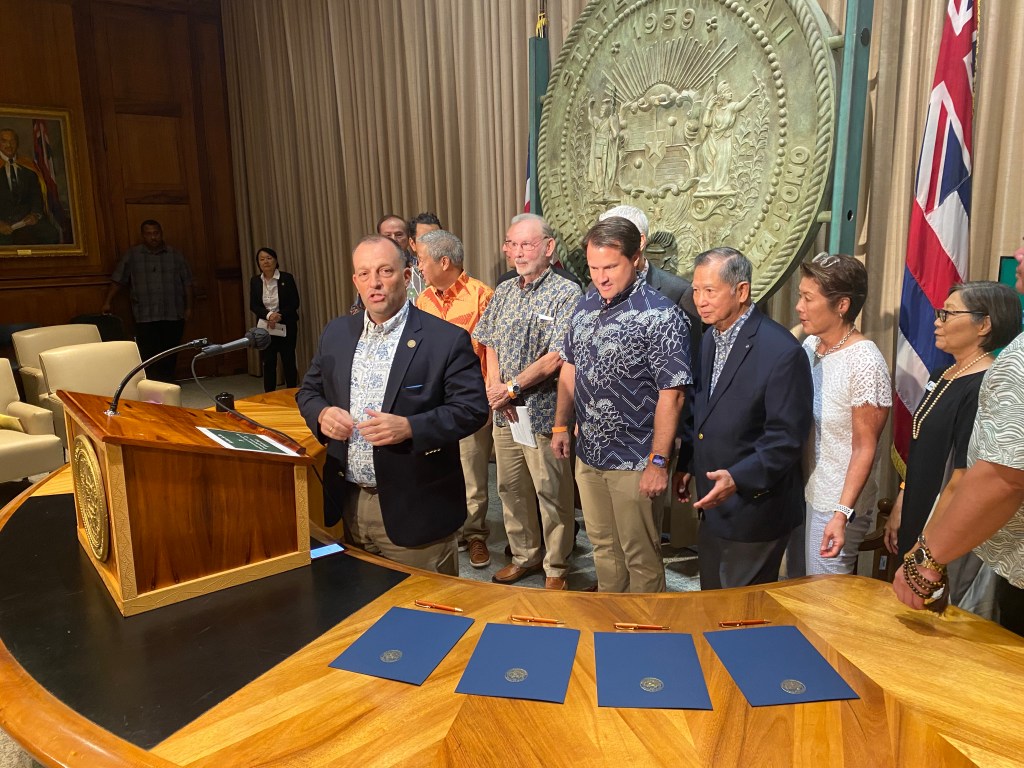
Ihara said he hoped the wave, which began when two former legislators pleaded guilty to accepting bribes last year, will continue.
The senator highlighted three of the 18 bills: one creating a digital voter guide, one requiring lawmakers to reveal in financial disclosures relationships with lobbyists, and one protecting journalists from revealing their sources.
That last measure, Ihara said, restores Hawaii’s shield law, which suffered a “painful death a decade ago.”

Also on hand were members of the Commission to Improve Standards of Conduct — aka the Foley commission. Many of the bills were proposed by the commission, along with others from the government agencies for ethics, campaign spending and elections.
In March Green signed seven other good-government bills. He said on Friday that other similar measures were expected to be approved, and that none of them would land on his veto-intent list, which he announced later on Friday.
“I don’t think any of those bills are related to ethics whatsoever,” the governor said. “In fact, a lot of those bills that we’re vetoing would otherwise have decreased transparency or decreased people’s participation on boards, those kind of things.”
Other bills signed Friday are expected to do the following:
- make sure presidential electors actually vote for their party’s nominee;
- ensure that voters only vote once and do not also vote in another state;
- ensure that their vote counts even if they die after voting;
- require all candidates make available to the public their full legal name so that people can know who they’re voting for;
- prohibit during legislative sessions and shortly before and after, lobbyist contributions and expenditures to lawmakers, and
- increase transparency of boards and commissions by posting recordings of their meetings on their websites.
By Green’s count, a total of 26 good government bills are now law or will soon be. That, he estimated, amounts to roughly 10% of all the bills that passed the Legislature this year.
The final count, according to Civil Beat’s own sunshine bill tracker, may be closer to 30. And more reform may be coming.
Retired Judge Dan Foley said at the press conference, “The work is not done. There’s more work to do. There are some bills that are still on the way to the governor’s desk. There’s some bills still pending in the Legislature. But I’m confident if we continue to work together, we’ll get that done.”

