Could Storage Pods Be The Answer To Food Shortages During Disasters?
Food caches can buy time for agencies to bring in additional resources.
Alicia Higa was only 7 years old when Hurricane Iwa hit Oahu in 1982. She lived in a house in Makaha across from an empty beach lot and remembers the lack of electricity and the blocked roads.
But Higa’s mother was prepared and had stored basic food like dried beans and jarred pickles to ride it out.
Now, as director of health promotion at Waianae Coast Comprehensive Health Center, Higa is helping ensure the Westside community is prepared in the event of another natural disaster.
Her health center is the location of a “Pre-covery pod” that can provide short-term food security during an emergency.

The health center pod holds 200,000 meal packets containing cereal, soup and rice, all with a 25-year shelf life. Each meal packet cost 65 cents and the total cost for the pod, including the container was about $150,000.
The pod is part of a pilot program launched earlier this year by the City and County of Honolulu, along with the Hawaii Foodbank.
The concept was introduced on Oahu by Chad Buck, CEO of the state’s largest local food distributor, the Hawaii Foodservice Alliance. Buck said he paid for the first pod “out of his own pocket,” figuring that if he waited for officials to step in, it would not have run as smoothly.
The effort comes as many communities on Oahu and other islands worry about levels of disaster preparation.
A study earlier this year by the University of Hawaii West Oahu, found that more than half of the state’s households did not meet the Hawaii Emergency Management Agency’s 14-day emergency preparedness recommendation: 81% did not meet the water supply recommendation, 71% did not have food stored and 61% did not have medical supplies.
The pods are designed for food-insecure communities – like Waianae – where some residents are unable to afford to store the quantities of food recommended by the agencies.
Under former Honolulu Mayor Kirk Caldwell’s administration, the city planned to advance food security by mapping food banks, reaching out to private companies across Oahu with storage space and supporting organizations taking the lead.
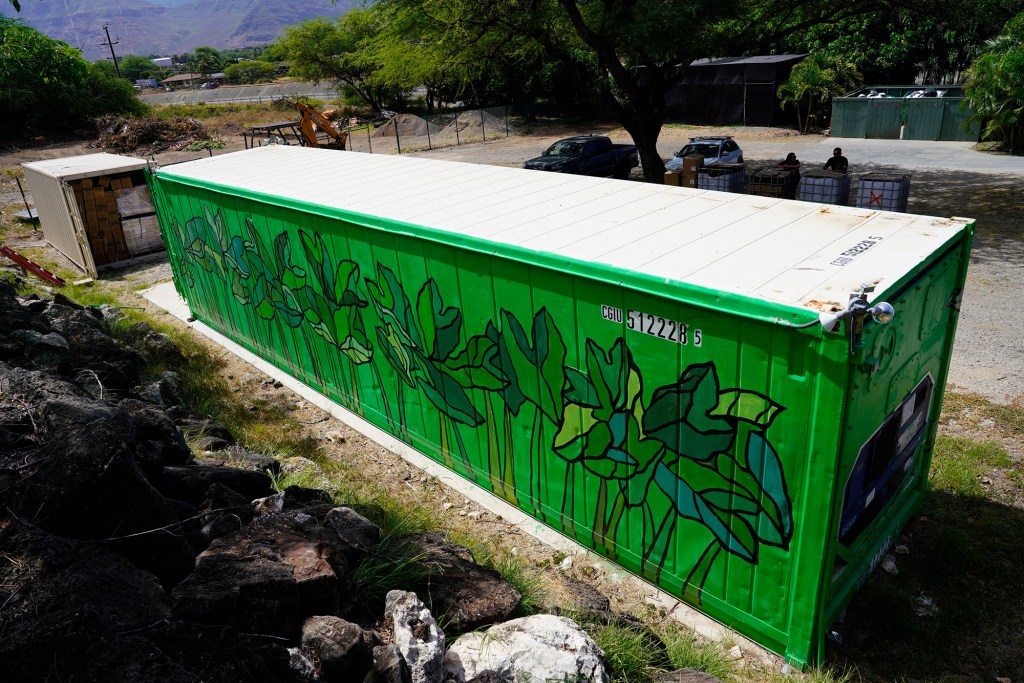
The city now plans to place two more pods around Oahu – one on the Windward Coast and another closer to the North Shore near Hauula.
These new pods will be funded through the FEMA Homeland Security Grant Program and the DEM estimates that 230,000 food servings will cost $110,000.
Food insecurity rates have been exacerbated by inflation and the end of additional pandemic-related resources, Higa said. “If we’re already like leveling up and trying to do more with less and then if a hurricane or a tidal wave comes in, we’re pretty screwed as a community.”
“While they are not the total answer,” Buck said, “the pods are a piece of a more robust disaster preparedness plan for food-insecure communities in our state.”
Officials are still encouraging households to put away some extra cash and stock up by steadily buying extra groceries and storing canned or freeze-dried food.
“Hawaii Grown” is funded in part by grants from Ulupono Fund at the Hawaii Community Foundation and the Frost Family Foundation.