Some Hawaii Students See Gains In Learning Since The Pandemic
Superintendent Keith Hayashi said it will take more time to return to pre-pandemic levels of achievement.
Traditionally underserved students have made significant improvements in areas such as math, reading and graduation rates since the end of the pandemic, according to data released by the Hawaii Department of Education on Thursday.
The 2022-23 Strive HI results reflect the performance of public school students across the state, including those in charter schools. In addition to publishing statewide performances on key indicators like reading and math proficiency, the DOE also broke down achievement by different subgroups of students in its Accountability Data Center.
In math and reading, the state overall saw small improvements in math proficiency and no changes in reading proficiency between the 2021-22 and 2022-23 school years. In the 2022-23 school year, 40% of all students achieved proficiency in math – a 2% increase – while 52% of students achieved proficiency in reading.
In a media briefing on Wednesday, Superintendent Keith Hayashi said the pandemic and online learning only exacerbated the challenges schools faced in addressing students’ academic and social emotional needs. While online learning took place for approximately two years, it will take much longer for schools to return to their pre-pandemic levels of achievement.
“We ask for people’s patience because it will take time,” Hayashi said.
In the 2019-20 school year, Hawaii received a federal waiver for standardized testing due to Covid-19. As a result, the 2019-20 Strive report does not include math or reading results for comparison.
In math, all subgroups of students have yet to return to their levels of proficiency from the 2018-19 academic year, the last full academic year that took place before Covid-19. But some groups of students have seen significant improvements in their test scores since returning from the coronavirus pandemic.
Many groups of students followed the statewide trend of remaining steady in their English Language Arts achievement over the past two years. But two groups of students stood out: students in foster care nearly matched their proficiency rate from before Covid, while English language learners surpassed their proficiency rate prior to the pandemic.
While both groups showed improvement, their ELA proficiency remains below the statewide rate of 52%.
Deputy superintendent Tammi Oyadomari-Chun said DOE has requested funds from the legislature to hire specialists who can better support and connect with families who do not speak English as their first language. She added that teachers are also undergoing training to learn how to better support English language learners.
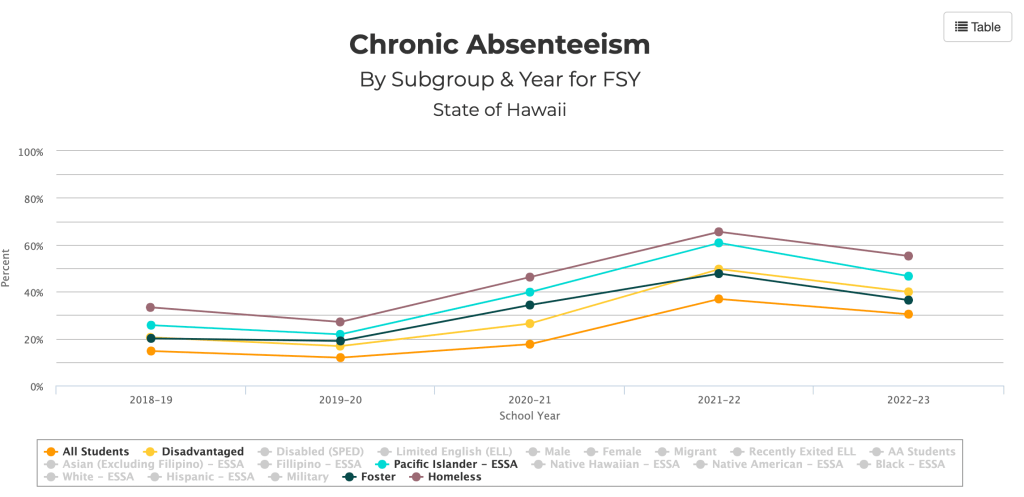
Statewide, chronic absenteeism was 30% in the 2022-23 school year, marking a 7% decline from the previous year.
Some groups of students saw at least a 10% decline in their chronic absenteeism rates over the past two years, including economically disadvantaged, fostered and homeless students. These groups’ chronic absenteeism rates still remain above the state average, with homeless students having the highest chronic absenteeism rate of 55% in the 2022-23 school year.
Pacific Islander students had one of the largest declines in chronic absenteeism over the past two years, with their rates dropping from 61% in the 2021-22 school year to 47% in the 2022-23 school year.
Cheri Nakamura, director of the educational advocacy group Hui for Excellence in Education, said federal pandemic relief funds have provided schools with more resources than usual and has helped students’ recovery.
For example, the DOE has allocated roughly $12 million in federal relief dollars to support complex area proposals for initiatives addressing student attendance.
David Miyashiro, executive director of HawaiiKidsCAN, said he would like to see more data on what programs worked most effectively over the past few years as pandemic relief funds expire next fall. DOE received an unprecedented amount of federal funding during Covid, he added, and he would like to see successful programs continue beyond their expiration date.
“It really comes down to how we provide targeted support and what kind of investments we’re able to make to help struggling students,” Miyashiro said.

Graduation rates were only available up until the 2021-22 school year, with 85% of all students graduating in 2022. This number matched the state’s graduation rate in the 2018-19 school year.
Several subgroups of students surpassed their 2018-19 graduation rates in the 2021-22 school year, including Asian, Black, Native Hawaiian and white students. Asian students led the state with one of the highest graduation rates of 94% in the 2021-22 school year.
Terry George, president and CEO of the Harold K.L. Castle Foundation, said the state must prioritize closing achievement gaps among different student groups moving forward. But, he added, this work can be difficult when multiple factors impact student achievement, including students’ access to early learning opportunities and stable study places at home.
“These gaps are really, really hard to close, but they must be closed,” George said.
Civil Beat’s education reporting is supported by a grant from Chamberlin Family Philanthropy.