Senators Grill DOE Officials For Failure To Spend Project Money Before Deadline
They question how the Department of Education communicated about its struggles to handle nearly $1 billion in capital improvement funds.
Three weeks after the Hawaii Department of Education proposed to relinquish over $465 million in school facility funds, DOE officials faced tough questions from state senators at a briefing Wednesday.
DOE leaders cited a lack of internal communication, staff vacancies and construction delays as factors driving the department’s proposal to lapse the capital improvement project funds. But many senators were dissatisfied with the explanations, criticizing the DOE for wasting time and resources on school projects that will never reach completion.
“We hate to add money if it could have gone to something else that’s equally important,” said Ways and Means chair Donovan Dela Cruz.
Among the senators’ chief concerns was the lack of communication from DOE as the department struggled to spend much of the nearly $1 billion appropriated in CIP funds from the 2021 to 2023 fiscal years.

As of June 30, the department had actually spent approximately $34 million of that money and encumbered an additional $140.5 million, according to Department of Budget and Finance materials shared before the briefing.
Any remaining unspent CIP funds would automatically lapse next June unless legislators choose to reappropriate the money. DOE is confident it can encumber or spend roughly $435 million in remaining funds before the June deadline, department spokeswoman Nanea Kalani said.
DOE Superintendent Keith Hayashi said the department proposes that $465 million lapse before the June deadline, adding that it is prioritizing the completion of projects that help schools comply with Americans with Disabilities Act or Title IX requirements.
“To think we can reappropriate all this lapsed money, it’s not going to happen. You know it’s not going to happen.”
Sen. Donna Mercado Kim
Donna Mercado Kim, vice chair of the Senate Education Committee, said the DOE should have alerted legislators sometime during the past three years that it lacked the capacity to take on new projects and complete existing ones.
“Before you embark on new projects, you’ve got to take care of the old projects,” Kim said.
DOE first approached the Department of Budget and Finance in March about the possibility of lapsing a large number of projects, said Budget and Finance Director Luis Salaveria.
According to the materials released before the briefing, the Department of Budget and Finance ultimately required DOE to give up at least $400 million in CIP funds. Less than a week later, DOE returned with a revised proposal to lapse $465 million.
While DOE was considering lapsing some of its CIP funds from early in the year, it didn’t initially intend to give up $465 million, said deputy superintendent Curt Otaguro.
No one in the DOE is responsible for seeing projects through from beginning to end, Otaguro said. He added that separate departments within the Office of Facilities and Operations are in charge of different aspects of a project, such as planning and construction.
“It seems like we need to follow a project every step of the way,” said Sen. Lynn DeCoite.
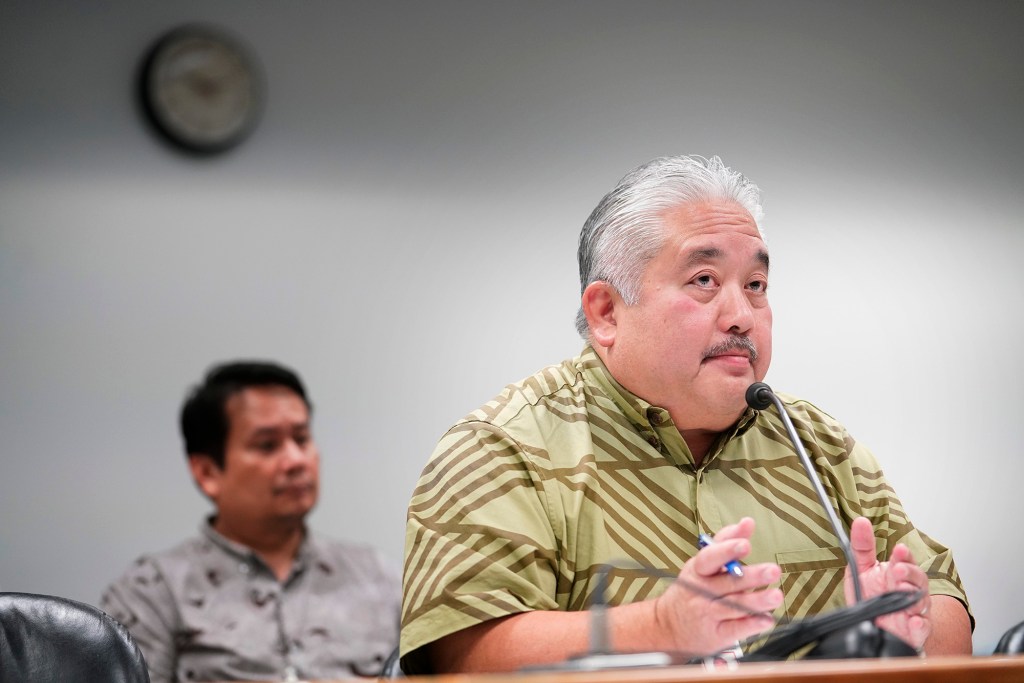
The lack of internal DOE communication about CIP funds speaks to long-standing issues in the department, Dela Cruz said. In fact, according to DOE’s website, the department actually has a total of approximately $2.1 billion in unspent CIP funds, which have accumulated as legislators appropriate growing amounts of money to school facilities over time.
In the governor’s proposed budget for the 2025 fiscal year, DOE is set to receive $400 million in CIP allocations – a third of the state’s total CIP funds. But, Kim said, there’s no guarantee the Senate will reappropriate the CIP funds that DOE fails to spend by June.
“To think we can reappropriate all this lapsed money, it’s not going to happen,” Kim said. “You know it’s not going to happen.”
“We definitely will do better.”
DOE Superintendent Keith Hayashi
Right now, Kim said, DOE should prioritize completing ongoing construction projects at roughly 180 schools across the state. But it’s unclear how the department will achieve this with limited project completion funding, which is meant to cover unexpected costs that arise in the construction process.
Last year, the Department received no funding for project completion. The governor’s proposed budget for fiscal year 2025 includes $49 million for project completion, roughly $1 million less than what DOE had originally requested for the 2023-25 biennium, according to a Board of Education memo from a June meeting.
Moving forward, Dela Cruz said, senators will review DOE’s proposed list of lapsed projects and decide what projects they would like to see continue or allow to lapse. He also suggested senators take the lead in reorganizing DOE’s Office of Facilities and Operations, adding that the former structure placed an “overwhelming” amount of responsibilities under the assistant superintendent overseeing the office.
Randall Tanaka left the position of assistant superintendent of facilities and operations earlier this month shortly after information emerged about the lapsed CIP funding.
Hayashi agreed with Dela Cruz’s emphasis on reforms, adding that he’s been working with the Board of Education to re-evaluate the department’s CIP spending and construction processes.
“We definitely will do better,” Hayashi said.
Civil Beat’s education reporting is supported by a grant from Chamberlin Family Philanthropy.