

Maui Has Yet To Launch A Covid-Era Housing Program That Could Provide $24 Million In Relief To Fire Survivors
County council members want the Bissen administration to take advantage of the federal money before it’s too late.
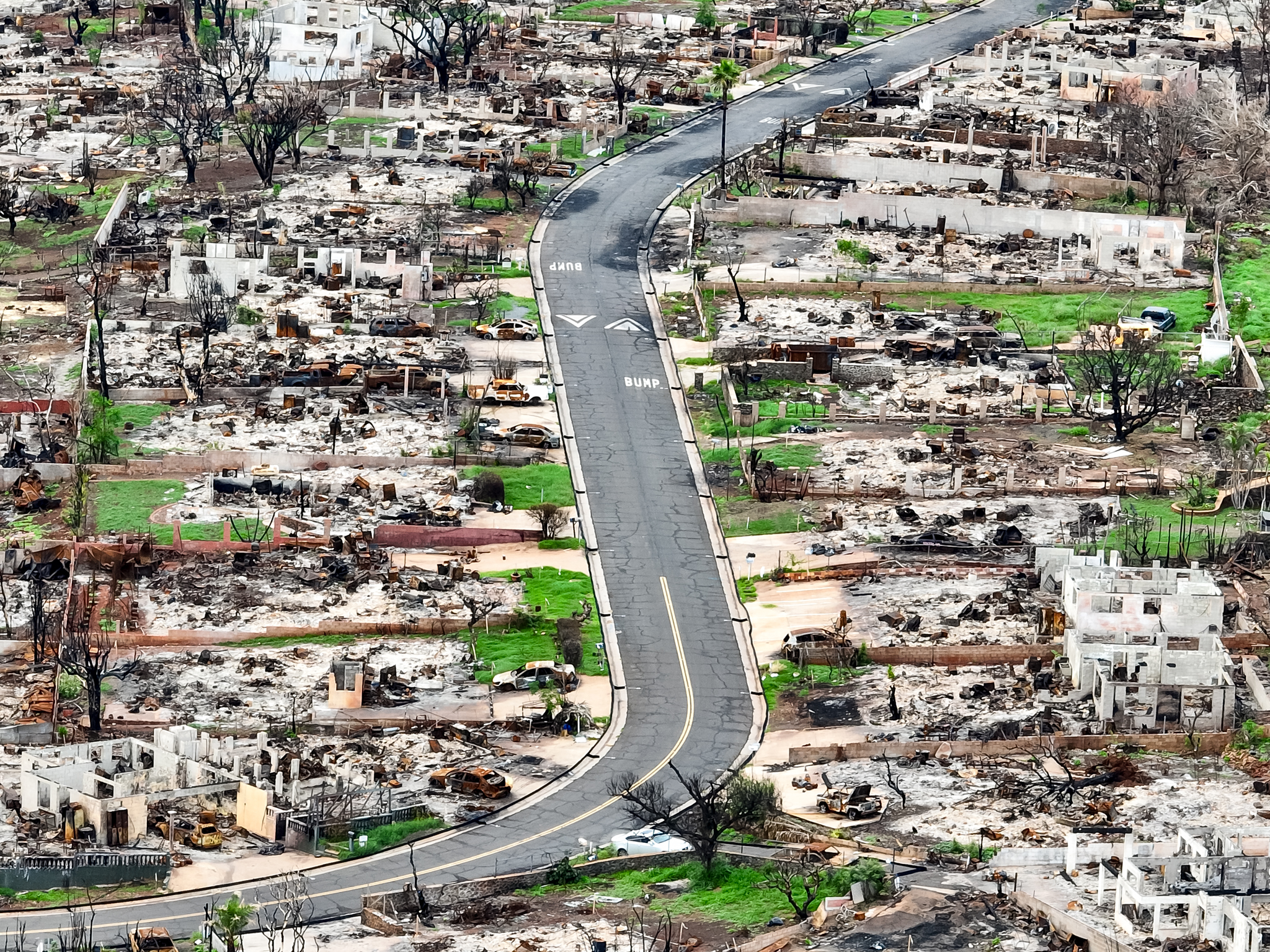
Maui County is sitting on $24.5 million in pandemic relief money that could be going to help thousands of residents displaced by the Aug. 8 wildfires in Lahaina and Upcountry, according to state and county officials.
Tamara Paltin, who represents West Maui on the nine-member Maui County Council, has been trying for the past year to get the administration moving — and that was when the county’s share of the federal Homeowners Assistance Fund stood at $8 million.
Since the fires, the state redirected another $16.4 million from the Covid-19 housing fund to Maui that was originally earmarked for the City and County of Honolulu. Eight days after the Maui fires destroyed more than 2,000 structures, the Hawaii Department of Budget and Finance ended new applications for Oahu’s program, according to the state.
These grants of up to $60,000 apiece — part of the American Rescue Plan Act of 2021 — can be used for past due mortgages, property taxes and other housing expenses for homeowners under 150% area median income who faced financial hardship during the pandemic.
But Maui has yet to spend a single dollar — the only county to not do so — after struggling to find a nonprofit service provider to administer the program.
“It’s disappointing,” said Paltin, who is putting the matter on the council’s Wednesday meeting agenda.
The council, which passed a resolution in February 2023 urging the new administration led by Mayor Richard Bissen to get the program up and running, will again push for the program to be a priority next week before its Housing and Land Use Committee.
Maui has been trying to get the program underway, officials said. The county issued a request for proposals in May but did not receive a single application.
The county took a different path and solicited organizations through direct procurement. On Nov. 3, it selected Catholic Charities Hawaii, which also administers the county’s Emergency Rental Assistance program, and was a contractor for the state’s Rent Relief and Housing Assistance Program in 2020.
The background work has been completed with the state and vendor, but the contract is still not done, said Lori Tsuhako, the director of the county Department of Housing and Human Concerns who is responsible for the program, during last Friday’s council meeting.
“I am very sorry,” she told the council.
Tsuhako’s department is short-staffed, like most in the county, and she said she needs help from corporation counsel and the finance department to get the contract done.
“Every day a local family moves away,” Paltin told Tsuhako at the meeting. “That’s the bottom line. If you need help to execute the contract, ask the administration for help or whatever it takes. But it’s been years and people in my district are really, really hurting.”
The state received nearly $50 million of the $10 billion in funding for the national program. Hawaii and Kauai counties both launched their programs in October 2021 with Hawaii Community Lending as the administrator. Oahu’s program got off the ground in January 2022 with the Council for Native
Hawaiian Advancement as its provider.
Maui County elected to delay starting its program because it had unspent Community Development Block Grant funds to help Maui homeowners. But Paltin said the programs should have been run simultaneously because they covered different expenses.
To help homeowners meet the federal guidelines, Jeff Gilbraith, executive director of Hawaii Community Lending, said he has “really savvy processors.”
“The rules require that a family has either had a 10% loss of income as compared to prior to Covid, or a 10% increase in expenses as compared to prior to Covid,” he said. “That 10% of increased expenses can be as a result of inflation.”
To make it easier to administer the program for Maui homeowners affected by the fire, the state asked the U.S. Treasury Department for various waivers. Those were not granted but treasury staff did make it easier for those homeowners to be eligible, including self-attestation of Covid-related hardship, and narrowing the focus to forward mortgage payments and homeowner association fees, according to the state Department of Budget and Finance.
When Maui County published its request for proposals for an administrator of the program in May, Gilbraith said Hawaii Community Lending did not apply because Maui County was starting 1.5 years later than the other counties. This made it difficult, with a 15% cap on administrative costs, to do the work necessary before the September 2026 deadline without additional resources.
He said implementing the program is a “pretty heavy lift.” Hawaii Community Lending started with a pilot phase for six months to get the systems set up. The work includes entering into collaborative agreements with mortgage servicers and compiling weekly, quarterly and annual reports to the county, state and federal governments.
“It’s not just putting the grant out,” he said. “It’s actually doing the negotiation for a mortgage modification with the banks. Not only would we bring the family current, but then we would change the terms of the loan so it’s affordable for them going forward and less likely for them to fall into
hardship in the future.”
Kauai, Oahu, Big Island Disperse Millions
The Hawaii Housing Finance and Development Corporation will provide technical assistance to Maui County to help with the program’s administration, including those detailed and numerous compliance reports.
In Hawaii County, $5.24 million has been distributed to 696 homeowners with an average grant of about $25,000 and on Kauai nearly $2 million has been provided to 294 homeowners with an average grant of about $30,000, according to a fund dashboard on the Hawaii Community Lending website.
“We’ve prevented foreclosure for 990 homeowners so far,” Gilbraith said.
A combined $4.8 million is left to disperse for Hawaii and Kauai counties. Gilbraith said he expects this will be completed by the end of July. Applications are still open, but the programs are winding down and the homeowners with the most hardship will be prioritized.
Oahu permanently closed its applications for the program, and it is continuing to process all those submitted by Aug. 16. As of the last quarterly report on Sept. 30, $5.1 million had been dispersed to help 350 homeowners out of about $13 million in its award.
The Department of Budget and Finance set up the rules within the federal guidelines for the Homeowners Association Fund, with each county administering its own funds.
The state originally set the maximum grants at $30,000. But with the three counties having difficulty finding enough qualified homeowners, the state announced in June that it had doubled the amount to $60,000.
The state also made it easier to qualify by eliminating the requirement that a homeowner had to be delinquent on a mortgage, allowing reverse mortgages and making forward payment mortgage assistance available up to 12 months.
The grants are paid directly to the mortgage company, utility, homeowner association or tax office on behalf of the homeowner.
“We saw other states doing like $100,000 per homeowner in higher cost areas, and I think we saw Alabama was at $30,000, and that’s what ours was initially,” Gilbraith said. “So as we started to see what the real demand was and the need from families … we were able to change some of the rules.”
At the recent council meeting, council member Gabe Johnson underscored the need for urgency.
“This is Covid money,” he said. “I don’t know anybody who hasn’t been touched in some way or another from that so I think it is really important that we act fast and we act now.”
Civil Beat’s coverage of Maui County is supported in part by a grant from the Nuestro Futuro Foundation.

