

Maui Police Are Tackling A 30% Job Vacancy Rate By Opening A New Recruiting Center
Officers want to show their personal investment in potential hires as the department tries to fill the empty positions.
The Maui Police Department has leased space at the Queen Kaahumanu Center shopping mall in Kahului as part of a new strategy to personally recruit officers and emergency services dispatchers for its massively understaffed agency.
The department, which has a combined 550 sworn and civilian positions, has 165 vacancies. And while there are some signs of improvement, the department’s leaders have recognized that more needs to be done to streamline the process and bring more people on board.
Maui Police Chief John Pelletier said the office space at the mall, which used to be leased by the U.S. Army and Navy, is more inviting than a police station.
“You don’t just go walk onto the military base and say, ‘Hey, I’m thinking of joining.’ No, you go to a recruiting station and ask questions,” he said. “This is why we are in office space that’s in a mall. It is welcoming.”
When Pelletier took over the department in December 2021, he said he quickly recognized that he needed dedicated recruiters to address the worker shortage he inherited — and to increase the number of applicants who make it through the arduous process to get hired.
Of the 400 sworn officer positions, 25% are not filled. But more alarming, 63% of the 41 dispatcher positions are vacant. With four dispatchers leaving following the Aug. 8 fires, only 15 remain to cover about 1,600 daily police, fire and medical calls for Maui, Molokai and Lanai.
It didn’t help that all recruiting was halted in 2020, the year the Covid-19 pandemic prompted work and social restrictions that lasted months. But MPD is also part of a national trend affecting law enforcement agencies that have been having trouble recruiting.
Pelletier said for a while the “world society frowned upon” what once was a coveted career for reasons that included the pandemic, George Floyd’s death and polarizing racial justice movements. A report issued in 2023 by the Justice Department says there is a “historic crisis in recruiting and retaining qualified candidates.”
A big issue for MPD also has been getting those who do apply across the finish line. In 2021, only 11 out of 938 applicants for police officer were hired and only 1 out of 258 applicants for dispatcher made it.
“The national average is usually around 5%, so why are we hiring 1% of just under 1,000 people?” Pelletier said. “Something’s not right. We had to do a diagnostic to learn where are we missing the mark.”

MPD was sued in July by a 27-year-old female recruit who said that in February 2022 she suffered heatstroke and became unresponsive following a cross-country run that was part of a regular “Beat Down Friday.”
Pelletier said: “There is no Beat Down Friday. Period.” He added that there is no hazing, but that since the incident, under the leadership of Capt. Joy Medeiros, every candidate who is going through the 5.5-month academy has a monthly Army physical fitness test to ensure they are ready to pass the physical requirements of the academy.
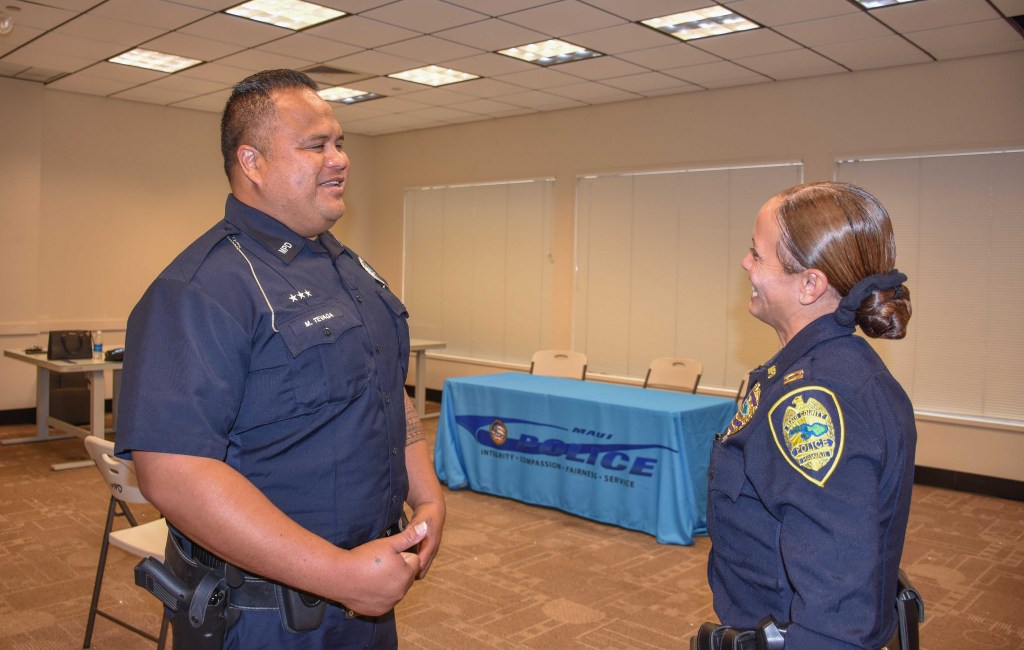
Medeiros is overseeing the new recruiting team to provide the “personal touch.”
Two officers “who are energized and actually give a darn about the people who come in” were assigned to it full-time more than a year ago and two civilian positions are in the works, Pelletier said.
These officers have been holding recruitment fairs and seminars, but in the next few months will be moving into the new office space on the second floor of the centrally located Kahului mall, which still has the Army and Navy signs on the outside.
Inside, the mostly empty three rooms contain two tables, some folding chairs, a police banner and a large TV still in the box. The space is being transformed to include computers for applicants to take practice tests and comfortable seating to talk one-on-one with applicants, people wanting to learn more and even family members.
Medeiros said it’s much less intimidating than going to a police station, which some associate with getting arrested.

But it’s still not easy to become a police officer. The process involves passing written and physical tests, including being able to run 1.5 miles in under 17 minutes and doing 19 pushups in a minute. An applicant must also get a green light from a psychologist, pass a polygraph, impress in an interview and undergo a background check.
Pelletier said the force is not looking for perfect people because “there’s no perfect human being. If we make mistakes, we own them.”
And while using medical marijuana is not an automatic fail to become an officer in Hawaii, “if you’re a habitual drug addict, that’s a problem,” he said.
Officer Marvin Tevaga, one of the two full-time recruiters, said he wants to help people “fulfill the dream they had as a kid when they played cops and robbers” by engaging them throughout the process, and helping them address areas of the process where they may be struggling to pass.
This includes letting some know it’s not too late to get the required education, pointing them to McKinley Community School for Adults.
The department has been working to streamline the process, including making sure background checks get done in a timely fashion. It also has been working on a more holistic approach to prevent potential good candidates from getting eliminated over one aspect of the process.
Pelletier cited the recent case of a dispatcher applicant who had failed partly because the psychologist said the person did not follow through with things they had begun. What the psychologist didn’t know, but the background investigator did, was that person quit the police academy years earlier to support family following the death of the person’s father.
“That should have been a positive not a negative,” Pelletier said.
Now, the agency has a final review of the candidate with all the results of the tests considered as a package.
MPD is competing for employees with private entities and the military, in which a person only needs to be 18 to join. An MPD officer applicant must be 20. To keep potential young applicants engaged, MPD has a cadet program geared primarily for college students.
An MPD Police Officer 1 position starts at $75,000 per year plus benefits. But Pelletier said that pay in relationship to the high cost of living on Maui is a barrier to hiring.
He said at a job fair three months ago, he was told that TSA at Kahului Airport provided 35% cost-of-living stipends and was fully staffed.
“If the federal government is doing it, and it seems to be working, then why are we not doing everything we can to follow suit?” he said.
Pelletier said the new strategy of “personal investment with the applicants” is working.
In 2023, only 585 people applied to become a police officer, but 25 made it, the most in eight years. The 4.3% hire rate and the 21.9% of applicants who were deemed eligible also were the best in eight years. And there are now about 45 people in the pipeline for the upcoming 95th Recruit Class.
Pelletier, Maui’s first chief from the mainland, said he obviously is not opposed to hiring officers or accepting recruits outside of Maui or Hawaii.
“But we want to do everything we can do to have folks who are already here within our community come join us on the department,” he said. “That’s the goal.”
Civil Beat’s coverage of Maui County is supported in part by a grant from the Nuestro Futuro Foundation.

