

New Smart Sensors To Be Deployed On Maui To Provide Early Detection When Fires Break Out
A combination of thermal imaging, gas detection and artificial intelligence will help provide firefighters with real-time data to be able to respond faster.
In time for the upcoming wildfire season on Maui, 20 newly developed smart fire sensors are being installed in two areas of the island to enable early detection and quicker response, Gov. Josh Green announced Friday on the seven-month anniversary of the destructive and deadly Aug. 8 blazes.
The sensors, about the size of a loaf of bread, were developed by the Department of Homeland Security Science and Technology Directorate, the U.S. Fire Administration and Maryland-based company N5 Sensors.
They combine thermal imaging, gas detection and artificial intelligence to work together to detect the start of wildfires in real-time.
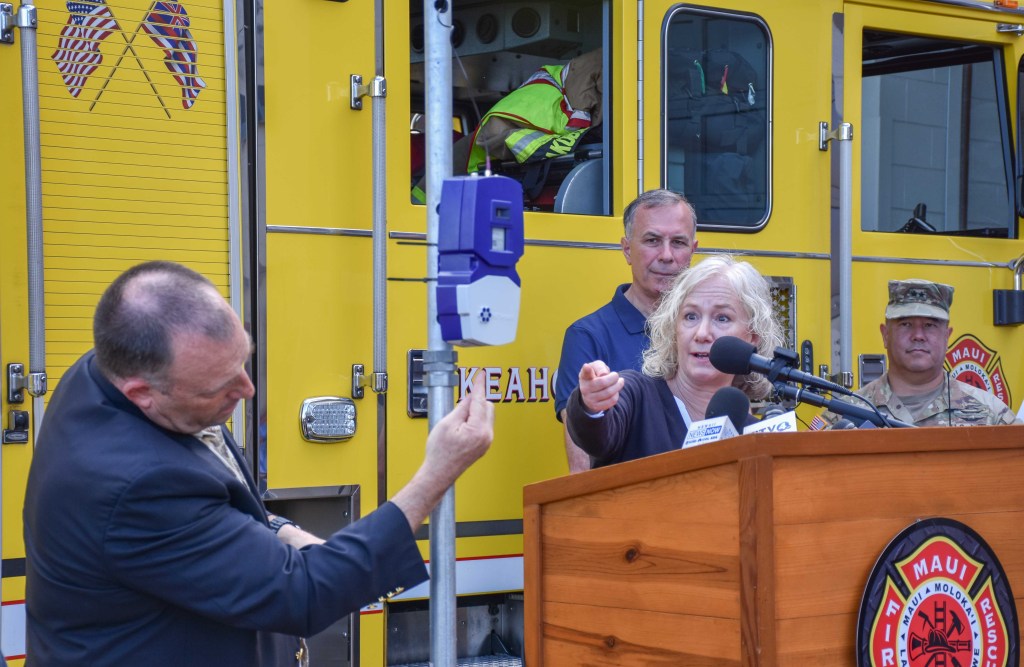
“They will give our emergency responders a critical advantage in protecting our community,” Maui Mayor Richard Bissen said. “They will save lives.”
The sensors will be installed on existing utility poles, towers and the like, and will be active by April 8, with another 60 fire sensors and 16 wind sensors to be placed around the state, said U.S. Fire Administrator Lori Moore-Merrell at a news conference at the Wailea Fire Station.
“As firefighters and public servants, I can tell you that we often vow never again,” she said. “That helps us personally. It helps us prepare for the next emergency. The impact of climate change-driven drought conditions, the warmer conditions, extremely unusual weather, storms, high winds, all of these conditions are very likely to occur here again.”
DHS’ Science and Technology Undersecretary Dmitri Kusnezov said the sensors are a tool that continues to be refined. There already have been trials using them in 11 states and Canada. Hawaii was chosen as a place to test them partly because the air is different.
“You have volcanic ash. You have other conditions,” Kusnezov said. “Smart sensors like this will learn what does the air feel like here. And what does an anomaly look like? What is a barbecue? What is a fire?”

The cloud-based artificial intelligence will learn over time the difference by analyzing 30 measurements of gases, chemicals, particulates and environmental conditions that the devices take continuously. Little tiny packets of data are sent up to the cloud for AI analysis, said Debra Deininger, chief revenue officer of N5 Sensors.
Maui Fire Chief Brad Ventura said the winds, salt air and fuels that burn in Hawaii are different than other places.
“So the sensors are going to have to learn all of those different types of our environment,” he said.
As the artificial intelligence learns, the number of false alarms should decrease, Deininger said.

The sensors are placed about a mile or two apart in a line called strings. One string will be in South Maui from Kihei to Wailea on the slope of Haleakala and the other will be in West Maui from Olowalu to the Hokiokio area of Lahaina. The sites were chosen because of their high fire risk and proximity to densely populated residential areas.
“These sensors aren’t just looking, they’re also smelling the environment at the same time,” Ventura said. “That’s a very important part of this project, because at night, when the thermal imaging capability is working and the gas detection is working, we’ll be able to earlier detect fires.”
The sensors each have a photovoltaic battery to keep them charged. They collect data that is sent as text messages or emails to fire officials and others via cellular service.
Ventura said it is still being worked out who will receive these notifications, which will be used to help allocate personnel and make decisions about evacuations.
They cost about $10 per acre, with one sensor generally able to cover about 640 acres, Deininger said.
But Moore-Merrell said the first round of sensors for Hawaii are being paid for by the Department of Homeland Security Science and Technology Directorate and the U.S. Fire Administration.
Ventura said while these sensors won’t prevent fires, it could help firefighters respond faster and minimize the size of fires.
He said the sensors likely would not have prevented the tragic outcome in Lahaina though. He said a variety of other fire mitigation efforts also need to be done.
Civil Beat’s coverage of Maui County is supported in part by a grant from the Nuestro Futuro Foundation.

