Neighborhood Boards To Get Active Shooter Training After Alarming Incident At Meeting
Members of the Kalihi-Palama board said they were upset by what turned out to be a man breaking a glass window, sparking a conversation about safety.
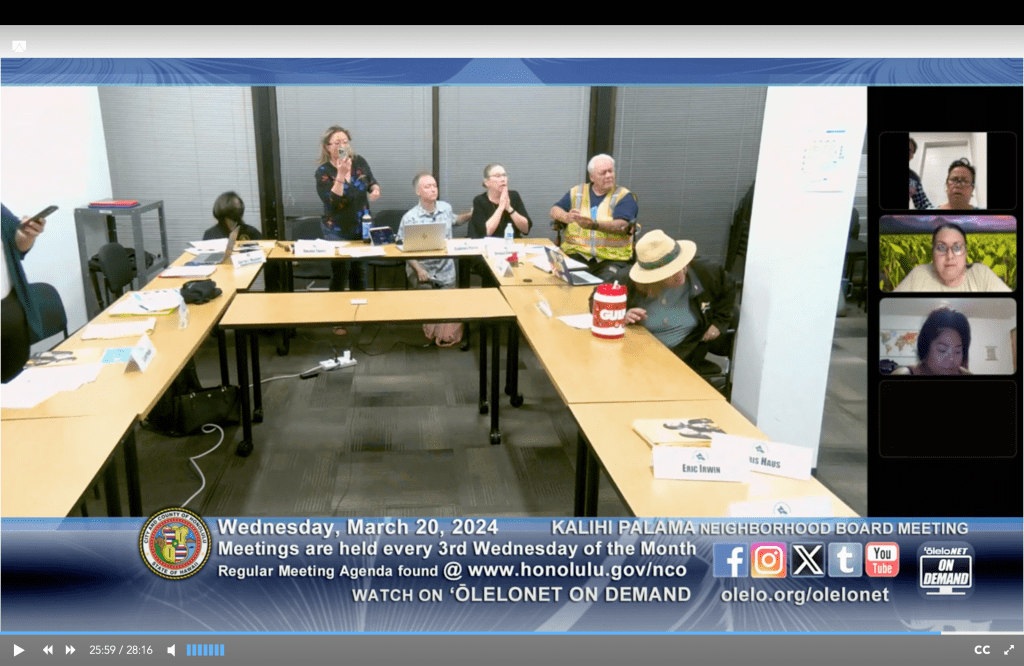
One evening in March, members of the Kalihi-Palama Neighborhood Board convened for what was supposed to be a routine meeting. They ended up deciding they needed training in emergency procedures after a man disrupted the session by breaking a glass window.
Police arrested a 37-year-old man at the scene for second-degree property damage and later released him. It appeared he threw a glass object at a window, according to HPD spokesperson Michelle Yu.
The man’s motives are unclear. Amanda Ybanez, the board chair, said the man had asked somebody the day before what time the neighborhood board would be meeting, suggesting he meant to target it.
Whatever the back story, that was not the end of the incident.

Board members asked for active shooter training a few days later at the Neighborhood Commission’s monthly meeting, saying they had found the incident deeply disturbing.
And now the commission has agreed to give active shooter training to its roughly 400 board members.
“It is a concern and it is something we should do,” Neighborhood Commission Executive Secretary Lloyd Yonenaka said.
City officials said that security at public meetings has become more of a concern during the past few years.
Technology has made it easier for people to view media that may incite them to such acts, they say, and strict regulations to slow the spread of Covid-19 angered many people who lost trust in government officials.
It tends to have a chilling effect on democratic expression. Members of the public eager to testify on certain agenda items might think twice about putting their names and faces out there, Honolulu City Council member Radiant Cordero said.
“We want people to come out, but people who want to say great things are also afraid,” she said.
The exact format of the training is still to be determined, whether through videos or in-person coaching, Yonenaka said.
He said that he’s talking to the Honolulu Police Department about helping to coordinate the training.
‘The Emotional Toll’
Cardenas Pintor, a vice chair on the Kalihi-Palama Neighborhood Board, testified during the commission’s meeting that it was difficult to fall asleep in the days after the March 20 incident.
“I’m frankly terrified of what just happened on Wednesday night,” Pintor said.
Kathleen Pahinui, who was present as the spokesperson for the Honolulu Board of Water Supply, and who chairs her own neighborhood board on the North Shore, concurred with Pintor.
“The emotional toll, the psychological toll that Cardenas just shared — it’s a real thing,” Pahinui said.
Yonenaka said in an interview that such incidents are rare at neighborhood board meetings.
Tensions can run high during controversial discussions. But they usually don’t escalate to the point of needing better security measures.
“I have never seen or heard about any kind of gun violence at all,” Yonenaka said.
A Chilling Effect
Cordero said that just the possibility of danger can have a chilling effect on public participation.
She cited a controversy last year over the council’s 64% pay raise. Cordero, who ended up rejecting the raise for herself, said some constituents expressed private support for the raises but avoided saying so on social media out of fear of backlash.
“They didn’t want to just be a target,” she said.
Social media has made people feel more comfortable expressing their anger, especially over policies they dislike, Cordero said. She thinks it’s gotten worse even compared to just a few years ago, when she was chief of staff for her district’s previous council member, Joey Manahan.
“It’s just another way to release some type of aggression, and it’s not always productive commentary,” she said.

Cordero, who was attending the Kalihi-Palama board meeting remotely when members heard the glass break, told the Neighborhood Commission about a similar incident during the pandemic.
About 200 residents came to Honolulu Hale in response to a measure urging the administration to implement a health card system for allowing people into public establishments, banging on the glass of the council chamber in opposition.
“This did not help public discourse. This did not further any productive discussion. But it only instilled fear,” she said.
Pintor, a vice chair on the board, is a college student majoring in social work and had been interested in pursuing a career in politics before the March 20 incident. But the moments of fear gave Pintor pause.
“It makes me a bit more cautious on what I’ve planned to do,” Pintor said in an interview.
At the Neighborhood Commission’s meeting, Pintor pointed out that scheduled presentations from Amazon and AT&T that night had to be canceled.
“We had such a great agenda … Now, those people may not want to come back again,” Pintor said.
It’s a point that Ybanez, the board chair, also made during the Neighborhood Commission’s meeting.
“It should be safe for everyone at every single board. This is the community’s board — we deserve a place that’s safe,” she said.