

Maui Mayor Takes ‘Bold Step’ To Eliminate 7,000 Short-Term Rentals By 2026
Emboldened by state lawmakers’ action this session, Bissen has proposed county legislation to phase out certain vacation units to open up more long-term housing.
A day after the Legislature passed a bill that gives Hawaii’s counties more authority to regulate short-term rentals, Maui Mayor Richard Bissen wasted no time proposing legislation that would eliminate more than 7,000 vacation units — more than half of the island’s stock — by Jan. 1, 2026.
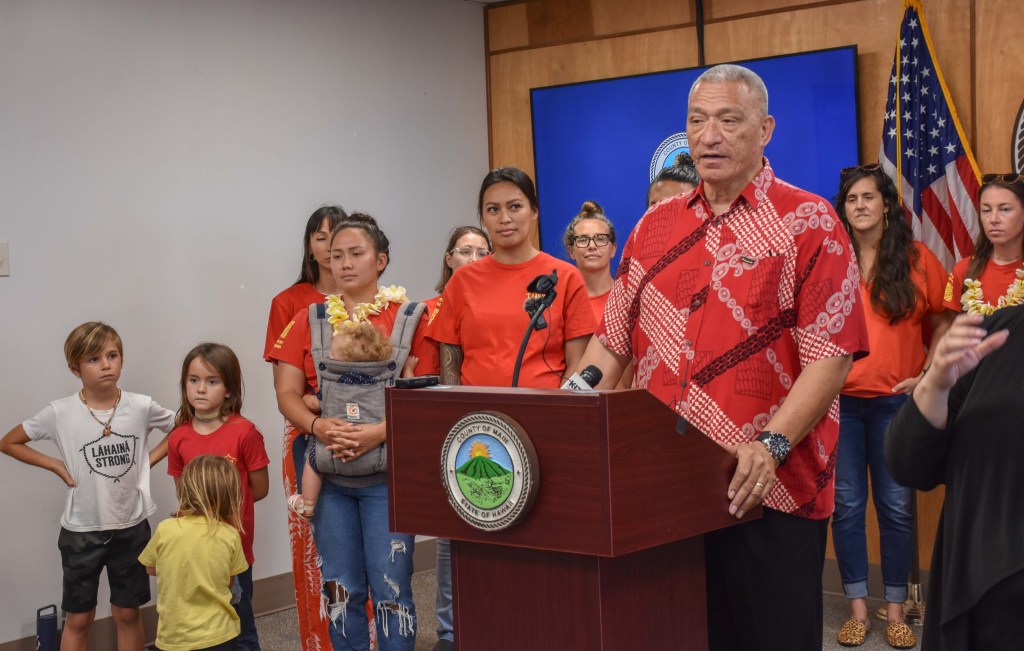
The “bold step” is necessary to create urgently needed long-term housing for displaced wildfire survivors and to increase inventory for residents across the county, Bissen announced at a news conference Thursday.
He was flanked by leaders of the grassroots organization Lahaina Strong, which has been advocating for “dignified housing” since shortly after the Aug. 8 wildfires killed at least 101 people, destroyed more than 2,100 structures and displaced about 13,000 people.
The mayor’s bill calls for phasing out and repealing transient vacation rentals in the apartment districts, referred to as the Minatoya list.
In 2001, the late Richard Minatoya, then deputy corporation counsel for the county, wrote a legal opinion saying that if condos were built before 1992 and were already being utilized for short-term rentals approved by their respective condo associations, they could be grandfathered in and continue to be used for short-term rentals — fewer than 180 days — with a permit from the county or state as long as that type of use was not stopped for more than 12 consecutive months.
If Bissen’s proposed bill becomes law, of the 7,167 units on the current Minatoya list, the approximately 2,200 that are in West Maui would no longer be able to operate as short-term rentals starting July 1, 2025. The remaining units on the list would have until Jan. 1, 2026.
“We cannot wait as more families uproot and move away,” said Maui County council member Keani Rawlins-Fernandez, who for years has passionately advocated for the reduction of vacation rentals. “We must take immediate action now to correct the injustice of commodifying our apartment units the county has attempted to address since the ’80s.”
Because the bill would change zoning on three of the islands that make up Maui County, it must first be presented to the planning commissions on Maui, Molokai and Lanai. The commissions’ recommendations are expected to then be consolidated before being presented to the council’s Housing and Land Use Committee, chaired by Tasha Kama. From there, it would go before the full nine-member council for a vote.
The Maui Planning Commission plans to be the first to discuss the bill and hear from the public on June 25.
County Planning Director Kate Blystone said this commission meeting will be held in the council chambers to provide more space for people to attend in person and testify.
“We anticipated it was going to be a big deal,” she said.

Maui was dealing with a housing crisis long before the wildfires exacerbated the problem of a lack of affordable long-term rentals, with the median cost of a house exceeding $1 million. But there will be many ramifications of removing more than 7,000 short-term rentals in just over 1.5 years.
These include the potential loss of jobs, loss of property tax revenue, fewer tourist dollars, disruption to the real estate market and the high likelihood of lawsuits.
Bissen conceded there will be some “economic fallout.”
“We understand that there’s going to be a give and take,” he said. “So the question is what is most important? And our priority is housing our local residents, especially now.”
Property owners of units on the Minatoya list will be forced to either convert to a long-term rental, live in it as their primary residence, make it their second home, sell or sue.
Bissen, a former judge, said he expects there will be lawsuits.
“That’s why it hasn’t been done all this time,” he said. “That’s why it’s been sitting and sort of festering. It hasn’t gotten better and it’s not going to get better. Now is our best opportunity because we need it now.”
He said now is a good time because the state law will help make the county’s actions more defensible.
The Legislature on Wednesday passed a bill by a huge margin that clarifies “the counties’ authority to regulate the time, place, manner, and duration in which uses of land and structures may take place.” It specifically includes a provision allowing the counties to phase out certain short-term rentals.
Gov. Josh Green said Wednesday after the groundbreaking for a 450-unit temporary complex for fire survivors in Lahaina that “if we succeed on reducing the number of short-term rentals, then a lot of these housing problems will be much smaller.” He plans to sign the bill Friday.

The governor said the state’s bill will also help with the housing crisis on the other islands.
“We have a short-term rental disaster in our state,” Green said Wednesday. “We have tens of thousands of units that are owned by mainland owners that are reaping in incredible profits here from our people. And that has to be scaled back.”
He said there are an estimated 89,000 short-term rentals across the state, of which “75,000 of them are questionable as to whether we should have them.”
“And so hopefully tens of thousands of those units will be right back into our market way faster than building,” he said.
Rawlins-Fernandez said she expects there will be “hours of testimony” about the county’s bill, as there was over the state legislation on short-term rentals earlier this year.
“Consistently, the argument was about protecting their investment properties — their second, third, fourth, fifth home — when our residents have lost their only home,” she said.
Regarding the loss of jobs for people who support the units, including housekeepers, maintenance workers and property managers, Rawlins-Fernandez said: “They can’t clean these condos, these STRs, the hotels if they don’t have somewhere to rest their head at night. And that’s what we’re doing.”
Green said he hopes the potential of more long-term housing inventory also will reduce skyrocketing rents. That is one reason he said he is signing the bill into law this week instead of waiting until July like he normally would do.
“I want the mayors to be able to start moving,” he said. “I just think we can’t wait.”

If the county’s bill becomes a reality, no one is sure exactly how it will play out. But it is clear there will be significant lost revenue.
According to the Maui Vacation Rental Association, there are about 13,000 units getting taxed at the short-term rental rate. This includes approximately 200 legal short-term rental homes, 160 bed and breakfast operations, 6,700 rental condos on the legal short-term occupancy list and more condos in hotel-zoned areas that can operate short term.
The estimated property tax revenue for fiscal year 2025, which starts July 1, that would come from short-term rentals is $246.3 million. This makes up 42% of the overall property tax revenue — by far the biggest chunk — despite representing only 25% of the overall real estate value.
Long-term rentals and apartments for fiscal year 2025 are estimated to make up 3.9% of the total property value of Maui County, contributing only 1.9% of the total property tax revenue.
Josiah Nishita, head of Maui’s Office of Recovery, said the county is estimated to lose about $30 million in tax revenue with conversions of the short-term rentals to another tax category.
While this will be an annual loss going forward, some of it will be offset in the short term when the $15 million to $20 million worth of long-term rental exemptions provided during this fire emergency period end.
“There are impacts if we don’t do this and there are impacts if we do do this,” Bissen said. “And we’re willing to accept the results of the impacts of doing this.”
The bill does not address illegal vacation rentals. Blystone said enforcement efforts will continue as they are now on a “complaint-based system.”
Rawlins-Fernandez said about two to three years ago the Maui Planning Department worked with Airbnb to ensure that only permitted properties were on its platform and about 3,000 ads were flagged at the time.

Lahaina Strong says the state legislation is a big victory that the members had sought when they began their “Fishing for Housing” campaign in November on Kaanapali Beach.
Paele Kiakona said the organization occupied the beach in the “heart of West Maui’s tourism industry to bring awareness to the fire survivors’ dire need for long-term dignified housing.”
“As we pushed through those days on the beach, we realized that this issue needed to be dealt with for the future generations of not just Lahaina, but all of Hawaii in mind,” he said. “As Lahaina Strong, we rallied hundreds, if not thousands to support the efforts to take action against the entirety of the short-term rental industry.”
Kiakona said the organization is ending its 175-day occupation of the beach as a result of the state bill’s passage.
“We now call on the Maui planning commissions and the Maui County Council to immediately support this critical bill,” he said.
Civil Beat’s coverage of Maui County is supported in part by a grant from the Nuestro Futuro Foundation.

