

The Miske Trial: Witnesses Describe Bank Transactions
“Structuring” can be evidence of a racketeering conspiracy, the first and overarching charge against Mike Miske.
Editor’s note: This article was originally published on Ian’s Lind’s blog, iLind.net. It is being reprinted with the author’s permission.
Several witnesses testifying this past week in the racketeering trial of former Honolulu business owner Michael J. Miske Jr. focused on bank transactions that appeared to be “structured” to avoid the banks’ mandatory reporting of cash transactions over a $10,000 threshold.
Banks have been required to report customer’s large cash transactions since the passage of the Bank Secrecy Act in 1970. The law, and the reporting it requires, are designed to “deter and detect money laundering, terrorist financing and other criminal acts and the misuse of our nation’s financial institutions,” according to a summary of the law by the Comptroller of the Currency.

The Bank Secrecy Act requires financial institutions to file reports of all cash transactions exceeding $10,000, and to also report “suspicious activity,” including deliberate attempts to avoid the reporting requirement by “structuring” transactions into amounts that stay under the $10,000 limit.
Although cash transactions over $10,000 are not illegal, incident reports can raise “red flags” for investigators focused on money laundering and related criminal activities, like drug trafficking.
From the federal government’s Financial Crimes Enforcement Network (FinCen):
Can I break up my currency transactions into multiple, smaller amounts to avoid being reported to the government?
No. This is called “structuring.” Federal law makes it a crime to break up transactions into smaller amounts for the purpose of evading the CTR reporting requirement and this may lead to a required disclosure from the financial institution to the government. Structuring transactions to prevent a CTR from being reported can result in imprisonment for not more than five years and/or a fine of up to $250,000. If structuring involves more than $100,000 in a twelve month period or is performed while violating another law of the United States, the penalty is doubled.
Shortly before Miske and 10 initial co-defendants were indicted in July 2020, affidavits filed in support of applications for search warrants indicated Miske was being investigated for the crime of illegal structuring, in violation of 31 U.S.C. § 5324.
Ultimately, he was not charged with structuring, but it is one of a long laundry list of crimes that can be evidence of a racketeering conspiracy, the first and overarching charge against Miske.
None of this background information was provided to the jury when prosecutors began calling a series of witnesses focused on “structuring.”
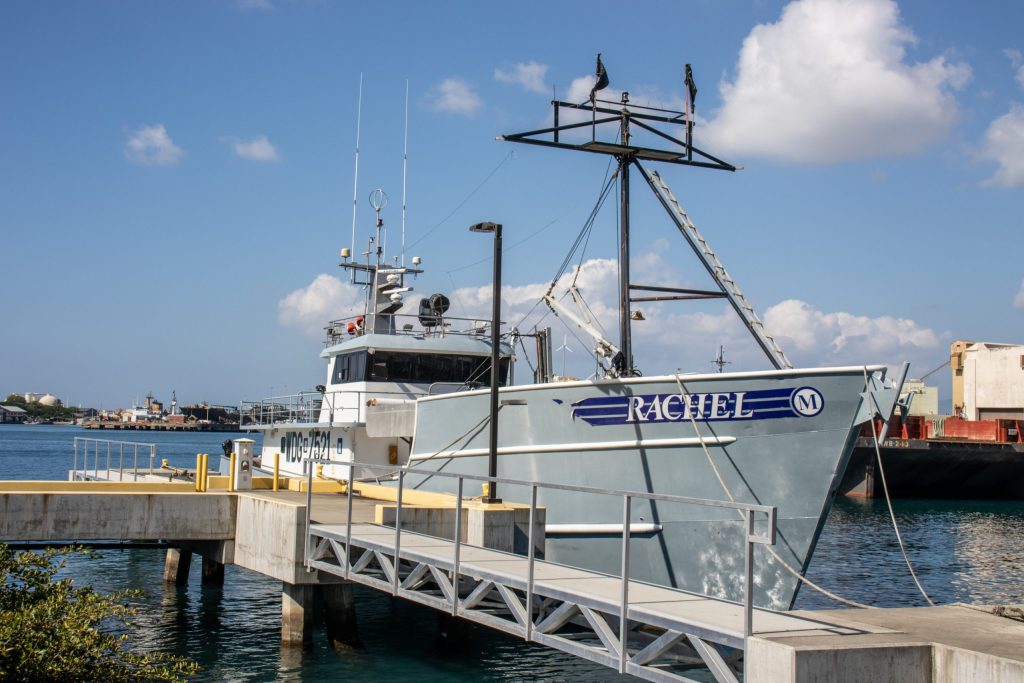
Several current and former employees of First Hawaiian Bank testified on Tuesday about situations in which Miske, or representatives of his companies, attempted to cash what they said were multiple paychecks for employees of the fishing vessel “Rachel.” These were foreign citizens who were not allowed to leave the boat when it was in port in Honolulu.
In each of the situations described, the bank tellers said they told Miske or his representatives that their checks totaled more than $10,000 and would require the bank to submit a CTR, or Currency Transaction Report. In each case, the person seeking to cash the checks then removed one or more checks so that the immediate transaction would be below the reporting threshold.
The first transaction identified by prosecutors took place in January 2011, soon after one of Miske’s companies, Kamaaina Holdings LLC, had purchased the “Rachel.” Jason Yokoyama, who was known to the bank at that time as Miske’s “assistant,” wanted to cash four checks. When told that the total exceeded $10,000 and would require the bank to submit a CTR, Yokoyama removed one the checks, and reportedly said Miske would come later to cash the last one, keeping the total under $10,000.
Yokoyama was one of the co-defendants named in the third superseding Miske indictment. He pleaded guilty in December to wire fraud, and admitted skimming cash from Miske’s M nightclub, and turning the cash over to Miske each week. The weekly deliveries of cash sometimes exceeded $10,000, according to Yokoyama’s plea agreement.
Another FHB employee described a similar transaction on March 12, 2012, also at the Ward Branch.
She described the situation in an incident report:
Office manager for Kamaaina Holdings (Andrea Kaneakua) came in to cash their employees checks totaling $9404.45. Usually the owner Michael Miske comes in to cash the checks. They do this because the checks are payable to employees who are not allowed to leave the fishing boat. The owner claims he cashes their checks and repays them. Checks were payable to (Ratu Dokanivalu $4349.76, Raymon Samola $3879.81, and Shar Tua $1174.88). She mentioned she had more checks but they were not small enough to keep under the 10K threshold for reporting. She took the cash all in large bills.
Kaneakua is considered an unindicted co-conspirator in this racketeering case. She is a longtime employee and as well as one of Miske’s girlfriends who resided with him over a number of years. The government has filed a notice that it intends to call Kaneakua to testify as a hostile witness, along with several other women Miske had been involved with.
Another transaction by Miske the following year was deemed suspicious, and the incident report noted: “Investigation Worthwhile.” The teller reported being concerned that it “felt suspicious” because the total was $9,787.39, just below the CTR threshold. In addition, she reported that after getting approval to cash the checks, she asked Miske if he wanted the money separately for each employee. She said Miske declined, telling her to “just put it all together.”
A third similar report was filed February 3, 2014:
Andrea Kaneakua, office manager came in to cash their employees’ checks. She only cashed 7 of the checks she had. Andrea kept the total below $10,000 to avoid filing a CTR. She said she will be back later to cash the rest.
During cross examination, Miske’s attorneys displayed bank statements which listed each check cashed on a separate line, and tried to get witnesses to agree that they were therefore separate transactions, even if presented together at the same time. The bank employees, however, were firm that multiple checks presented at the same time were considered by the bank to be part of a single transaction.
The government then called IRS Special Agent Bennett Strickland, an expert in the field of financial investigations. Strickland testified the incident reports from banks are used as leads that can suggest further avenues of investigation.
In the case of Miske’s companies, Strickland said he had examined transactions between 2011 and 2014, and had found “a pattern of structuring” involving Kamaaina Holdings LLC. He found there had been 12 pay periods during which payroll checks totaled more than $10,000, but those were presented to the bank in 29 transactions, with only one exceeding $10,000.
A chart Strickland prepared was introduced into evidence as Exhibit 1-1024.

