This Alternative Method Of Demolishing Structures Could Help Honolulu Avoid A Landfill Crisis
Honolulu is considering how to promote deconstruction and re-use of the materials from buildings that are being torn down, an idea that has already caught on in other cities.
When Kilauea erupted in 2018, thousands of earthquakes struck Hawaii Volcanoes National Park and irreparably damaged its Jaggar Museum.
Its foundation was cracked, and the caldera edge it’s built on was damaged. For six years it sat closed until work began to remove it last month.
But instead of excavators and wrecking balls demolishing the museum and sending the debris to a landfill, contractor Re-Use Hawaii is carefully deconstructing it with the hope of its materials being used again in future projects.
“Essentially what we do is look at how the building was built and approach in the opposite order,” Re-Use Hawaii executive director Quinn Vittum said.
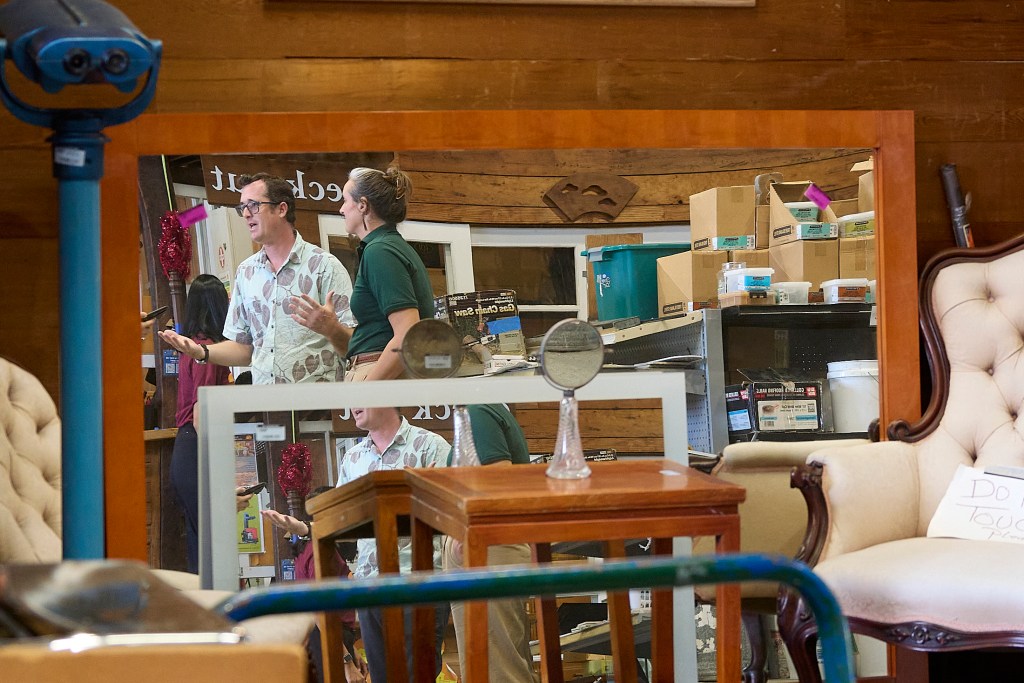
The materials that would ordinarily be sent to a landfill are diverted to one of Re-Use Hawaii’s redistribution sites, where customers can buy second-hand materials like lumber and windows for their own projects.
The idea of recycling buildings is gaining momentum in Honolulu, where the question of what to do with construction and demolition waste has become more pressing in the run-up to the island’s two landfills closing.
One potential solution is to promote deconstruction, according to a recent draft final report from the city’s Source Reduction Working Group.
Other cities like San Antonio and Portland, Oregon, have ordinances that mandate deconstruction in certain cases. But something like that is probably years away for Honolulu.
In the meantime, the city plans to pilot a recycling program at its Kailua waste transfer station this fall that partners with Re-Use Hawaii so that materials can be brought to its warehouse in Kakaako rather than trucked to the landfill in Nanakuli.
At the Jaggar Museum, like at their other project sites, interior items went first. Doors and windows were dismantled and loaded for shipment back to the Kakaako warehouse, since a project that large yields more material than could be sold from the Kona yard. Now workers are taking apart the metal roof.
“Then there’s usually a sub-roof, and then underneath that there’s rafters. Then we get to the ceiling joist, and go on from there,” Vittum said.
‘This Is Our Biggest Problem’
Deconstruction advocates often frame it as a way to promote a circular economy, where discarded goods can be used again by somebody else.
In their warehouse in Kakaako, Re-Use Hawaii’s in-house craftsman Philipp Ziegler pointed to a piece of lumber that was once part of a house they deconstructed in Manoa.
“It’s trash, but it turns into treasure. For some people there’s value to it,” he said.
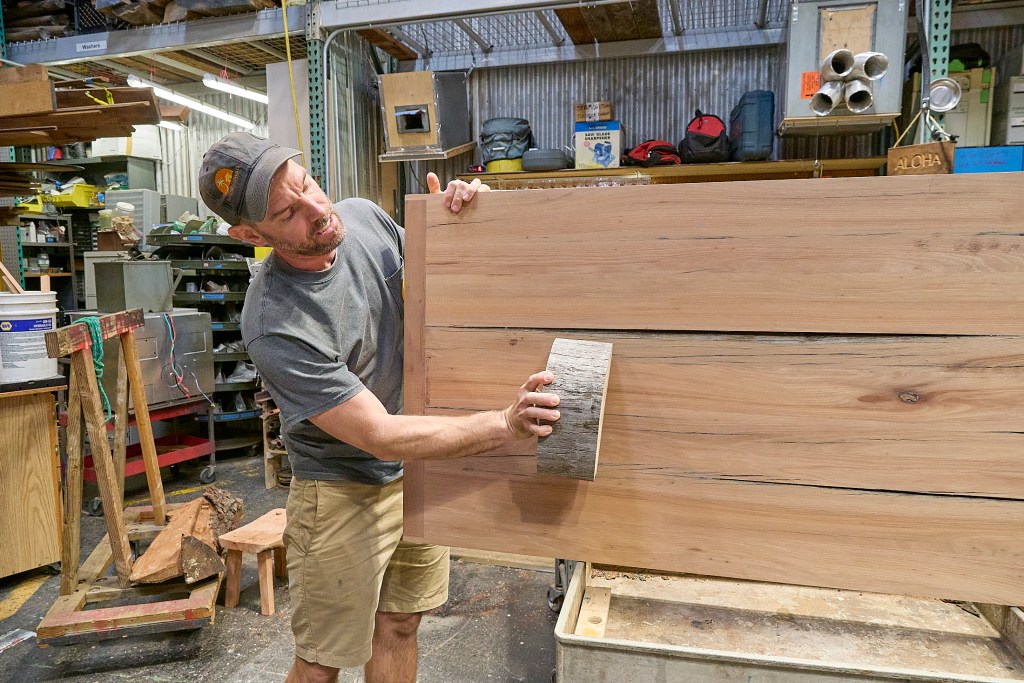
Re-Use Hawaii’s redistribution centers are in Hawaii, avoiding the need to ship to large processors.
Customers can buy materials that in previous lives were used in ordinary houses like the one in Manoa or in bigger facilities like the Jaggar Museum.
Vittum started Re-Use Hawaii as a nonprofit in 2006. The company typically handles between 40 and 80 deconstruction projects each year.
Its model has attracted Honolulu officials eager to reduce the amount of waste going into the city’s two landfills.
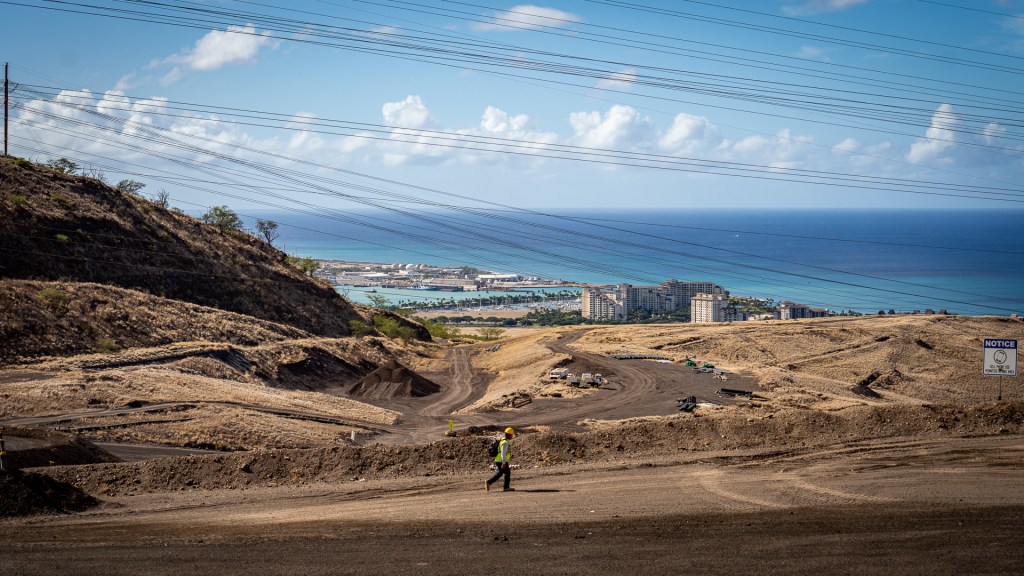
The city’s municipal landfill is scheduled to close in 2028, according to its permit. But finding a new site for the landfill has proven to be a challenge.
While the current location has the capacity to keep taking trash until about 2036, that cushion will diminish when the island’s other landfill closes.
PVT Landfill is privately owned and specifically devoted to construction and demolition waste. Its upcoming closure will mean that all of the waste it was taking will become the city’s responsibility, Department of Environmental Services Deputy Director Michael O’Keefe said.
“When PVT closes, that essentially doubles the amount of material by weight that we would have to take in to a city landfill. So it’s no small thing,” O’Keefe said.
O’Keefe said the city has heard that PVT Landfill will close in three to eight years. PVT Landfill did not respond to a request for comment.
Whatever the case, the city convened a Source Reduction Working Group in 2023 to discuss over the course of a year how to reduce waste heading toward its landfills. Vittum was appointed as a member.
Among other recommendations — like subsidizing shipping to the mainland to recycle solar panels and reducing food waste by promoting food donations — implementing a deconstruction ordinance emerged as a top priority.
O’Keefe said his interest in construction and demolition waste was “just because of the order of magnitude … This is our biggest problem.”

Other cities like San Antonio and Portland, Oregon, recently started requiring deconstruction in certain cases, with exemptions for things like unsafe structures.
Portland requires it for houses and duplexes built before 1940 or that are designated historic resources. The work must be done by a certified deconstruction contractor. The city lists the contact information for certified contractors on its website.
San Antonio requires deconstruction for all residential structures up to the size of fourplexes built before 1921, or for structures of this type built before 1946 that are designated historic or are in a Neighborhood Conservation District.
Each city places a special emphasis on preservation, seeing the salvaged materials as one way of honoring history. In San Antonio, the deconstruction requirement was spearheaded by its Office of Historic Preservation, which now oversees the program.
That kind of coalition-building hasn’t happened yet in Honolulu, where the conversation is still mostly about sustainability and promoting a circular economy.
Gradual Implementation
Practically, an ordinance requiring deconstruction is still a long way off. Vittum and O’Keefe think getting a foot in the door, like a report on where demolition debris goes, is the most realistic first step.
The Portland City Council unanimously approved the requirement in 2016, but the original cutoff date was for houses built before 1916 before the pool was widened a few years later to houses built before 1940.
In Hawaii, Rep. Nicole Lowen and Sen. Maile Shimabukuro introduced legislation this year.
They wanted to require state and county governments to prioritize projects in the competitive bidding process that recycle their construction and demolition material or use recycled materials.
But each bill only received one hearing, effectively killing them. Testimony from organizations such as the Building Industry Association of Hawaii showed that while people appreciated the sentiment, they worried about the cost.
“Deconstruction of an existing structure to divert materials from the landfill is quite costly as it requires a significant amount of manual labor. For owners who can afford it, it’s their decision to do it for the greater good; however, for owners who can’t afford it, the work will not get done because it costs too much to deconstruct,” BIA communications director Holly Kessler said in an emailed statement.
Vittum estimated that while a traditional demolition of the Jaggar Museum would take about three weeks, deconstruction will take about four months.
For now, Vittum is hoping to inch the idea forward.
Eight years after Portland’s mandate was passed, its webpage of certified contractors lists 16 options for the public to choose from.
Already, Honolulu’s elected officials seem open to promoting more redistribution of discarded materials.
The city’s pilot program of recycling the material brought to its transfer stations is being finalized now, O’Keefe said, and Re-Use Hawaii will likely be the vendor to run it. The Honolulu City Council unanimously gave its blessing last year.