US Supreme Court Ruling Gives City More Leeway In Removing Homeless Encampments
The ruling gets rid of a key constitutional protection that homelessness advocates had been using to contest municipal laws they said were too harsh on homeless people.
Hawaii may have more leeway to pass laws removing homeless people from sidewalks and other public spaces following a U.S. Supreme Court ruling Friday.
The ruling comes out of the small Oregon town of Grants Pass, which bans outdoor camping on public property. Homeless repeatedly cited for sleeping in public spaces in the town can face a jail sentence of up to 30 days. Opponents of the ban say that it unconstitutionally targets homeless people, but the Supreme Court’s ruling allows the town to maintain the ban.
Municipalities around the country can now enact stricter laws, which supporters of the decision said gives the City and County of Honolulu one more tool for keeping the sidewalks clear.
“We were pleased with the outcome of this decision,” deputy corporation counsel Ernest Nomura said.
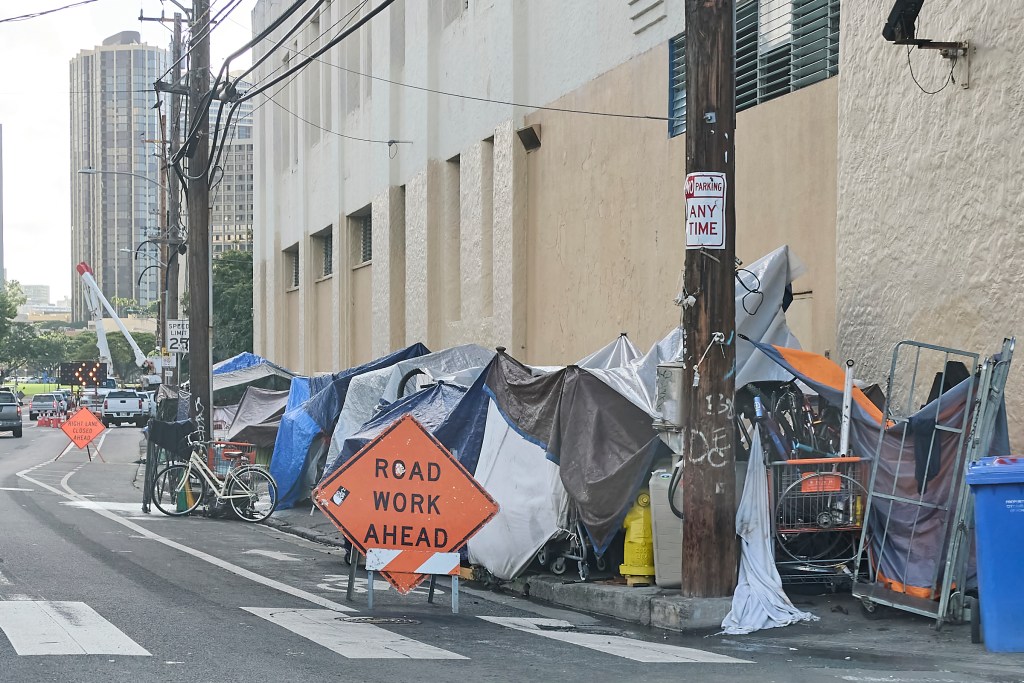
The city struggles to balance keeping the sidewalks clear with respecting the constitutional rights of homeless people who may have nowhere else to go. Tents and shopping carts block the sidewalk in some areas of Honolulu, making it difficult to get by.
Enforcement won’t change overnight as a result of the decision. But the ruling means that council members could pass stricter laws policing homelessness.
One possibility is that council members could expand the hours of the city’s sit-lie ban, which makes it illegal to sit or lie in certain commercial areas of Honolulu between 5 a.m. and 11 p.m.
“The legal concerns that motivate, for example, City Council, to limit the scope of sit-lie are lesser,” American Civil Liberties Union Legal Director Wookie Kim said.
Opponents to such bans often point to the Eighth Amendment’s prohibition against cruel and unusual punishment. They say that criminalizing activities such as outdoor camping with fines and jail time essentially criminalizes being homeless.
But that’s not cruel and unusual, according to Friday’s ruling on 6-3 vote along ideological lines. The majority opinion, authored by Justice Neil Gorsuch, says that cruel and unusual punishment is more about how somebody is punished than whether they are punished at all.
That’s a blow to homeless advocacy groups that use the Eighth Amendment to contest municipal policies they say target homeless people.
The ACLU is currently suing the city over its sit-lie laws. In January a judge rejected the group’s demand that the city halt enforcement. Kim said that while the Eighth Amendment was previously a key legal tool for advocates against laws like this, there are still other tools, including Hawaii’s constitution.
Partners in Care executive director Laura Thielen said that governments should tackle homelessness by giving more resources to social workers and psychiatrists and by not relying too much on shelters, many of which are at or close to capacity.
“The shelters are not a replacement for housing,” she said.
John Mizuno, the state’s homelessness coordinator, made a similar point in a statement he issued following the Supreme Court’s ruling.
“Governor Green believes that sweeping houseless individuals without providing housing or safe options is disruptive and unsustainable. Low-barrier housing, like kauhale tiny home villages, can address this by offering a home and a safe place for those facing housing instability,” he said.
Council member Tyler Dos Santos-Tam, who introduced the council’s latest expansion of its sit-lie law into Kapalama, supported the Supreme Court’s decision and said that it gives municipalities more control over how they handle homelessness.
“I think the public understands that we need every tool available,” he said.