How A Human Bone Collection in Honolulu Aids Forensic Anthropology in Asia
Taking advantage of Hawaii’s diverse population, scientists have built the state’s first known-identity human osteological lab.
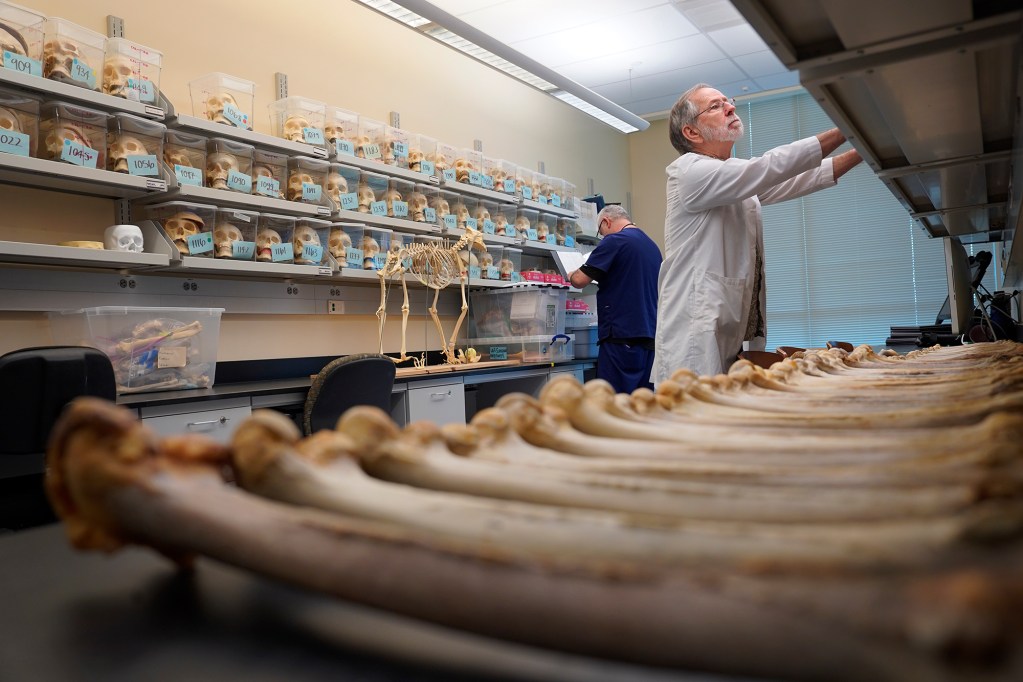
Rows of human skulls are neatly organized on wall-mounted shelves, each placed in a number-labeled clear container, in a lab at the University of Hawaii’s John A. Burns School of Medicine.
Other bones are placed throughout the room, from robust femurs lined up on a table beneath the shelves to finely pulverized cremains – human ashes – contained in hand-sized plastic bags next to a microscope.
A full-body skeleton lies on the biggest table as part of forensic anthropologist Robert Mann’s new study. He refers to the specimens as “silent teachers.”
These are among the remains of about 350 Hawaii residents that were donated to the university. For eight years at the JABSOM Bone Lab, Mann, along with UH Willed Body Program Director Steven Labrash, has amassed a human osteological collection that represents the population of the islands.
Collected in the state with the greatest racial and ethnic diversity, it encompasses a wide array of samples of Asians and Pacific Islanders — groups largely underrepresented in American medical research.
“This is a really diverse collection,” Mann said, as he looked at the list of ethnicities represented in his collection spanning from Okinawan to Native Hawaiian.
The collection allows researchers from Asia to literally get hands-on experience with bones from various Asian ancestries through a single visit to the state conveniently located closer to the Far East than the mainland is.
Mann’s lifelong dedication is helping those whose job is to identify and discover bodies — from just-perished victims in a catastrophic fire to centuries-old remains among the ruins of Pompeii — and trace the tiniest marks on their bones to unearth details about their lives. Thanks to Hawaii’s ancestral diversity, his collection is applicable to cases around the world.
‘You Ought To See What They Can Do With Human Bones’
Mann’s interest in forensic anthropology began as an archaeology student at the College of William & Mary in Virginia, where he learned how to do excavations — numbering potsherds and ancient bricks.
He wanted to be a classical archaeologist, “Indiana Jones-kind-of-stuff before Indiana Jones came out,” he said.
But his career trajectory shifted when he was approached by a colleague who showed him a piece of bone.
“Somebody came in and showed me a bone, asking, ‘You know what this is?’”
While he knew that it was from a turkey, which he recognized from past Thanksgiving dinners, he was fascinated that the bone itself contained far more history about the bird – including its age and gender.
“If you think this is cool, you ought to see what they can do with human remains,” the colleague said.

This sparked his interest in human osteology. Learning that he had a good eye for bones, Mann went on to study at the University of Tennessee, Knoxville, where the first “body farm,” or forensic anthropology center, was set up.
For Mann, tracking life history postmortem was fascinating, leading to a lifetime of forensic anthropology.
“You’re never going to know who these people are, but you’re going to be able to figure out what they did,” Mann said. “And that was enough for me.”
Throughout his career at the University of Tennessee, Knoxville, the Smithsonian Institution and Hawaii’s Hickam Air Force Base, among other places, Mann worked on projects ranging from studying decomposition to recovering and identifying missing American service members from conflicts in Southeast Asia.
After three decades of government service, the last few years in Hawaii, he launched his “post-retirement” project at JABSOM to build this osteological collection. He realized that, while Hawaii’s population was “like nowhere else in the world,” the state did not have a known-identity collection that represents this diversity. Before Mann and Labrash’s venture, JABSOM had held around 75 skulls of unknown histories.
Ethnic Transparency
Through the university’s body donation program, the duo was able to select diverse individuals who had offered to someday donate their remains for Hawaii’s science.
The Willed Body Program has been hugely successful. Labrash, who has worked in the program for 35 years, says part of the credit goes to the university’s unique memorial services.
JABSOM annually holds a memorial service for families of donors, where students perform the hula and give speeches to show their appreciation.
“The families come and hear the students talking, and they got the crackly voice,” Labrash said. “They’re nervous, but the appreciation comes through. You can’t fake appreciation.”
While the university received about 35 bodies yearly two decades ago, by 2020 it was receiving nearly 200 donations every year. Since the pandemic, the program was closed twice for half-year stints as restrictions on travel and social gatherings proscribed foreign surgeons and medical students from training at JABSOM.
When the program reopened this year, Labrash said he saw an explosion of applicants.
“That’s when we decided we need to make some adjustments,” he said.

Now the program has imposed a weight limit for new donors, which reduced applications by about 10%. In addition, all donors must now self-enroll, meaning that their family members cannot sign them up.
When Hawaii residents fill out the application, they self-report all ethnicities they identify with, instead of picking one or two dominant racial affiliations.
This has allowed the team to precisely categorize and track ancestry, which can easily get complicated in a state where a quarter of the population is multiracial, according to the Department of Business, Economic Development & Tourism’s census data.
It has also allowed Mann to resolve a deep-rooted malpractice in American medical research: the often-negligent aggregation of Asians as a single-race category.
“It is really fascinating to see how people self-report and what their DNA is showing,” Mann said. He has noticed a myriad of unique characteristics discoverable in specific ethnic groups.
Nilay Shah, an assistant professor at Northwestern University’s Feinberg School of Medicine who researches Asian American representation in medical studies, said self-identification lets Asian immigrants be represented the way they truly identify ethnically.
“If you ask someone to self-identify, it is a complex and multifaceted response that may not have a single answer,” Shah said. “The motivation for recommending self-identification is to represent people the best way that we can.”
A Hub For Asian Bone Study
The volume and diversity of known Asian identities in this collection, along with a granular categorization of its specimens into individual ethnicities, have attracted forensic researchers and surgeons from Asia to Honolulu to study the Mann-Labrash Osteological Collection.
There are about 150 osteological collections around the world, only nine of which are in Asia, according to the Forensic Anthropology Society of Europe. As most universities and researchers amass their samples locally, the collections in Asia are largely homogenous in nature.
“Guess what 99% of individuals in a Thai collection are – they’re Thais, right?” Mann said. “It’s what you would expect when you go to Japan or Korea as well. Wherever it happens to be, samples and collections are very much regional; they’re population-specific.”
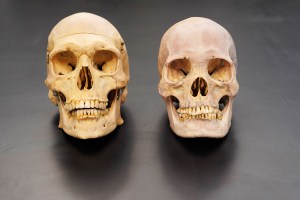

One forensic scientist, Sittiporn Ruengdit from Chiang Mai, Thailand, has worked with Mann throughout the collection’s development to advance this field for Asians. They have studied the impact of thalassemia – an anemia-inducing blood disorder – on a Thai patient’s bones, analyzed various trauma-induced specimens, and recently discovered a new bone feature the size of a fingernail found near the ear canal.
The latest ongoing project includes using about 450 skull samples from Thailand and JABSOM to gauge how reliable a widely used forensic software called FORDISC is for Asian cases.
FORDISC is designed to help classify skeletal samples by ancestry and sex by plugging in a set of measurements. As of now, Mann believes that there is a relative lack of Southeast Asian data, which is why they are also contributing their own information to the FORDISC database in hopes of improving its accuracy.
“One great thing about JABSOM is it has a great variation of samples,” Ruengdit said, “so we can do things like comparison research between our samples and JABSOM’s.”
Comparing local collections to that of Mann’s has helped forensic experts like Ruengdit research subtle osteological differences between multiple Asian ethnicities through a single trip to Honolulu.
Lessons From Mass Disasters
While most of Mann’s specimens are well-preserved bones, some are less recognizable — either fractured in chunks or pulverized like sand.
Mann has participated in various high-profile missions that involved mass casualties. He helped recover and identify victims of a commercial plane crash in Guam that killed over 200 passengers, the 9/11 Pentagon attack, and last year’s Maui wildfire.
Witnessing firsthand the aftermath of these disasters, Mann saw how trauma-induced impacts could alter the condition of bodies, some being reduced to indiscernible forms.
This led him to work on his newest initiative: educating first responders on how to find human remains at disaster sites.
“Should we expect not to find anything at a mass disaster, where there’s been a horrific fire that raged and burned for days? No. We should always expect to find something.” — Robert Mann
Mann said that he had received calls from perplexed first responders saying that they could not find victims who clearly died at a particular spot.
“It’s because they didn’t know what to look for,” Mann said.
Through his works, Mann hopes to help first responders be better equipped for unexpected scenarios they face on scene, helping them identify the many varieties of form human remains can take.
“Should we expect not to find anything at a mass disaster, where there’s been a horrific fire that raged and burned for days? No. We should always expect to find something,” Mann said.
Dealing with intense emotions — realizing for first responders that they may have missed or even stepped on the victims that they were searching for — is an experience that Mann knows all too well and has learned to cope with. He reminds himself that these are important jobs that need to be done for those left behind.
“You never forget a case you work on – never, never, never – and some are much more gruesome than others,” Mann said. “But I think it’s important to realize the whole world isn’t all that. And there’s a time and place to focus on it.”