

The Honolulu Police Chief Just Got A Good Job Review But Many Employees Think Otherwise
The “disconnect” between the police commission and police employees has raised concerns from the police union to the mayor.
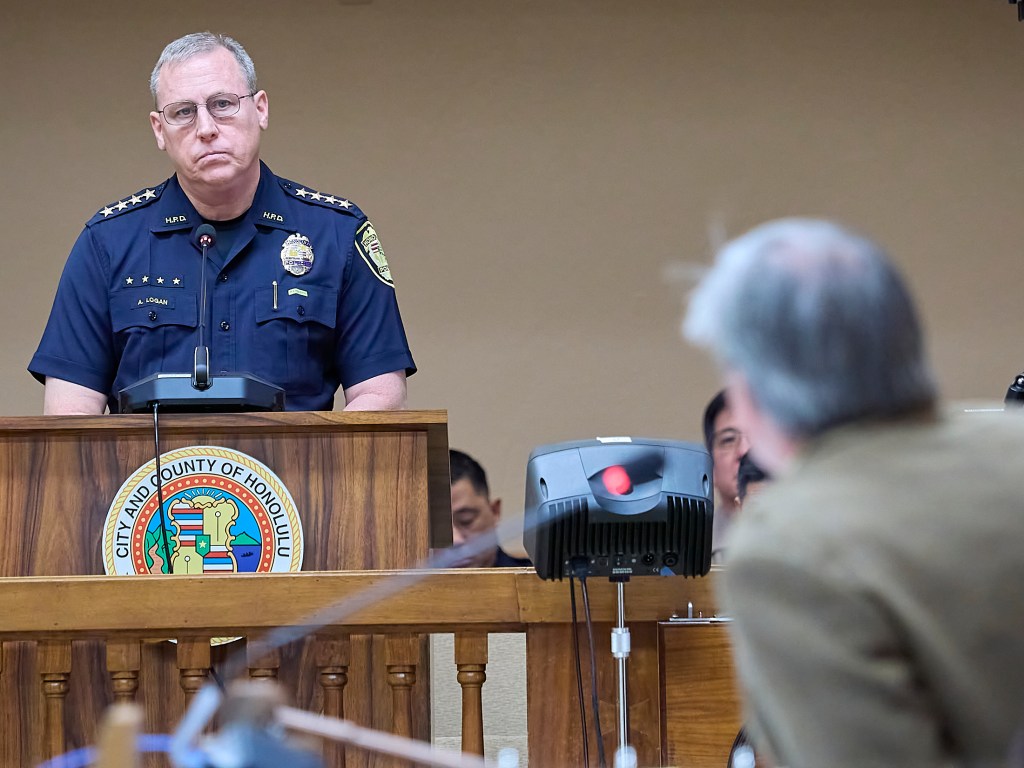
Honolulu Police Chief Joe Logan got good news and bad news last week with a pair of reviews of his leadership more than two years into the job.
An anonymous, internal survey at the HPD exposed serious complaints ranging from poor communication by leadership to outdated equipment and even a need for some officers to buy their own uniforms.
That was released Friday, two days after Logan got an overwhelmingly positive annual evaluation from the Honolulu Police Commission, which oversees the position.
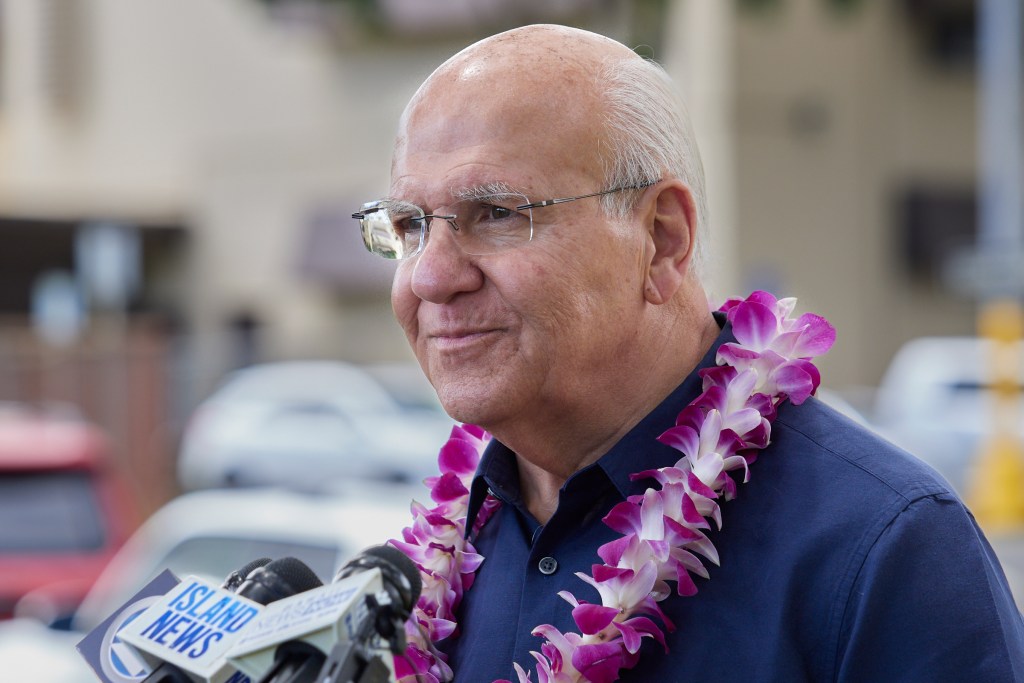
Mayor Rick Blangiardi, who has long been critical of Logan, said the conflicting results “represented a disconnect.”
The mayor appoints members to the police commission but cannot hire or fire a police chief.
Logan has enjoyed a good relationship with the police commission but has struggled to build trust among the ranks since he took the reins of the Honolulu Police Department in June 2022, inheriting a scandal-ridden department that was plagued by a serious staffing shortage and a series of high-profile shootings. He also has faced criticism over communication failures with the media and the public.
Conflicting Results
While the police commission praised him for recruitment efforts and initiatives to change the culture of the department, many officers and civilian employees said they weren’t feeling it on the ground.
“I don’t know how we’re functioning,” said Linda Gouveia, who believes morale and working conditions are the worst they’ve ever been in her 32-year career as a dispatcher. The survey responses were anonymous, but Gouveia and others elaborated on their concerns during interviews with Civil Beat.
Gouveia, who said she was one of the survey respondents, told Civil Beat dispatchers are now mandated to stay four hours past the end of their shifts at least three days a week and some have worked 24 hours straight to help fill vacancies in the division.
“People are getting burnt out, getting sick,” she said.
In an interview on Wednesday, Logan said he has taken the criticism to heart and is committed to making himself more available to staff. He also pointed out that 56% of survey respondents agreed or strongly agreed that management was effective and there were positive comments.
He plans to visit all of the divisions and districts in person more often and wants to create focus groups of different ranks within the department to ensure everyone is being heard.
“I’ve got to do better at coming at all different times and meeting with all of those entities,” he said.
The 15-question survey was not scientific and fewer than 500 people responded — about 370 officers and nearly 100 civilian employees — an overall response rate of just over 22%, according to HPD. It was conducted in March but not made public until Friday.
Some of the anonymous survey participants praised Logan in their comments.
“As a department, I feel that we are so fortunate to have Chief Logan,” one comment says.
“I think the Chief and the Deputies are doing their best to be effective,” reads another.
But many criticized the chief, particularly on what they described as a lack of communication.
“Chief Logan has consistently shown that he doesn’t care to meet with officers, to go out to where officers work to see what we do everyday, or to engage effectively to make changes that would make officers’ jobs and work days easier/more efficient,” one comment reads.
Positive Evaluation
Police Commission Chair Doug Chin said commissioners reviewed the survey results and took them into account when forming their evaluation, but they considered other factors as well.
Overall on the evaluation, commissioners marked “meets expectations” 29 times and “exceeds expectations” eight times. They did not mark “below expectations” in any category but recommended for the second year in a row that Logan improve his department’s communications with the public and the media.
Commissioners interviewed around 10 HPD staff members individually, solicited public testimony about the chief’s performance and discussed whether he was meeting various aspects of his strategic plan, Chin said. In addition, the chair interviewed stakeholders outside the department, including representatives of other law enforcement agencies about their views on Logan.
“I thought that was very important because if there ever is a major catastrophe or a major public safety incident that occurs here on Oahu, it’s pretty important to have a chief that gets along with all these other law enforcement entities,” he said.

Jonathan Frye, the state police union’s Honolulu chapter chair, was one of the survey respondents who was surprised by the police commission’s evaluation.
“When we look at the results of this evaluation it’s pretty clear to us that they weren’t really evaluating or looking at the opinions our officers and other members of the community,” Frye, who is a detective in District 3, which covers the Pearl City area, said Wednesday.
Blangiardi said the commissioners’ evaluation of Logan should have focused more heavily on the thoughts and feelings of internal staff members rather than people outside the department.
“They had a survey, they saw the survey results and they nonetheless … went to outside stakeholders,” he said. “I don’t get that logic.”
Roxanne Nobriga, a dispatcher who’s been with HPD for 35 years, said her survey responses were all negative, so she couldn’t understand why commissioners gave Logan such a positive review.
“I listened to what the police commission did and gave him good grades, and I’m like, how?” she said. “Why isn’t everybody on the same page?”
Concerns About Leadership
Dispatchers were also feeling sidelined by a new policy that requires them to be separated from sworn officers during peer support briefings, Gouveia said. Dispatchers and officers used to attend the briefings all together after critical incidents, such as officer-involved shootings.
“Dispatchers are not part of the department, and that’s how it feels,” she said.
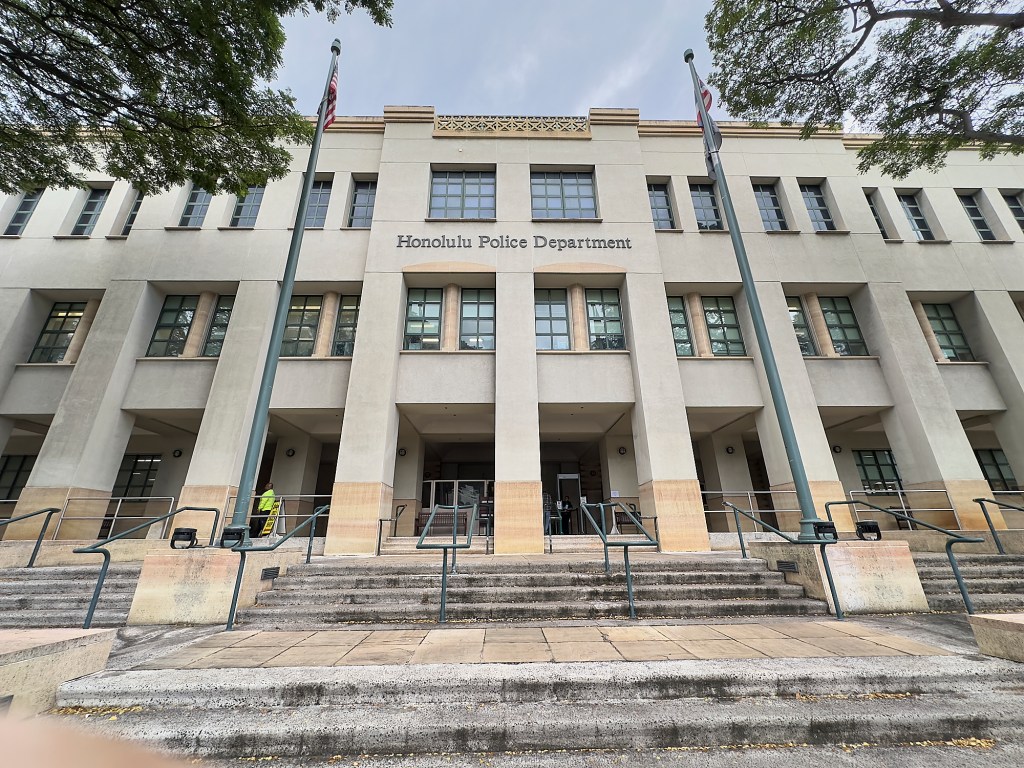
Logan said he’s visited the communications division multiple times. He acknowledged he needs to make more of an effort to see all of his employees when they’re working. He also pledged to make more visits to regional patrol districts that he doesn’t go to as often.
Feeling connected to other members of the department and seeing the chief face-to-face more often would go along way, said Gouveia, who added Logan had only visited dispatchers on her midnight shift once in the last two years. She remembered former Chief Michael Nakamura, who served between 1990 and 1997, and said he would call every employee on their birthday each year.
“These are small, stupid things that don’t even matter, but they make you feel like you’re a part of that family,” she said.
Frye said the feeling of being overworked and under-appreciated extends to sworn officers, too.
Many complained in the survey that the department has been slow to replace outdated equipment, leaving officers feeling like their safety is not being prioritized.
“Just pick any station and take a walk around their upper parking lots, and you’ll see broken and damaged police cars all over the place,” Frye said.
While some specialized divisions get updated equipment, patrol officers feel like they’re getting left behind. For example, in Frye’s district, the long guns and shotguns available for officers are more than 10 years old, he said.
Logan said part of the reason vehicles have been taking so long to replace is because of a nationwide backlog that caused delays at the Ford and Chevrolet dealers the department purchases from.
He also said the department is working on getting other types of equipment replaced, including long guns, but that it takes time to work with finance to put out bids, select a weapons system and find a vendor. He could not say when he expects the guns to be replaced.
“Whatever safety equipment that keeps the officers safe as they do their job in the field, that’s a priority,” he said.
Blangiardi said one of the biggest red flags about the survey for him was the fact that only 22% of the department participated.
“That to me, from a leadership standpoint is not good,” he said.
Frye said one of the reasons for the low participation was a fear among employees that what they said could get back to their managers, even though the survey was anonymous.
“Right now a lot of the men and women on the ground level, they’re not entirely trusting of giving their full opinions, especially in a survey,” he said.
Gouveia said some people in her division also feared retaliation if they gave their honest feedback, while others felt apathetic and didn’t think the survey would lead to any real change.
Logan said the survey was anonymous and he was disturbed to hear that employees would fear retaliation for filling it out.
“I need to get that extracted from our vocabulary,” he said of the word retaliation. “That’s a concern to me that people would feel that way.”
Blangiardi, who met with Logan on Wednesday, said he wants to see better communication from the chief, both with the mayor’s office and HPD staff. Blangiardi said he didn’t know about the survey until members of the police commission told him about it on Aug. 7.
“We have a lot of work to do,” he said. “This is a report card that I’m not happy about.”
Read the survey results below:

