

Convention Highlights New Prominence Of Hawaiian Leadership
This year’s Native Hawaiian Convention focused on how Hawaiians have played a much bigger role in shaping policy.
Native Hawaiians now hold top leadership positions in tourism, Mauna Kea management and recovery efforts in West Maui after wildfires destroyed most of Lahaina in 2023.
It’s a scenario that seemed unlikely just five years ago after decades of Hawaiian-led protests over environmental issues, tourism and development culminated in a standoff on Mauna Kea between law enforcement and activists opposed to the construction of the Thirty Meter Telescope.
There was the sense that Native Hawaiians weren’t given a seat at the table where decisions are made. Now, it seems, they run the show.
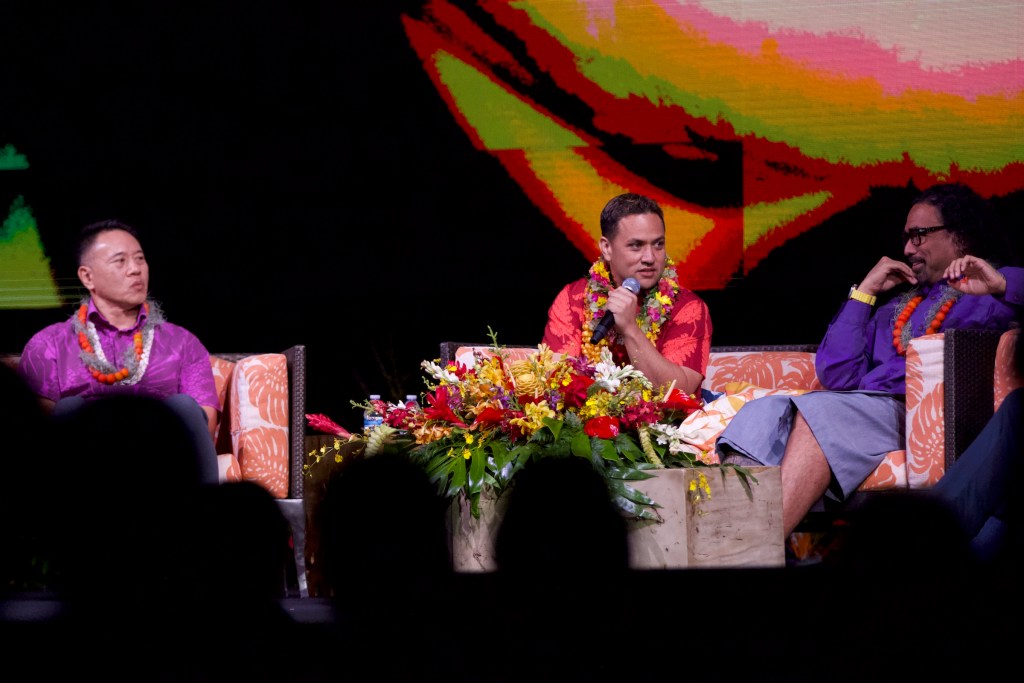
The Council for Native Hawaiian Advancement wrapped up its annual conference at the Hilton Waikoloa on the Big Island last week. It was the largest gathering yet, with more than 2,000 attendees. Panel discussions explored what Native Hawaiian leadership would mean for the future of some of Hawaii’s biggest issues such as tourism and resource management.
While many of those initiatives are just getting started, conference attendees hope that the discussions will lead to a greater focus on caring for the land and its people.
Hawaiians Lead Tourism Agencies
CNHA CEO Kuhio Lewis recalled organizing protests against tourism in Waikiki as a college student.
“We still protesting guys,” he told a packed ballroom Thursday. “We’re just doing it at our computers and in boardrooms.”
Last year, the Hawaii Tourism Authority awarded CNHA a multi-year contract to manage tourism in the islands. The Hawaii Visitors and Convention Bureau won a similar contract to market tourism to the U.S. mainland, a job the bureau has held for the last 100 years.

Those three agencies are now led by Native Hawaiians. There’s Lewis at CNHA; Daniel Nahoopii, president of the HTA; and Aaron Salā, the HVCB president.
The three executives spoke at a panel on Hawaiian leadership in tourism on Thursday focused on weaving cultural education into the tourist experience.
Nahoopii said the HTA needs to balance cultural values with the state’s need for tax revenue from tourism. He also views this moment as a stepping stone to change the business culture of the state.
“We bring with us our Native Hawaiian values and worldview and we’re fusing it into the most predominant industry here in Hawaii,” he said. “If we succeed, we can change Bishop Street. We will change how the banks think, how the other industries here process.”
The CNHA and HCVB are in their first year of the new contracts.
Salā said that the HVCB is undergoing a new strategic planning process for the first time in 15 years. He wants to explore opportunities to utilize artificial intelligence in the tourism industry.
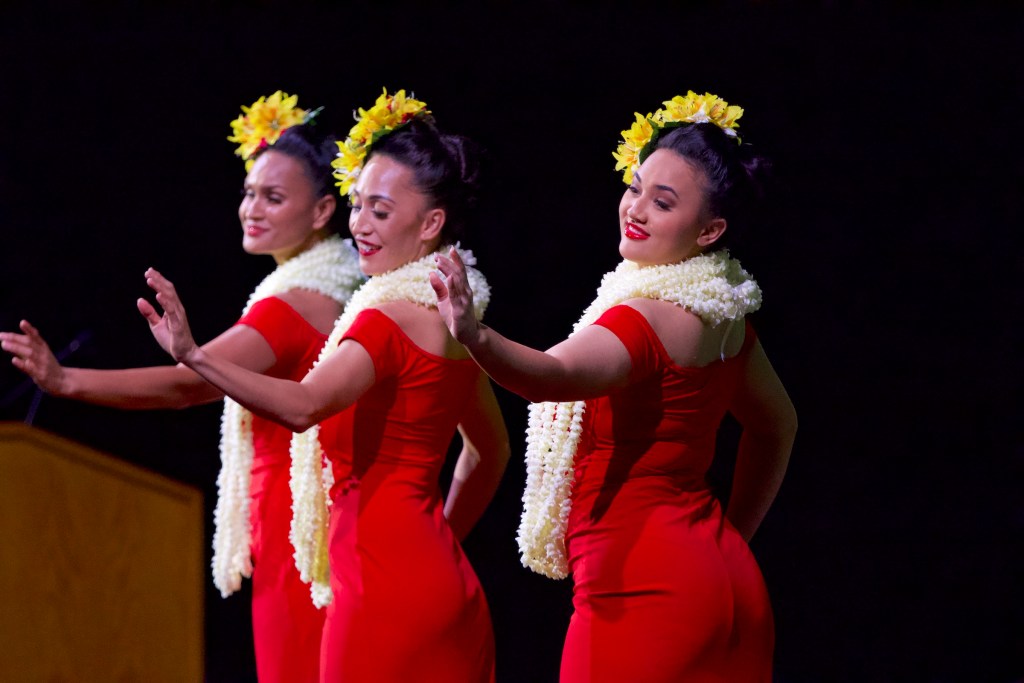
CNHA has restarted the 1950s-era Kodak Hula Show, now rebranded as the Kilohana Hula Show. It’s also started its own hula show, Na Lei Aloha, at the Hyatt Regency in Waikiki.
Lewis said those initiatives and others like them are not part of the HTA contract. But they are part of a pivot in the tourism industry to provide a more genuine cultural experience to visitors.
“These are things that wouldn’t exist if we’re not at the table,” he said. “Everything is still culminating, it’s still figuring itself out.”
Mauna Kea Under New Management
The new Mauna Kea Stewardship and Oversight Authority is also just getting off the ground.
It’s off to a slow start, with meetings filled mostly with status reports before the real work of transferring duties from the University of Hawaii and Department of Land and Natural Resources begins in the coming years. It’s also set to solicit proposals for its management plans for the mountain in October.
The authority is still trying to hire staff and find its own offices and a meeting space. Its current meeting location, in the DLNR forestry division’s Hilo office, is just large enough to fit three rows of tables with a little more than a dozen chairs.

Despite the slow start, Noe Noe Wong-Wilson is surprised the authority exists at all. She was one of 38 kupuna arrested in 2019 while protesting construction of TMT.
“It’s never where I would have gone initially,” Wong-Wilson, a member of the authority, said. “I didn’t think, politically, it would succeed.”
It started differently than most state agencies.
The idea for the authority came from a commission convened by House Speaker Scott Saiki in the aftermath of the 2019 protests that included those for and against the TMT project.
Another major difference from most state boards: A majority of the authority’s members – 8 of 11 – are Native Hawaiian, Wong-Wilson said.
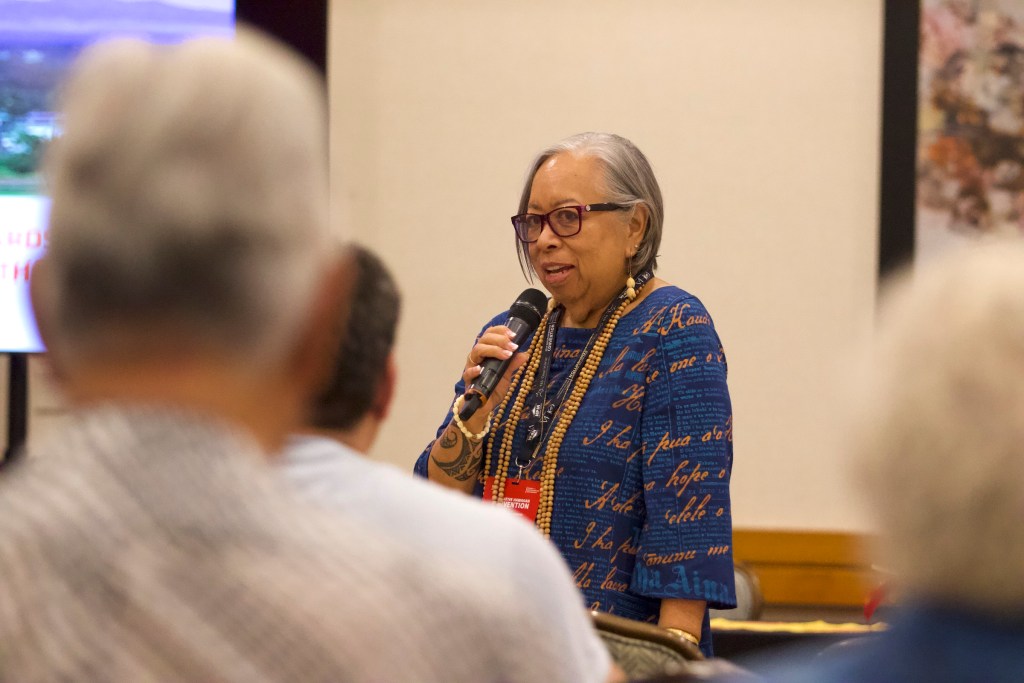
The authority’s new director, John De Fries, is also Hawaiian. During a panel discussion on the future of Mauna Kea Wednesday, Wong-Wilson said that members made a concerted effort to recruit Native Hawaiians to fill seats on the board.
The board has been hosting community meetings to solicit feedback. Ideally, the community will drive the decision-making over Mauna Kea, which Wong-Wilson said is another key difference compared to other state agencies.
“There’s a huge intent that this not only be founded on our cultural principles and understanding of what the mauna means, but that the community has a huge role to play in our formation and in how the mauna gets managed and protected,” she said. “That is not the norm of how government works.”
Recovering From Disaster
Community leaders in West Maui hope that Hawaiian culture and community input will drive the rebuilding of Lahaina.
On Wednesday, cultural practitioner Keeaumoku Kapu led a panel on Lahaina recovery efforts. He showed the audience a map of Lahaina overlain by the locations of traditional fish ponds and other cultural sites.
He hopes recovery plans will lead to the restoration of those sites, which could mean that residential lots or commercial areas may have to move to restore the wetlands that were drained and paved over when the town was developed.
“Maybe we can find spots where the community was built too tight,” Kaipo Kekona, Kapu’s son-in-law, said.

Kekona, a Lahaina resident, sits on the state’s Maui Economic Recovery Commission. Although he’s testified at and participated in boards and commissions at the county level, he said he’s been reluctant in the past to engage with state-level boards because their scope is often much broader than one geographic location, such as Lahaina.
“But when I found this thing come up, and they asked if I could sit on it, and it’s all about us but on the state level — oh hell, yeah,” Kekona said.
Kekona is also the chairman for Maui’s Long-term Recovery Group through the nonprofit Ho’ōla iā Mauiakama. The nonprofit works to fill in gaps not covered by other federal and state assistance programs. The goal of that group is to put Lahaina’s people at the forefront of recovery efforts.
“It’s not about long-term recovery of economics, the long-term recovery of landscapes — it’s of the recovery for people,” Kekona said.
Civil Beat’s coverage of Native Hawaiian issues and initiatives is supported by a grant from the Abigail Kawananakoa Foundation.

