

Waikīkī Restaurant Owner Investigated For Not Paying Workers
State, federal agencies are looking into claims of bounced paychecks from the owner of Makana Lani and Burgers on Bishop.
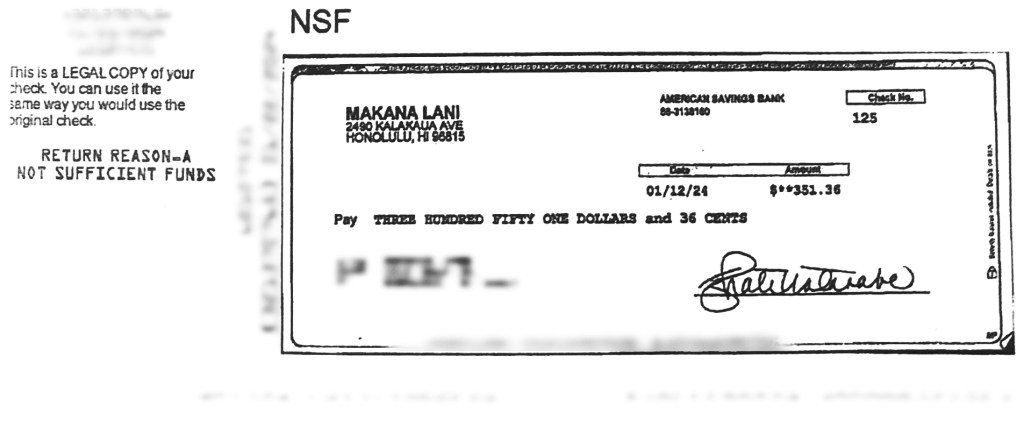
Patrick Dawe just wants what he says he is owed for his work as a prep cook: $351.36 he was denied when a final check from a previous employer bounced a year ago.
“That’s my hard-earned money,” Dawe said.
He is among former workers at the Makana Lani restaurant — located until early January inside the Alohilani Resort in Waikīkī — who say its owner frequently issued payroll checks that didn’t clear and still owes them money, in some cases thousands of dollars.
Such charges are nothing new for restaurateur Elizabeth Hata Watanabe, whose culinary ventures have often been featured in Hawaiʻi news media.

According to Hawaiʻi’s Department of Labor and Industrial Relations, which houses the wage standards division that investigates wage theft complaints, from the end of 2018 to December 2024, 19 claims were filed against Watanabe for nonpayment of wages. Those claims relate to Makana Lani, which offered high-end brunch and dinner service, and another former restaurant located downtown, Burgers on Bishop.
Food service accounts for more wage theft claims than any other industry, said Chavonnie Ramos, a spokesperson for the state labor department. Among that group, Ramos added, Watanabe has been the target of an unusually high number.
She also has a history of ignoring government investigators’ inquiries and requests, Ramos said, and of disregarding orders to pay back wages and penalties.
“With that particular employer, it’s hard to collect because she’s not cooperating with us,” Ramos said. “She’s not cooperating with the investigations or the decisions that were made. It’s frustrating.”
Of the 19 claims cases, six have been referred to the state Attorney General’s Office to pursue collection and six remain under investigation, Ramos said. In four additional cases — two related to each restaurant — Watanabe has been found liable for back wages and penalties.
In one of the Burgers on Bishop cases, Watanabe paid in full, according to Ramos. In two other cases, she was found to not owe anything.
The federal Department of Labor also is now investigating Makana Lani’s “compliance with federal labor standards,” said Terence Trotter, director of the Honolulu office of that department’s Wage Hour Division.
Trotter said he could not comment on the ongoing investigation.
‘I Do Owe People’
Watanabe acknowledged in an interview with Civil Beat that she still owes some former employees their pay. But she insisted she paid most of them, including in cash when her checks bounced.
She blamed the Alohilani Resort for being slow to reimburse her for expenses for which it was contractually on the hook, which made it harder for her to maintain a sufficient bank balance to cover checks.
“I do owe people some checks. I do. I know my attorney said not to say that, but it’s the truth,” Watanabe said. “But what am I supposed to do? The hotel owes me.”
She said the Alohilani would not reimburse her in a timely fashion for vouchers that hotel guests used to dine in the restaurant, or for meals that hotel guests charged to their rooms. Hotel management in November gave her until Jan. 5 to close down, she said, and still owes her more than $60,000.
Kelly Sanders, Hawaiʻi region president at Highgate Hotels, which owns the Alohilani, said in an email: “All I can say in this matter is that Alohilani has worked in good faith with Makana Lani. There is not money due to her today.”
Watanabe also accused employees of making the situation worse. She said some workers whose checks bounced, and whom she then paid in cash, later successfully deposited the original checks, getting paid twice.
“There are workers who did take advantage of the situation, and it is what it is,” she said. “But if I were paid on time from the hotel, this would never have happened.”
“I do owe people some checks. I do. I know my attorney said not to say that, but it’s the truth.”
Elizabeth Hata Watanabe, Restaurateur
At Burgers on Bishop, Watanabe and her staff earned favorable reviews from customers. One on Yelp even singled her out for praise: “Liz interacted with all of the tables like they were family (and some were here (sic) family!) and it made us feel so warm and welcoming!”
But Watanabe said workers she brought on board as part of an effort to hire people who had been incarcerated deceived her and the state’s investigators.
She said they didn’t cash their checks, then filed claims with the state alleging they had not been paid. Eventually, she said, they were awarded not only the wages owed but an equivalent penalty, as the law allows when an employer has “illegally withheld wages without equitable justification.”
“I didn’t know that this was another type of scam that people could do,” she said.
Upset that wage division investigations came down in favor of former employees, Watanabe said, she started disregarding subsequent official communications and paperwork, including subpoenas.
“I’m going to be really honest with you,” she said. “I just give them to my attorney without even looking at it, because I was left so disheartened.”
‘I Felt Hopeless’
Watanabe played favorites in who got paid, former Makana Lani employees said; those not rewarded with their wages struggled to pay rent, buy groceries or relocate.
A chef at Makana Lani from October 2023 to April 2024 said Watanabe owes him more than $5,000. As a former manager, he was not eligible to file a complaint with the state wage division, so he filed one for nonpayment of wages with the state Prosecutor’s Office, which confirmed it was investigating.
The former chef, who requested anonymity out of fear Watanabe would retaliate against him and his family, said that without those earnings, he had to drain his savings.
“She doesn’t get the damage she has done,” he said.
The former chef also said there was a lot of turnover at the restaurant, but others continued to work for her because she would promise to pay them — and occasionally did — and they didn’t want to desert her while the business was struggling.
A Note On Anonymous Sources
He was among 18 former employees of Makana Lani who talked to Civil Beat. Others said they were afraid of her or that she might come after them if they spoke publicly.
Marion Smith worked at Makana Lani as a server for about two weeks in March 2024 and said she never received about $300 in tips she was due.
After exchanging repeated texts about the issue with Watanabe, Smith wrote in an April 2024 text message that Civil Beat reviewed, “I may need your attorneys (sic) information if I don’t get paid.”
Watanabe replied: “You are far from a good fit with our team. You are a troublemaker and I wondered why you targeted me,” and added, “stop, or I will file harassment charges.”
Eight of the 18 former employees, including kitchen staff, servers and bussers, said they were still owed money. One said he was paid after threatening to sue Watanabe. A former manager confirmed the accounts of workers who said they were not paid, but did so on condition of anonymity because he is still in the food service industry.
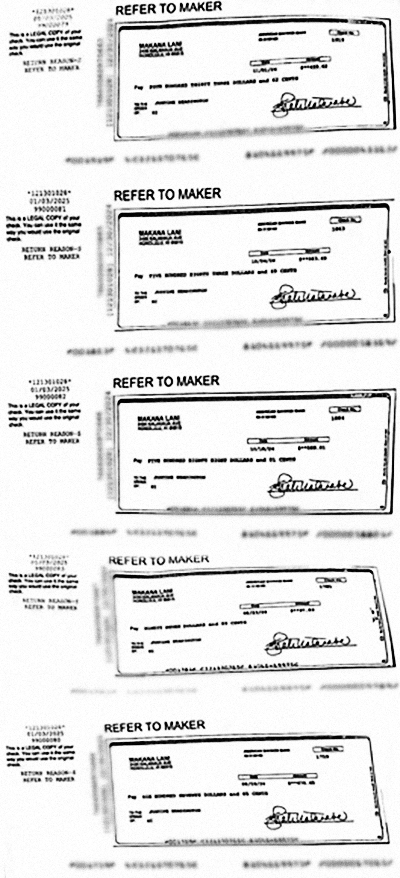
Three former employees — including Dawe — provided copies of checks their banks had returned for insufficient funds. Two shared checks from Watanabe that had not been cashed. They said Watanabe’s bank, American Savings Bank, declined to accept the checks, telling them to speak to her instead.
“I got three checks from her, which I went to the bank and tried to cash them, but the checks are like empty, no money inside. (The bank) said talk to her,” said Taiky Ruben, a dishwasher at Makana Lani in October and November 2023. He provided copies of three paychecks from Watanabe totaling $4,281.33 that he said American Savings Bank would not accept.
Watanabe just told him to keep trying, he said.
“I went to the bank like 10 times and still the same story, and I just got tired and quit,” Ruben said. “I felt hopeless. I didn’t have any more energy to move on.”
American Savings Bank declined to comment on whether it is common practice for tellers not to accept checks if they know the writer of the checks has insufficient funds to cover them.
Damian Early, who also was a chef at Makana Lani for two months in mid-2024, said Watanabe regularly asked him to wait before cashing his checks. After he quit, he said, she didn’t give him his last paycheck for about $1,800 until months later, after he said he threatened through a lawyer to sue her.
“It’s ridiculous,” Early said. “I don’t even think you should open a business if you can’t pay your people.”
Payroll Sometimes Late, But It Cleared
Some of Watanabe’s former employees, at both Makana Lani and Burgers on Bishop, said she was harried and sometimes fell behind but that they believed all the staff were being paid.
Watanabe provided the names of eight people she said would vouch for her business and management practices. Four of them who wanted to remain anonymous — including one who said Watanabe “is my auntie” — said she had paid them correctly. One did not recall when she had worked at Makana Lani but said she had been paid, and one could not be reached.
One of the other two was Dana Devers, who said she is a longtime friend of Watanabe’s and helped her manage Burgers on Bishop from August to November 2023. Devers said Watanabe was busy operating both restaurants and payroll was sometimes late but everyone eventually got paid.
“When I left I was never owed any money, I was paid up to date,” Devers said. “I’m pretty thorough so I would be like, ‘Girl, where’s our paychecks?’ So I would make sure I and the staff received our pay.”
Lyn Kinoshita, who also considers herself a friend of Watanabe’s, said she worked for about four months at Makana Lani in early 2024 as a prep cook. She too said she was paid what she was owed.

“I know that it was really difficult for her in the sense that the hotel didn’t pay her and so it was really unfair,” Kinoshita said. “They didn’t pay her, then how can she pay whatever she’s got to take care of?”
Other former workers said Watanabe, when pressured, would pick and choose whom to pay.
“Some people got paid. I think it was the people she knew would go straight to turn her in,” said one former employee who provided bounced checks from Watanabe totaling more than $5,000.
“She pacified the people who she thought, ‘Oh, they won’t turn me in,” said the employee, who spoke on condition of anonymity, saying they feared reprisals from Watanabe. “She just took advantage and took us for granted and decided to not pay us.”
In a text to Civil Beat, Watanabe suggested those who did file claims are the ones with the unfair advantage.
“These people, who have all played the system, know they have the upper hand because they have Gov workers working for them for free … I have to hire attys.”
In texts she sent around the same time to a group of former employees, she focused more on uncovering who had spoken to Civil Beat about their complaints.
“Attorney is working on finding how they got employees’ information because that’s confidential and illegal to share,” Watanabe wrote. “So hang tight guys we may have grounds to sue.”
‘They Don’t Have Any Recourse’
Jasler Kukkun is from Chuuk, a state in Micronesia, and moved to Hawaiʻi for work in 2014. He said he worked as a prep cook at Makana Lani for two weeks in early 2024 and left because he never got a check from Watanabe.
To this day he has not received one, he said, despite visiting the restaurant repeatedly to ask for it.
“Every time I went down to the restaurant, they always say I have to wait for her so she can give me the check. I called her number and she never answered,” said Kukkun, who estimated he is owed about $1,800.
“I just don’t know where to go,” he said, explaining why he had not filed a claim with the state or federal labor departments.
Many low-wage workers just move on to another job if an employer doesn’t pay them, said Sergio Alcubilla, executive director of the Hawaiʻi Workers Center.
“They don’t have any recourse,” Alcubilla said, adding that can be especially true of immigrant workers.
Ruben, the former dishwasher, said he decided to file a claim with the state wage division because when he quit, servers at the restaurant urged him to. Recently he joined the Workers Center to organize other workers from his Micronesian community, many of whom work in restaurants.
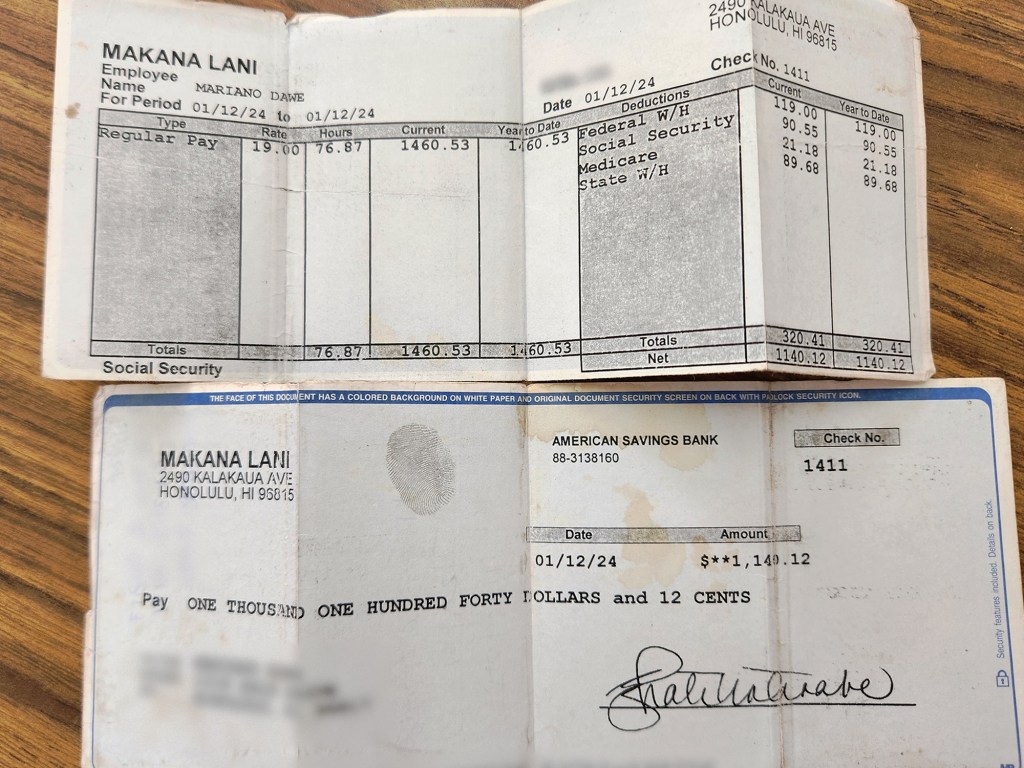
Patrick Dawe learned about the center from Ruben and came in with his brother Mariano – a dishwasher at the restaurant who carries a worn check for $1,140.12 in his wallet 15 months after he left the job. Mariano Dawe said American Savings Bank would not cash the check for him.
The center filed claims on behalf of both Dawe brothers in February 2024. Patrick Dawe said he has not heard from the state but added that he had lost his phone and changed numbers since the claim was filed.
“We want our money,” he said. “I worked hard for it. I got bills to pay.”
Ramos, the state labor department spokesperson, said the Dawes’ claims are still under investigation, so she could not comment on them.
Meanwhile, the months continue to pass and the Dawe brothers and their former coworkers continue to wait to get paid.
“We all want to rely on a good steady job and go to work; we don’t think she’s not going to pay us,” said Smith, the former server who filed a claim for $300 in tips. “I guess for her, she’s maybe thinking, ‘How long can I last,’ and takes it as far as she can, and then just drops you.”

