

Major Fireworks Seizure At Honolulu Port Points To Federal Failure
An Oʻahu fireworks company got a federal license to import tons of fireworks even though it didn’t have a state license to possess them once they got here.
For more stories like this, sign up for the Morning Beat, our free daily email newsletter that keeps you up to date on Hawaiʻi news.
Last year a task force working to stem the flow of illegal fireworks into Hawaiʻi touted its biggest seizure yet: 24 tons of commercial fireworks that arrived at the Port of Honolulu from what is known as China’s “hometown of fireworks.”
Only fireworks companies licensed by the state can import, sell or even possess such explosives, and the company listed on shipping records as the importer, Explicit Pyrotechnics, was not licensed, according to the Honolulu Fire Department.
But the fact that the shipment even made it to Hawaiʻi exposed an apparent failure in federal oversight of fireworks, Civil Beat has found. Explicit Pyrotechnics was able to obtain a federal license allowing it to bring the explosives into the country even though it didn’t have a state license to do anything with them once they arrived.
Two state lawmakers and the national trade group for pyrotechnics and fireworks questioned how the explosives made it into Hawaiʻi without that state license.
“We’re not talking refrigerators, we’re not talking tennis shoes. It’s hazardous material, and explosives are subject to the highest level of scrutiny,” said Julie Heckman, executive director of the American Pyrotechnics Association.

It’s against state law for the general public to have aerial fireworks. A massive explosion on New Year’s Eve that killed six people and injured more than 20 has heightened scrutiny of law enforcement’s efforts to keep illegal fireworks out of Hawaiʻi. Authorities have said that most of them come through the port, generally concealed among legal fireworks or other goods.
The fireworks in this shipping container, however, weren’t hidden at all. They were sent in accordance with federal guidelines, with the Waiʻanae-based company listed as the recipient.
The Department of Law Enforcement didn’t disclose the recipient of the fireworks when it announced the seizure last year, but Civil Beat learned of it during a review of shipping records. Department of Law Enforcement spokesperson Brooks Baehr confirmed that Explicit Pyrotechnics was the subject of the investigation, which concluded last month.
Baehr said the case has been turned over to the Attorney General’s Office, which declined to comment. Importing commercial aerial fireworks, also known as display fireworks, without a license is a felony under Hawaiʻi law.
Brandon Henderson, who is listed on a state business license as one of Explicit Pyrotechnics’ two owners, told Civil Beat that the company “never received the fireworks.” He declined to say more without speaking to his lawyer and hasn’t responded to calls and messages since. A call to the number listed on the company’s website was answered by a woman who said it was a wrong number.
Task Force Makes Marquee Seizure
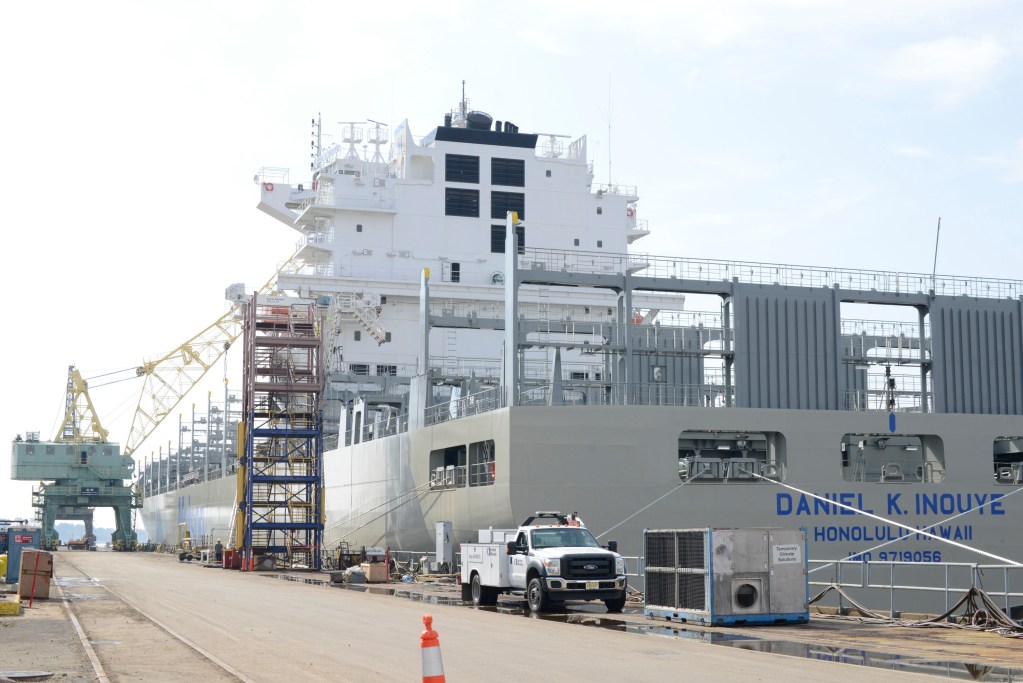
Jan. 28, 2024, was a bit slower than usual at the Port of Honolulu, with ships carrying about 100 containers arriving from the mainland and other countries. Matson Navigation’s Daniel K. Inouye was one of those vessels, just in from Shanghai.
Among its cargo was a 20-foot container loaded with 1,320 cartons of display fireworks from the Liuyang Kingdom Company, according to the bill of lading. Those records say what’s being shipped, who sent it and where it’s headed.
At some point between Jan. 28 and Feb. 15, the task force conducted a routine inspection on container MATU2665206.

Inside, they found pretty much what was described on the shipping documents. Photographs released by the Department of Law Enforcement show boxes labeled “1.3G” and “UN0355,” hazard designations required by the federal Department of Transportation. Other photos show spherical shapes wrapped in plastic, labeled “Warning – Professional Use Only.”
Such fireworks, which include aerial fireworks like the ones shot off weekly on Waikīkī Beach, are more powerful than what the general public can buy. In Hawaiʻi, companies must be licensed to import, sell, store, shoot them off or even possess such high-powered fireworks.
In announcing the seizure, the Department of Law Enforcement didn’t say that the importer lacked a state license, but Deputy Director Jason Redulla said in a news release that commercial fireworks “require significant licensure and are only authorized for importation, storage, and use by lawfully permitted entities.”
Earlier this month, a spokesperson for the Honolulu Fire Department told Civil Beat that there is no record of Explicit Pyrotechnics or its two owners ever being licensed or permitted to handle fireworks. County fire departments are responsible for issuing licenses and permits, monitoring imports and auditing inventories.

Nevertheless, Explicit claims on its website that it is licensed. It says the company, founded in 2020, produces “large-scaled pyrotechnics shows for all events on and off-island.” The company’s “mission is to give our clients an unforgettable memory that would last a lifetime,” it says.
Videos on the company’s Instagram account, which appears to have been taken down recently, and website show silver rocket launches and starbursts exploding in brilliant showers of gold, blue and red. One video is set to a rock-n-roll version of Adele’s “Easy on Me.”
It’s unclear whether the company has conducted any shows in Hawaiʻi and where those fireworks were ultimately headed.
Federal Agency Granted License
Although Explicit Pyrotechnics didn’t have a license from the state, someone with the company did have one from the federal Bureau of Alcohol, Tobacco, Firearms and Explosives, said Jason Chudy, a public information officer based in Seattle. The license allowed the company to import professional-grade fireworks into the U.S. in order to sell, distribute or use them.
To get that license, an applicant would have had to fill out a form detailing their business, the type of explosives they wanted to use, and any history of crimes, drug use or mental illness. They would then undergo a background check.
Among the questions is one about whether the applicant had access to an ATF-approved facility to store the fireworks.
Another asks about state law: “Is a State or local license or permit required for explosive business and/or operations?” If so, the form requires applicants to write in the license numbers.
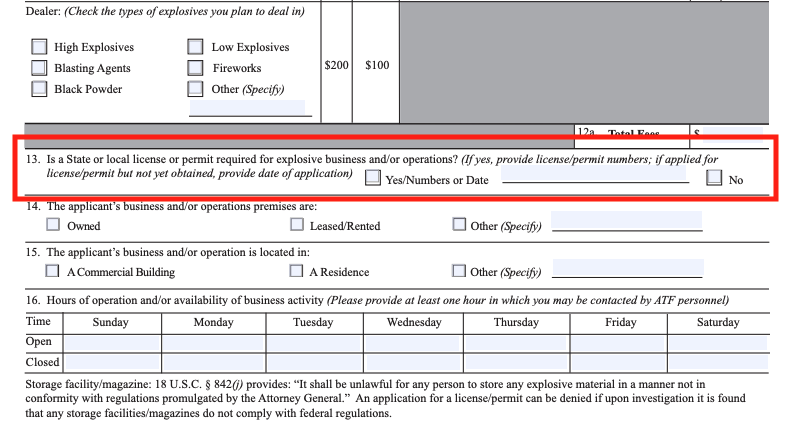
Civil Beat doesn’t know how Explicit Pyrotechnics responded to that question; Chudy didn’t immediately respond to a question about it on Tuesday. The ATF denied Civil Beat’s public-records request for a copy of the license.
In explaining the ATF’s role in fireworks oversight, Chudy said that while the agency regulates explosives and issues licenses, it would only get involved in investigating a violation of state law if there were unusual circumstances, such as those involved with the recent lethal New Year’s explosion.
“Federal explosives licensees are required to properly follow all federal, state, and local laws and regulations regarding the proper storage, safeguarding and usage of these fireworks,” he said. “However, ATF does not have the regulatory authority to inspect inbound maritime vessels or aircraft at Hawaiian ports of entry.”
That falls to the U.S. Customs and Border Protection. A spokesperson for Customs and Border Protection deferred comment to the state Attorney General’s Office because the case is under “active state investigation.”
Told of Civil Beat’s findings, Hawaiʻi Rep. Gregg Takayama said the incident shows that there needs to be more coordination between state and federal authorities — which was the point of creating the fireworks task force in the first place.
Headed up by the Department of Law Enforcement, the task force includes state and local law enforcement, the state Attorney General’s Office and federal agencies including Customs and Border Protection, ATF, the Coast Guard and the U.S. Postal Inspection Service.
“If they didn’t have authority from the state level to bring it in,” Takayama said of the Explicit Pyrotechnics shipment, “I question how it gets into the state.”
More Inspections At The Port?
Only a small percentage of the shipments that arrive at the port are ever inspected. Takayama said lawmakers now are trying to address the illegal fireworks trade by having the task force conduct more searches and giving it more resources.
State leaders have wanted to increase such inspections since at least 2011, when a legislative task force concluded that “there are deficiencies in both air and shipping cargo inspections that provide avenues for illegal fireworks to enter Hawaiʻi.”
Senate Bill 1226 would require the Department of Law Enforcement to establish a program to conduct more “random and risk-based” inspections of containers. In written testimony submitted this month, however, the department has said random searches would likely be unconstitutional and would run counter to its strategy of doing targeted searches.
The Hawaii Harbors Users Group — which represents more than 20 commercial shipping, labor and allied operators, including Matson — opposes the bill. It said additional searches could harm businesses and raise costs.
The current version of SB 1226 would also require inspection of all containers of fireworks shipped to the state, “using personnel who are able to distinguish legal fireworks from illegal fireworks.” Over the past five years, that would have meant inspecting 187 shipments of legal fireworks imported into Honolulu, according to shipping records.
The Department of Law Enforcement told lawmakers that would require additional staff, transportation, offsite facilities and explosive-detecting dogs, all of which would cost far more than the $750,000 the bill would appropriate over two fiscal years. The agency estimated it would cost $600,000 for two dogs alone.
Meanwhile, the department has a new director, Mike Lambert. He said at his Senate confirmation hearing last week that he expected it would take several months for him to fully understand the flow of the state’s ports. At that point, he said, he would be in a better position to develop strategies to target sources of explosives and drugs.
Civil Beat’s community health coverage is supported by the Atherton Family Foundation, Swayne Family Fund of Hawai‘i Community Foundation, the Cooke Foundation and Papa Ola Lōkahi.

