

Alarm Sounded Over Big Island Police Pacts With Federal Immigration Agency
The MOUs have existed for years but in the new Trump era they are red flags for immigrants and their advocates, especially after Kona raids last week.
For more stories like this, sign up for the Morning Beat, our free daily email newsletter that keeps you up to date on Hawaiʻi news.
Agreements in place for a decade between Big Island police and federal law enforcement agencies are suddenly facing fierce scrutiny as the White House campaign against immigrants without legal status advances.
Immigrants and their advocates fear the longstanding Hawaiʻi island memorandums of understanding could make it easier for local officers to be enlisted in mass deportations.
Against the backdrop of anti-immigrant rhetoric from the president and his administration, a seemingly simple request for the mayor to sign the MOUs has set off loud alarm bells, said Armando Rodriguez, founder of Aloha Latinos, a Big Island nonprofit that supports immigrants.

“Our concern is with the police here,” Rodriguez said. “We want them to be police officers. We don’t want them to be immigration.”
It’s a debate going on across the United States in various forms, in communities large and small, liberal and conservative. In San Diego, for example, elected officials have clashed over whether or how to cooperate with the federal crackdown on immigrants.
On Hawaiʻi island, fears ratcheted up after immigration authorities conducted two raids in South Kona, including one in which Rodriguez said a family that worked on a coffee farm was detained.
In a statement following the first raid, Homeland Security Investigations said in a March 5 release its agents teamed with ICE enforcement and removal agents to find “unaccompanied alien children who have allegedly entered the United States through fraudulent sponsorships.”

In a raid the next day that Rodriguez said took place at the same location, “four people were taken into custody pending deportation,” Special Agent Erin Musso said in a later statement.
Rodriguez said there already had been at least five such raids in Kona alone since President Donald Trump took office. It appeared no Hawaiʻi County Police officers took part in any of them, he said, but the prospect of local cooperation with federal agents has his community on edge.
“Right now,” he said, “everybody’s scared.”
What Do The Agreements Say?
The spark for the debate was an otherwise routine County Council vote to allow the mayor to sign two MOUs.
One is between the Hawaiʻi County Police Department and the FBI’s Honolulu Safe Streets Task Force; the second is with the U.S. Immigration and Customs Enforcement’s Homeland Security Investigations unit, to embed an agent in the police department.
Unlike Hawaiʻi County, representatives of the Honolulu, Kauaʻi and Maui police departments said that they do not have agreements with ICE. All those departments, however, do have MOUs with other federal law enforcement agencies, including the FBI.
Assistant Hawaiʻi County Police Chief Sherry Bird said her department just wants to formalize its standard annual renewal process. She said the department asked for the resolution after being alerted by the county’s legal counsel that all agreements with the federal government need council approval.
The MOUs fortify the police department’s ability to investigate drug and sex trafficking, cyber crimes and other serious felonies, Bird said, by allowing it to bring in federal agencies with more resources and reach in those areas of law enforcement.
“It’s very important that we continue to have that relationship with them for the safety of our community,” she said at a Feb. 18 meeting of the Hawaiʻi County Council’s Governmental Operations and External Affairs Committee, where the resolution was first introduced.
“There is no assurance we will not be co-opted into immigration enforcement because there is no limiting language, no guardrails in place.”
Sandy Ma, community and policy advocate at The Legal Clinic
But the MOUs have unnerved people who fear local law enforcement will be pulled into helping Trump keep his promise to deport millions of people.
“There is no assurance we will not be co-opted into immigration enforcement because there is no limiting language, no guardrails in place,” said Sandy Ma, community and policy advocate at The Legal Clinic, a nonprofit that offers legal, education and advocacy services to immigrants.
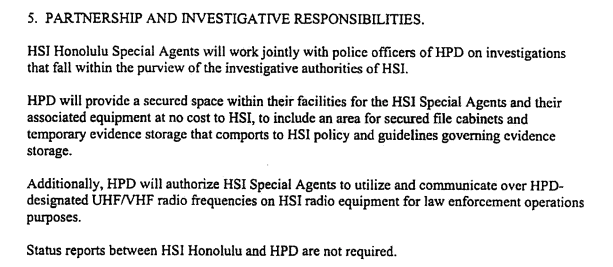
She pointed out that the section of the latest proposed agreement with Homeland Security/ICE that describes its purpose states only: “The purpose of this MOU is to formalize the embedding of (Homeland Security Investigations) Special Agents with the HPD.”

Key language from the latest version, approved in 2017, also is gone.
That earlier MOU’s purpose section included a statement that the Secretary of Homeland Security can designate people to perform the duties of customs officers but Homeland Security Investigations “is not conveying the authority to enforce administrative violations of immigration law.”
Since administrative violations are non-criminal infractions of immigration laws — such as overstaying a visa or entering the country without permission, which can lead to detention and deportation — that meant local law enforcement could not be brought in under the agreement to help arrest undocumented immigrants.
Instead, in the latest version, the section titled “Partnership and Investigative Responsibilities” says: “HSI Honolulu Special Agents will work jointly with police officers of HPD on investigations that fall within the purview of the investigative authorities of HSI.”
“That’s very problematic,” Ma said, calling the wording “incredibly broad.”
The existing MOU with the FBI – which would not change – does not mention immigration specifically although it does continue to mention “alien smuggling” as an area of focus for the Safe Streets Task Force. Other aspects of the force’s mission are to “identify and target for prosecution” groups involved in murder, aggravated assault, money laundering and “violent street gangs,” among other crimes.
As the Trump administration presses a range of departments into the service of its immigration offensive, agreements with other federal agencies are just as worrying to advocates. In January, for example, federal DEA agents joined ICE operations in Honolulu as the crackdown got underway there.
“Given the pressure that is coming from the feds for state, local and federal agencies that are outside of the Department of Homeland Security to get involved in the president’s deportation agenda, we just want to really, really know what our local police are signing up for,” said Liza Gill, co-coordinator of the Hawaiʻi Coalition for Immigrant Rights.
“We want to know exactly what you want to do before we sign an agreement giving you the powers to do X, Y, or Z.”
Will People Still Trust Cops?
Recent community meetings and years of more casual interactions have helped build a good relationship between the Big Island’s immigrant community and the police, advocates said — a relationship both fragile and essential.
“There has been a great relationship with the local police and that has allowed folks to come forward and ask questions and continue to build trust,” Gill said at the Feb. 18 committee meeting.

“If folks do not feel their police department is involved with community policing and just another arm of homeland security, then they will not come forward and report crimes or domestic violence,” Gill told the council.
Ma, who also spoke at the meeting, added: “There is a lot of trust between the Hawaiʻi County police and the immigrant community. If this measure advances, that trust quickly could be eroded.”
Bird reassured the council that the department understands the concerns.
“We do enforce the laws but I can assure you that we do not practice bias-based policing,” she said. “We don’t contact people based on their race, ethnicity, nationality, immigration status.”
“We do enforce the laws but I can assure you that we do not practice bias-based policing.”
Assistant Hawaiʻi County Police Chief Sherry Bird
Council members agreed that the MOUs needed further study. Several said the dramatic shift in how the federal government characterizes immigration – Trump frequently describes it as an “invasion” – warrants a closer look at how local law enforcement agencies work with their national counterparts.
“We’re in a situation where our federal partners have potentially changed their values in a way that’s very different from our values here in Hawaiʻi,” County Council member Michelle Galimba said at the meeting.
Council member Ashley Lehualani Kierkiewicz asked Bird: “Would you be open and amenable to language that would assuage community concerns in there being a very specific purpose” to the collaboration with the federal agencies?
Bird replied: “I don’t think we’re not open to anything.”
The committee voted unanimously to postpone a vote on the resolution to March 18.
‘Nothing Can Be Assumed’
Since the meeting, Galimba has softened her stance. She told Civil Beat that looking closer at the MOU with ICE allayed her concerns because she now believes the intent is to share office space with federal agents “rather than going out on missions together.”
But she said she wants to find out more about whether either MOU could be interpreted as a 287(g) agreement, which would allow the state’s law enforcement officers to be deputized to perform some federal immigration officers’ duties.
Those agreements have been flashpoints for years. They allow local law enforcement officers to question immigrants in custody about their immigration status, and arrest and turn them over to ICE.
Now, the Trump administration, supported by Republican officials around the country, is moving to reboot a version of the program, allowing local officers to arrest suspected undocumented immigrants on the street. The Obama administration discontinued that program in 2012 over concerns it amounted to racial profiling.
“In the current national context, we’re just trying to be more proactive about looking at any documents related to relationships with the federal government,” Galimba said, “trying to see if there’s any way that we can protect the police department from having to expend county resources on federal priorities.”

“We’re in a situation where our federal partners have potentially changed their values in a way that’s very different from our values here in Hawaiʻi.”
Hawaiʻi County Council member Michelle Galimba
Council member Holeka Inaba said that after reading through the agreements he believes community members’ concerns are valid but said, “I don’t necessarily have concerns myself regarding the language of the resolution.”
After the committee meeting, Inaba met with members of the immigrant community and tried to reassure them that the county was looking out for their interests.
“They’re an integral part of our community. So making sure that they feel safe and supported is important to all of us,” he said.
Rodriguez attended that meeting, which took place at the Kona Council office and lasted a half hour. While he said that he appreciated the efforts of Inaba and police officials to reassure the immigrant community, he thinks there is only so much they can do.
“They’re all good people. They’re trying to do their best, but a lot of it right now seems like everybody’s hands are tied,” he said. “Nobody wants to take up immigration. Nobody wants to have a target put on their back.”
Reflecting on the decision the council still has to make, council member Rebecca Villegas told Civil Beat that the dramatic changes to the political landscape mean even the police department’s existing agreements need reevaluating.
She noted that previously partnerships between local police and federal law enforcement had focused on crimes such as drug smuggling while “now, under the current national administration, I have deep concerns about the priorities and value systems driving their programs, projects and actions.”
She said her reservations were not about the intentions of local law enforcement and that during other presidencies she would have been more likely to support the proposed MOUs.
“Unfortunately, with the transition to this new administration,” she said, “nothing can be just assumed to be continuing in the same level of trust.”
‘Not Looking To Involve Ourselves’
The police department also has been mulling options since the February council meeting.
Last week, Bird told Civil Beat that the department is discussing whether to add language to the agreements that expressly prohibits officers from joining in immigration enforcement operations.
At the same time, she said, the MOUs as currently written already do not allow police officers to take part in such enforcement efforts.
“We’re not looking to involve ourselves in those kinds of activities,” she said.
Critics, though, say the MOUs need to be amended to make that explicit.
They need to spell out exactly what Hawaiʻi police officers are obligated to do, and what they can’t do, Ma said. Police should also be required to make regular reports to the council about how the arrangement is working “so there is some transparency and accountability.”
“We understand that there are agreements between local police and the federal government, for example, relating to drug trafficking, cyber crimes, child pornography, sex trafficking,” she said. “Those are necessary. Those are good. Those are to protect our community. We would just like specificity to protect our immigrant communities, our migrant communities who are on edge.”

