‘Damning’ Report: Hawaiʻi Falls Short Helping Inmates Reenter Society
The study says the lack of effective reentry programs is one reason so many inmates get in trouble again soon after release.
For more stories like this, sign up for the Morning Beat, our free daily email newsletter that keeps you up to date on Hawaiʻi news.
Nearly half of Hawaiʻi’s prison inmates serve out their sentences without being released on parole, and the state is failing to provide programs and services to help those former prisoners when they are finally released, according to a new state report.
The report by the Hawaiʻi Correctional System Oversight Commission found 47% of prison inmates released in the fiscal year ending Sept. 30, 2023, were never paroled, and instead “maxed out” when their sentences finally expired.
That means those prisoners were released directly from correctional facilities into the community without an adjustment period under the supervision of a parole officer. The former prisoners undergo an abrupt transition that can be especially difficult for people who have little family or other support on the outside.
The commission report warns that the jarring transition combined with limited services to help ease long-time inmates back into society can lead to new crimes that land people back in prison.
“The max-out population faces the highest recidivism rates and the lowest likelihood of success, primarily due to the lack of reintegration opportunities and support,” according to the report.

The report assesses a variety of corrections data and contracts to determine if Hawaiʻi’s law requiring a state-funded system to help outgoing prisoners as they exit prison is working properly. The report concluded it isn’t — not by a long shot.
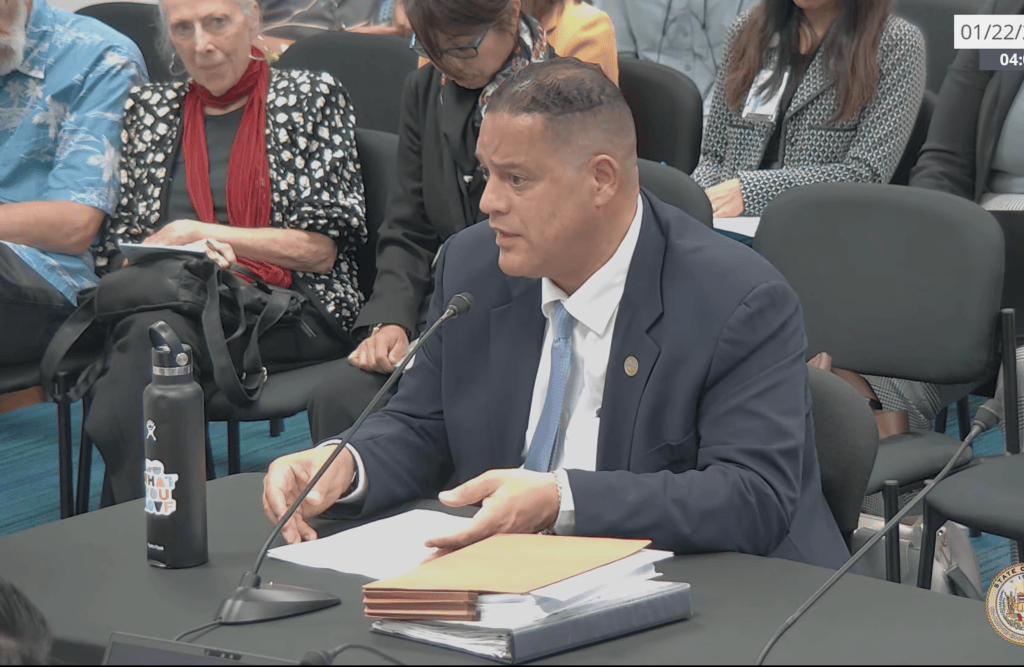
Tommy Johnson, director of the state Department of Corrections and Rehabilitation, warned state senators during a budget briefing earlier this year the commission’s report would be highly critical. He did not quarrel with its findings.
“You’ll see the commission report on the state of reentry in Hawaiʻi — it’s a damning report, and it should be. We do have challenges,” he told the Senate Ways and Means Committee.
“There are a lot of things we’re unable to do because we simply don’t have the funding to do the wrap-around reentry services,” he told senators.
Johnson used that Jan. 7 budget briefing to make an appeal for $4 million to provide some of the missing transition services, including help with temporary housing costs and case management in the community.
He said the $4 million would be split into several initiatives “so we can come back and show proof of concept to the Legislature, so you can see the money’s not wasted, and hopefully increase that funding when we can show that what we’re doing is successful.”
“That, we think, will help us reduce recidivism. By doing that, we will be able to have safer communities,” he told lawmakers. “It’s not going to be easy, we’re going to have hiccups, but we’re going to try.”
Legal Mandates To Help
The state correctional system released more than 6,300 people in fiscal year 2023, and Hawaiʻi lawmakers have made an effort to ease their transition back into society.
The Legislature created a Comprehensive Offender Reentry System in 2007 to help outgoing prisoners, a system that has evolved over the years. In 2018 lawmakers also ordered up annual reports detailing what the reentry system has accomplished, including updates on efforts to reduce recidivism.
The new commission report praises lawmakers’ efforts to steer the state system toward a rehabilitative model, suggesting that “Hawaii has an immense opportunity to transition to a correctional model that prioritizes its vision for corrections and rehabilitation: healing, accountability, and community safety.”
But it also found in a number of areas the corrections system failed to meet legal mandates imposed by the Legislature.

Mark Patterson, chairman of the oversight commission, said a community push in the Legislature years ago led to new laws that were supposed to develop and expand a reentry system.
But “in my years with the state, I’ve never really seen the department focus on reentry,” he said.
Patterson recently retired after working as a corrections captain at Hālawa Correctional Facility, the Oʻahu Community Correctional Center and Women’s Community Correctional Center, and also as warden of WCCC and the state youth correctional facility.
The department is constantly battling chronic problems such as excessive overtime costs, gang activity, inmate mental health issues and “reentry drops,” Patterson said. “It’s hard to get a foundation to move towards a vision of change and transformation.”
An example of the mismatch between the law and actual practice in reentry involves the hundreds of inmates the state holds in the privately run Saguaro Correctional Center in Arizona because there is no room for them in Hawaiʻi facilities.
State law requires those prisoners be returned to Hawaiʻi at least a year before they are scheduled for parole, “to facilitate reentry preparation in Hawaiʻi,” including participating in programs that prepare them for their next steps, according to the report.
But often that isn’t happening. Data from the Department of Corrections and Rehabilitation shows that in roughly the last year 60% of men serving sentences on the mainland were not returned to Hawaiʻi within a year of their parole hearing date.
According to the department’s data, almost all of of those inmates either had serious misconducts or refused to participate in prison programs, in some cases because they wanted to “max out.”
Misconducts or gang activity in many cases render those prisoners ineligible for transfer to minimum security facilities, prison programs or work furlough in the community, Johnson said in an interview Friday.
“Even though the commission may say they are concerned — and they are — they should do the drill-down to see why the numbers are the way they are,” he said.
The commission report suggested that even inmates who refuse programs or have misconducts could be returned to Hawaiʻi, “bringing them closer to family and reentry resources.”
The commission “frequently observes a culture that assumes people in custody are inherently unmotivated or resistant to programs,” the report added. “To facilitate a transition toward a corrections and rehabilitation model, a corresponding cultural shift is essential — one that acknowledges the potential for growth, healing, and successful reintegration.”
The reentry report also found the department has not fully met the provisions of a state law that requires it to help inmates to obtain identification and other documents before they leave prison. It recommends the department find ways to expand its ongoing efforts to provide ID’s to outgoing prisoners.
Johnson said the department is asking lawmakers for $100,000 this year to expand its efforts to provide inmates with identification cards and other documentation.
Reentry Programs With Few Resources
State law calls for a reentry system that “begins on the first day of incarceration,” starting with assessments of each prisoner and efforts to link them up with programs to support reintegration, according to the report.
But “independent evaluations of these programs have not been conducted or provided, making it unclear whether they are effective or meet the needs of the population,” according to the report.
The commission has also observed excessive idle time inside, insufficient out-of-cell activities and “limited access to programs, recreation, and reentry resources. These gaps indicate that the reentry practices required by statute are not being effectively implemented,” according to the report.
One example: The report found the four-person Reentry Coordination Office currently has three vacancies, and just one person who is actually on the job.
The report recommends reentry staff be deployed to all eight state correctional facilities to help connect outgoing inmates with outside programs as they prepare for release. Johnson said he is asking lawmakers for three additional positions for that office this year, and is trying to fill the vacancies.
It costs $253 per day on average to hold a prisoner in the Hawaiʻi correctional system, and “if we can have a successful reentry program, we can break the cycle of these guys coming back in,” Johnson said.
“The longer they stay out and stay productive members of the community, the less cost they are to the taxpayers,” he said, “and they’re not victimizing additional citizens out there in the community.”
Another problem is a shortage of correctional system case managers, who work with the inmates to assess their needs, and help them enroll and complete programs to prepare them for release. The current caseloads for case managers are over 100 prisoners each, Johnson said, “and that’s just too many.”
The department asked for 20 new case manager positions, but those were not included in the administration budget, and Johnson said he will ask for them next year.
Johnson said the report “gives us a baseline of where we are, and then we know where we need to go from there.”
“I think some degree it’s damning because it shows the lack of funding and the lack of resources for a comprehensive reentry plan,” he said, “but it does give us a baseline to work with the commission and go into the legislature next year and speak with one voice on the resources that are needed.”