

Hidden Links Exposed: Hawaiʻi Fireworks Bust Tied To Mainland Suppliers
One address on shipping documents in a seizure at Honolulu Harbor is the first in a chain of clues that lead across the country and through the decades — a mysterious web of connections between the legal and illegal fireworks trade.

The Matson container that arrived at Honolulu’s Sand Island was supposed to hold metal and plastic fasteners from an Illinois company, less than 5,000 pounds worth based on its shipping papers.
So why, port officials wondered, did the cargo weigh almost three times that much?
When they opened up the container on that March day nearly three years ago, it didn’t hold a single fastener. Instead, it was stuffed with cardboard box after cardboard box of illegal fireworks, $2.7 million worth.
Most were the kinds that streak across the skies of Oʻahu’s neighborhoods on New Year’s Eve, even though residents aren’t allowed to set off aerial fireworks here. Names stamped on the boxes called out their lofty claims: Baby Boomers, Echo in the Ear, Light the Night and Whistling Moon.


Hawaiʻi residents have long complained about the rampant fireworks that steal their sleep and terrorize their dogs. But this year, that nuisance turned lethal, leaving six people dead from an accidental fireworks explosion in Salt Lake, and another victim in Kalihi.
Those deaths have brought new urgency to the question of how illegal fireworks are getting in. And the Coast Guard discovery on Sand Island three years ago offered many clues.
With part of the port cordoned off for safety reasons, Coast Guard investigators were called out. They were joined by local sheriffs and federal agents with the Bureau of Alcohol, Tobacco, Firearms and Explosives.
But no one followed through to publicly reveal who sent the fireworks or where they were headed. Instead, the Coast Guard arranged for the explosives to be labeled as hazardous waste, bundled in blue shrink wrap, loaded into a new freight container and shipped back to the mainland for destruction.
The Coast Guard report on the incident does not indicate that anyone was questioned, and other federal and state agencies said they had no records of it.
No one was arrested. No one was ever charged with anything.
So the public never learned about a mysterious web of connections between the illegal and the legal, links between this contraband shipment and a company that has been selling permitted fireworks and firecrackers in Hawaiʻi since the 1990s and continues to do so to this day.
That web begins with one key piece of paper: The $11,107 bill for the illicit cargo, which lists an address for the shipper just outside Chicago — 5317 St. Charles Road.


‘We Have Nothing To Do With Any Type Of Fireworks’
The Matson bill identified the company behind the shipment as “Liberty Fasteners.” But Liberty Fastener, without the “s,” is at a different location — about nine miles north of the St. Charles Road address.
The real Liberty Fastener occupies a brown aluminum warehouse about half a mile west of the busy runways of O’Hare International Airport. It specializes in anything threaded: screws, bolts, rivets. Its motto is honesty, integrity and respect.
“When you do business with Liberty, you are assured that what we promise is what we deliver,” the company says on its website.
That does not include delivering fireworks, according to its president, Shari Nickens. Her company had nothing to do with the Sand Island shipment, she said. She didn’t even know that the company and its products had been listed on the Matson bill until Civil Beat reached out.
“Liberty Fastener Company is a distributor of fastener products ONLY,” Nickens wrote in an email. “We have nothing to do with any type of fireworks and/or explosives.”
So if not a fastener company, what is at 5317 St. Charles Road?
With a facade of rubble stone masonry and a chimney, the building in Berkeley, Illinois, looks like a miniature medieval castle. It’s across a parking lot from Rocky’s Gyros, and shares a wall with Coaches Sports Bar. Public records show that a few fireplace and chimney repair businesses have used that address.

The unassuming building on a commercial strip is also a key link in fireworks connections that lead from Illinois to Indiana to Ohio to North Dakota to that dock on Sand Island.
Civil Beat’s tracking of those connections started with a company called Fuse Fireworks.
Fuse runs a retail fireworks store each year in what looks like a former gas station in Winamac, Indiana – about a two-hour drive southeast of the St. Charles address.

Such operations generally order fireworks to their specifications directly from factories in China or through wholesalers who do the importing for them. The pyrotechnics are supposed to be tested for safety and issued a tracking number before arriving at U.S. ports. Retail sellers often set up shop in states with more permissive fireworks laws, like Indiana.
The store opens in late May each year and keeps going through July, past Independence Day. The store owners take photos of their customers holding up their fireworks for the business’s Facebook page — a pageant of American flags and colorful boxes of explosives.
Fuse urges consumers to be safe, but isn’t above a little gallows humor, like the 2022 posting about whether you should call 911 on the Fourth of July. “Fireworks debris is landing in my yard” – no. “Body parts are landing in my yard” – yes.
Fuse is incorporated in both Indiana and Illinois. In its Indiana business filing, its vice president is listed as “Nicholaus J. Folino.” Address? 5317 St. Charles Road, Berkeley, Illinois – the faux-medieval castle. In fact, Folino has been listed as an owner of that property.

The name Nick Folino is not common in the U.S. – maybe a couple dozen living people have it, according to public records. But search for the name online, and you will get a hit for a Nick Folino selling fireworks in Hawaiʻi.
That Nick Folino was identified by the news site Maui Alert as a worker at a seasonal store, Pacific Fireworks, in the Maui town of Kīhei. A broad-faced man with a neatly manicured beard now in his mid-40s, Folino touted the store’s popular Duck brand firecrackers as “louder, brighter.”
In 2018, Da Local Show on KAKU radio on Maui interviewed an employee of the Kīhei fireworks store. He was identified only as “Nick.”
“We have a lot of exclusive products we have made just for the islands,” he told interviewer Braddah Tony Midnite, an avowed fireworks enthusiast. “We’ve made custom fireworks that have names like Kona Gold, Waikīkī Lights – all stuff that we just sell here.”


In Facebook photos posted on Pacific Fireworks’s page, the man identified as Nick Folino by Maui Alert is selling fireworks there in 2018 and again in 2020 — a little over two years before the Sand Island discovery. Folino did not respond to multiple attempts to reach him, including emails, phone calls and a letter delivered to his home address.

‘The Muhammad Ali Of Fireworks Litigation’
The store where Folino was working, Pacific Fireworks, has operated for decades in Hawaiʻi, legally importing 300 tons of Chinese fireworks since 2007 to sell at retail stores scattered across the islands.
Until 2012, Pacific Fireworks was run by a notorious fireworks outlaw who in the early 2000s defied a federal consent decree by shipping fireworks to Hawaiʻi.
Larry Lomaz was the kind of guy who referred to himself in the third person. He once described himself as “The Muhammad Ali of fireworks litigation.” An Ohio newspaper mentioned as early as 1999 that he had outlets in Honolulu.


By that time, Lomaz had been in the fireworks business – and battling authorities who accused him of breaking the rules and endangering people – for two decades. Media outlets including the Plain Dealer of Cleveland, the New Hampshire Union Leader, the Miami Herald and the Akron Beacon Journal chronicled his escapades.
In New Hampshire in the 1980s, he successfully challenged state fireworks law, leading lawmakers to enact something stricter.
He skirmished repeatedly with authorities in New Hampshire. And in 1991, police seized fireworks from his store to cover $156,000 in fines. In Florida, nine patrol cars converged on one of his stores in 1985 to confiscate illegal fireworks.
Lomaz tangled with local laws most often in his home state of Ohio. It was a cat-and-mouse game with authorities that included a citation for illegally burying fireworks, neighbors furious about smoke from a pyrotechnic burn pit and a judge ordering guards to keep watch over 100 tons of dangerous fireworks until they could be sold.
But his biggest battles came with the federal government in the form of the Consumer Product Safety Commission, which regulates fireworks – and they involved his Hawaiʻi stores.

Straw-Man Shipments To Hawaiʻi
In 1999, U.S. District Court Judge James Gwin in Ohio found that Lomaz had committed more than 100 violations involving labeling, fuse length and the explosive power of his fireworks. One device was 96 times stronger than allowed for consumer fireworks. Another that shot multiple aerials had too small a base, which could cause it to tip over and shoot sideways into people.
The judge ordered several hundred thousand fireworks destroyed. Lomaz said he was being harassed and vowed to keep fighting.
“I’m going to fight until I’m dead,” he said.
A few years later, in June 2003, Lomaz agreed to turn over $30,000 in profits after the Consumer Product Safety Commission found that he had continued to sell illegal fireworks. His future fireworks imports would have to be tested by the American Fireworks Standards Laboratory and reported to the commission, according to a consent decree Lomaz signed.
Five months later, he was at it again.
Lomaz ordered 552 cartons to be shipped from China to Honolulu using the name of Erika Kleinfeld on the invoice and U.S. Customs entry papers. Only one carton had the required safety sticker, according to a 2005 report by U.S. Magistrate Judge James Gallas.

Kleinfeld, who to this day sells fireworks each year at a Pacific Fireworks store in Līhuʻe, told investigators the shipment had nothing to do with Lomaz. But Lomaz himself had walked into a Merrill Lynch office in Cleveland and arranged to wire the payment for the delivery of Chinese fireworks to Honolulu from an account he shared with his mother, Rose, according to testimony from the Merrill Lynch worker who handled the transaction.
The court documents make the setup clear: Kleinfeld was the one who applied for the licenses to sell fireworks at three seasonal retail outlets in Hawaiʻi, including the one on Kauaʻi that she managed. Kleinfeld signed the lease for that location. But it was Lomaz who signed the leases for two other stores and paid the rent for all three, testimony and documents showed.
“Figuratively Mr. Lomaz was hiding behind Ms. Kleinfeld’s skirt,” the judge wrote.
A fourth retail outlet in Hilo managed by a local man employed by Lomaz sold fireworks from the shipment in which only one of 552 boxes had been certified as safe.
Lomaz had also placed two orders from China through a man named John Massari, who owned another fireworks company near Fargo, North Dakota. One, for 514 cartons, was delivered to Florida. The other, 1,353 cartons, went to Honolulu.
Lomaz’s mother Rose was the one who reimbursed Massari, also known as “Johnny Starr” after his company, Starr Fireworks.
In 2006, Lomaz was sentenced to 30 days in jail and a $5,000 fine for violating the 2003 consent decree. By then, Lomaz told a Florida columnist writing about the state of the fireworks industry that he was spending most of his time in Hawaiʻi.
“They don’t celebrate the Fourth all that much,” he said. “They save that for New Year’s … and for the Chinese New Year, they just have to have firecrackers.”

The Sky Lantern Panic Of 2010
Lomaz had an instinct for what would sell in Hawaiʻi and he liked to push the limits. One of his companies, Sky Slam, is the name on the packaging of the Waikīkī Lights fountain brand that would one day be touted by Nick Folino in a radio interview.

In 2010, Lomaz promoted a new device that alarmed Hawaiʻi fire officials so much they would seek a new law to ban them.
Sold at Pacific Fireworks outlets under the names “Hawaiian Lantern” and “Sky Lantern,” they were basically miniature hot air balloons, with a base containing a solid fuel pad. When lit, the base created enough hot air to keep the balloon aloft for four or five minutes, hundreds of feet up.
Lomaz insisted to the Honolulu Star-Advertiser that the lanterns were safe. Though the label said they should not be used in winds higher than 5 mph, Lomaz said they’d been tested at as high as 20 mph.
Besides, he said, “You’ve got no winds on New Year’s Eve here.”
Big Island officials were so worried that they confiscated 1,200 lanterns. When the Hawaiʻi Fire Department tested them, they determined that they did pose a fire risk. You never knew where they would end up. They even got high enough to interfere with aircraft. During one test, a single-engine aircraft appeared to follow one.
Meanwhile, in 2011, the Honolulu City Council considered a ban on all fireworks. Lomaz testified that such a move would merely drive people to the black market.
“You’re going to turn thousands of law-abiding citizens here in Hawaiʻi to that illegal market that’s already selling product at 50 to 100 times mark-up,” he said.
Honolulu ended up going part way: It approved a prohibition on aerials and other devices but rejected a proposal to also ban firecrackers — the law still in effect today.
The following year, in 2012, the sky lantern prohibition went before the Hawaiʻi Legislature. Fire and other municipal officials across the state wrote in support, citing “numerous fires” when they touched down on buildings and croplands in Great Britain. They’d been banned in Australia and parts of Germany.
The Legislature approved it.
By then, Lomaz was ill and he died the following month at 62, his obituary suggesting donations to a hospice back in Ohio. But the Pacific Fireworks outlets would live on.

The Backstory Of ‘Johnny Starr’
Massari, the man who a federal judge found had arranged a shipment to Hawaiʻi for Lomaz, soon took over the Pacific Fireworks retail operations.
The current parent company of Starr Fireworks – Sky’s The Limit – has registered with the state every year since 2015 for seasonal sales of fireworks. Its annual reports list Massari and Constantine Alexakos as the corporate officers.
Import and retail licenses for Honolulu’s seasonal stores operate as Pacific Starr Fireworks – a mash-up of Lomaz’s and Massari’s business names – using the address of Massari’s North Dakota store.
The “sole proprietors” identified on the permits include Massari and “Dino” Alexakos. Alexakos also obtained retail permits on Maui, again using the Starr Fireworks address in North Dakota. Alexakos in 2015 pleaded no contest to selling firecrackers to someone without a permit after local police were tipped off and an undercover agent paid $146.30 for 50,000 of them.
“Bro, you don’t need a permit here,” Alexakos had told the officer.
Since 2013, Pacific Starr Fireworks has legally imported 258 tons of fireworks to Hawaiʻi from China, according to bill of lading data from U.S. Customs and Border Control.
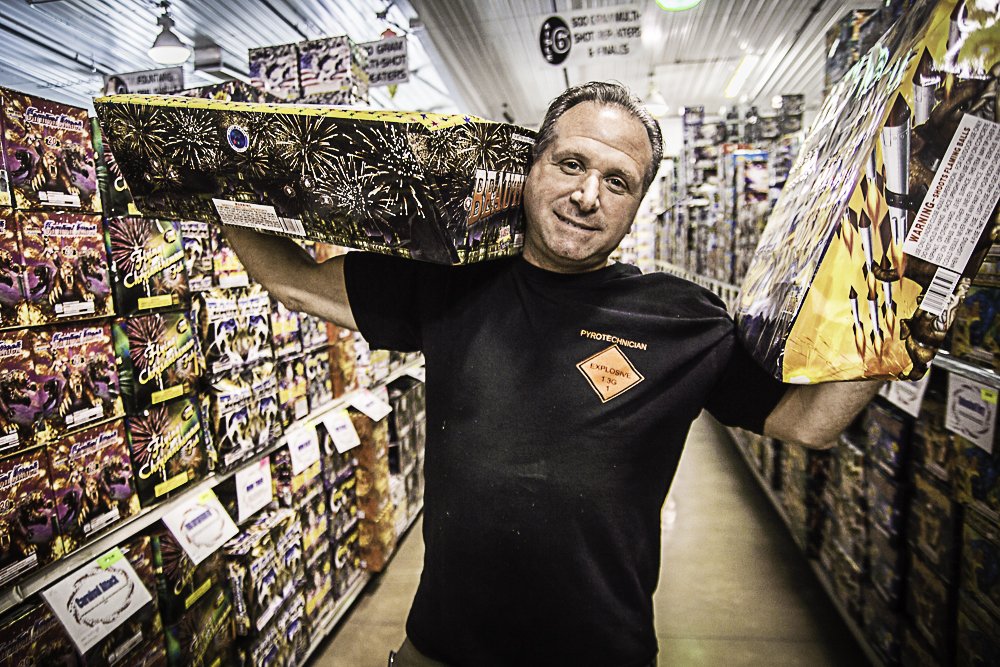
Massari, like Lomaz, had a long romance with fireworks. He told the High Plains Reader in 2015 that he had started selling fireworks as a kid “and just kept going and going and going.” He’d buy fireworks for a party, then friends would want him to get them some.
Back in 1991, the Chicago Tribune reported that Massari was driving a van full of bottle rockets, Roman candles and sparklers when a fire in the engine spread to the cargo compartment. The resulting explosions drew a crowd.
“There was a lot of popping,” a fire department lieutenant told the newspaper. “A lot of stuff was going off. One box was detonated, then the next box would go. It was kind of a chain-reaction thing.”
Massari told police his fireworks permit had burned up in the van fire. So they fined him for not having one.
Massari not only sells fireworks, he does a podcast about them. “The Fireworks Brigade-Pyro Podcast” has logged more than 150 episodes, including a one-hour roundtable last September in which Massari and three other fireworks aficionados swapped stories about the legendary Larry Lomaz.
Lomaz was infamous for stiffing business associates, they said, including rock and roll legend Chubby Checker. They talked about his many shell companies and read from old clippings about him, including an article that described him wearing a gold bracelet with a diamond-studded “L.L.”
He went to prison for six months in 1991, according to one of the roundtable participants, who once was a business partner of Lomaz. He had impersonated an FBI agent on the phone to try to force a West Virginia man who owed him money to pay up.
Another recalled Lomaz lighting firecrackers and throwing them into a bathtub at a swanky Baltimore hotel.
“That was Larry,” Massari said. “There were no rules.”
Massari knew Lomaz well, but it turns out he’s also well-acquainted with Nick Folino – and that chimney repair storefront in Berkeley, Illinois, whose address was listed on the illegal 2022 shipment.
One of Massari’s many businesses is N.J. Gary Properties. The registered agent for that company is Folino. And its address is 5317 St. Charles Road.
The two also had financial transactions for years before the Sand Island shipment was sent. In 2006, Massari and Folino signed the papers to buy a condo together on Michigan Avenue in Chicago. And in 2013, Folino got a mortgage of $49,700 from Massari – which appears to be a refinance of Folino’s stake in – once again – 5317 St. Charles Road.
Could Folino and/or Massari have been the intended recipients of the Sand Island shipment? It’s impossible to tell, because like Folino, Massari did not respond to multiple attempts to reach him, including emails, phone calls and letters delivered to his home and business.

Selling illegal fireworks from a legitimate retail outlet would be unusual, according to James Fuller, fireworks safety expert with the American Pyrotechnics Association.
“It is very uncommon,” Fuller said. “I cannot name another company that they were a legit operator and selling illegals. I have not run into that.”
Money, of course, would provide an incentive, he said, adding, “Crime is the intersection of profit and risk.”
Authorities Fail To Connect The Dots
These connections are laid out in public documents, many of them accessible to anyone on the web who is willing to do some digging. But federal and state authorities offer a confusing account of how extensively they pursued the leads in the 2022 case — a narrative so incomplete it’s impossible to discern whether they actually pursued them at all.
The container started its journey in Chicago, where Matson took possession and transported it to Oakland. At the Port of Oakland, it was loaded onto a container ship to make the roughly five-day trip to Honolulu.
The amount of stuff coming into Honolulu Harbor every day is staggering – the equivalent of about 1,420 20-foot containers. Shipping companies have little reason to examine the contents unless there is some red flag, like inconsistent paperwork or a leaking container.
In the end, it was just such a discrepancy that led to the discovery of the fireworks when a consultant working for Matson noticed the weight on the paperwork didn’t agree with the actual weight.
Civil Beat reached out to Matson to learn more and the international shipping giant at first agreed to discuss the case, but a few days later came back with a different response: decline to comment for fear that providing details would make matters worse.
“In the end, I was reminded that we work closely with State and Federal agencies to support law enforcement efforts and don’t want to inadvertently help smugglers or compromise enforcement work by sharing information about internal procedures,” spokesperson Keoni Wagner said in an email.

The Coast Guard has made it clear that it was primarily focused on the risk that the undeclared fireworks could set off an explosion, not pursuing legal sanctions. That’s why it made an area of Sand Island off-limits while authorities decided what to do.
“We’re concerned with identifying and correcting these safety issues,” Coast Guard spokesperson Matthew Vincent told Civil Beat in 2023 when we first asked what steps they had taken.
Vincent said that others had investigated the 2022 case – the FBI, the state sheriff’s office and the Coast Guard’s own investigators. But because the container had first been opened and inspected by the Matson consultant there was thought to be an issue with chain of custody that would have made legal action difficult.
Vincent said that authorities had identified the party receiving the contraband in Honolulu. It was someone not permitted by the state to receive aerial fireworks, he said.
When Civil Beat got the Coast Guard report several months later through the federal Freedom of Information Act, there was no mention of the intended recipient – just that “Liberty Fasteners” in Illinois was the named sender.
An official from the Bureau of Alcohol, Tobacco, Firearms and Explosives watched as the container was unloaded and inventoried on March 30, 2022, according to Coast Guard records. The ATF says it will help local authorities if requested and it’s able to.
An ATF spokeswoman told Civil Beat that because the fireworks were consumer-grade – containing less than the amount of explosives found in professional display pyrotechnics – they did not trigger federal jurisdiction.
However, in ping-pong fashion, the state Department of Law Enforcement, which now oversees the sheriffs, says it was indeed a federal case.
“As such DLE does not have a report,” the department’s then-spokesperson Brooks Baehr wrote in an email.
The state Department of Transportation’s Harbors Division likewise has no record of the incident.
State officials say things would be different today because they have since become more aggressive about rooting out illegal fireworks. A DLE task force established in 2023, a year after the Sand Island interdiction, has made some sizable seizures, including contraband found in containers at the port.
“If large quantities of fireworks are discovered in a shipping container today, DLE will confer with federal partners to determine the best path forward,” Baehr said. “That may include an investigation that results in state or federal charges.”
Back in 2022, the Coast Guard did find that the “Liberty Fasteners” shipment violated a provision of the federal hazardous materials transportation law. It ran afoul of state and local laws as well. The state and county laws in Hawaiʻi vary, but in general, aerial fireworks like the type found in the container are verboten without a professional license to set them off.
These laws involve monetary penalties and in some cases imprisonment. But no one was ever held to account.
The Pacific Fireworks Stalwart
Each December, around Christmas, Erika Kleinfeld flies to Hawaiʻi to open up the Līhuʻe fireworks store. It’s one of five Pacific Fireworks popups operating these days in Hawaiʻi – two on Oʻahu, in Kalihi and Kapolei, as well as one in Kailua-Kona on the Big Island and the Maui location where Nick Folino worked.
They’re generally in little strip malls like the New Year’s equivalent of a Halloween superstore, adorned with the company’s sign featuring tiki, a colorful bird and images of the aerial fireworks not allowed here.
It’s become an annual ritual for Kauaʻi’s newspaper, The Garden Island, to herald the advent of fireworks season by interviewing Kleinfeld. She likes to joke about seeing Santa as she travels to Hawaiʻi.
At some point, The Garden Island discovered that the retail store opens on or near her birthday, and now always mentions that. The stories update the number of years Kleinfeld has been coming to Hawaiʻi – now 24.

What the articles don’t mention is how she served as a front for Larry Lomaz’s shipment of 552 cartons of fireworks to Hawaiʻi – only one of which had a safety certification – so he could avoid reporting it to the feds in violation of his consent decree. Or that Kleinfeld did 20 days in jail in 2009 and paid $5,000 for her involvement in a computerized slot machine caper in Ohio promoted by Lomaz.
Civil Beat tried to contact her by phone and mail to ask about the many links between the store where she has worked for more than two decades and the 2022 Sand Island shipment. Like the others, no response.
In the annual Garden Island feature stories, though, she is always game to pose for photos filled with a riot of colorful fireworks displays, sometimes wearing a lei, always wearing a big smile, holding up the most popular fireworks product of the year.
The most popular item during the 2024 holiday season? “Waikīkī Lights,” she told the newspaper.
Civil Beat’s community health coverage is supported by the Atherton Family Foundation, Swayne Family Fund of Hawai‘i Community Foundation, the Cooke Foundation and Papa Ola Lōkahi.

