

Salary Commission Will Make Its Case For Big Raises For State Leaders
The effort may include public or private meetings with legislators, who have the ability to reject the entire pay package.
Facing political pushback, the commission that is recommending significant pay raises for top state executives, lawmakers and judges is planning to take its case to the media, legislators and others.
“This will require, really, an education, I think,” said Salary Commission Chair Colleen Hanabusa. On Thursday she asked her fellow commission members for ideas “to get this thing done.”
Commission members proposed writing articles for the editorial pages of local newspapers as well as meeting with editorial boards of various publications.
The seven-member state Salary Commission voted March 4 to award raises ranging from 35% to 48% over the next six years to top state officials, including the governor and lieutenant governor. The commission reaffirmed that vote Thursday.

Legislators Will Decide The Entire Package
State lawmakers play a critical role in this because most of the raises proposed by the commission will automatically take effect July 1 unless both the House and Senate vote to reject them by the end of the current legislative session.
That includes the raises for judges, the governor, the lieutenant governor and the governor’s department heads. Proposed raises for the Legislature would take effect later, on Jan. 1, 2027.
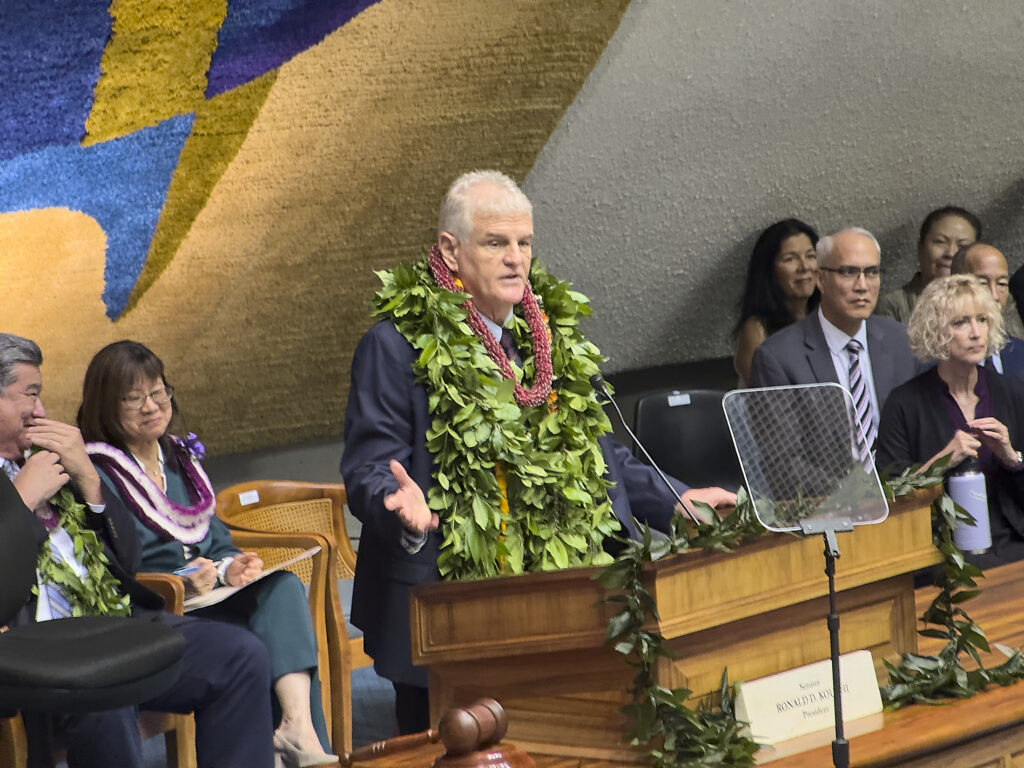
Hanabusa and other commission members agreed to consult with House Speaker Nadine Nakamura and Senate President Ron Kouchi on whether discussions with lawmakers about the pay package should be held in public meetings, or in closed-door caucuses.
“They probably would prefer that simply because they can yell and scream without having to worry about the public,” Hanabusa said of private meetings. “But some of them may want it in public so they can yell and scream at us in public.”
The commission heard testimony last fall from leading lawmakers who suggested higher salaries are needed to attract more candidates to run for seats in the Legislature.
Kouchi and Nakamura also argued that serving in the House and Senate is essentially a full-time job, and should be paid accordingly.
Legislators currently earn $74,160, and the commission has proposed a series of raises that would boost lawmakers’ pay to $114,348 by 2030.
Under the commission’s proposal, the House speaker and Senate president would see their pay increase from $83,052 today to $128,052 in 2030.
But some members of the House Republican caucus have been critical of the recommended raises, including Rep. Elijah Pierick.
“We’re basically getting a reward for not accomplishing anything,” he said. “Traffic is still bad, homelessness is still bad, crime is still bad, houses are still expensive.” He said lawmakers should not get a raise until more progress is made on those issues.
Urgent Need To Pay Judges Cited
The commission also heard testimony from state Supreme Court Justice Chief Justice Mark Recktenwald last year, who said there is an urgent need to raise the pay of state judges to attract the most qualified candidates to the bench.
Circuit Court judges currently make $217,014, and the commission has proposed increasing that salary in a series of six steps to $327,948 in 2030.
The pay package developed by the commission would also boost the pay for the governor in a series of steps, from $189,480 today to $275,304 in 2030. The lieutenant governor’s salary would also increase in steps from $188,400 today to $268,668 in 2030.
Hanabusa said the commission was required to take a second vote on the pay package Thursday because there was a possible violation of the state “Sunshine Law” in the March 4 meeting where the first vote was taken.
She said an “obscure provision” in the Sunshine law requires agendas for each meeting to be distributed to people who request them on the same day as the agendas are publicly posted.
The staffer who normally distributed those emailed notices was on vacation, and the notices went out late because they “fell through the cracks,” Hanabusa said.
Hanabusa asked the commission to vote again Thursday “in the abundance of caution.”
After making some technical changes, the pay package was then unanimously approved by the commission in a second vote.
The commission’s final pay proposal now goes to Gov. Josh Green, who will forward it to the Legislature for further consideration.

