

Hawaiʻi County Moves To Adopt Nepotism Rules For Government Employees
A lot of people know each other on the Big Island, and thatʻs all the more reason to be above reproach, a council member says.
It was an awkward moment for the Hawaiʻi County Council.
Last week, the nine-member board was considering the mayor’s nomination of Rebecca “Kawehi” Inaba to serve on the island’s Leeward Planning Commission.
The discomfort had nothing to do with her qualifications, experience or reputation. Inaba, a Native Hawaiian leader, has run her own business and nonprofit organization, and the testimony in support of her nomination by Mayor Kimo Alameda was glowing.
The issue was that Inaba is the mother of the council chair, Holeka Goro Inaba.
That same morning the council considered legislation to update the Hawaiʻi County Code to prohibit nepotism.
Bill 21 would ensure hiring and promotion of relatives be conducted in a fair and impartial manner. Specifically, it would adopt the state’s policy on nepotism found in the State Ethics Code.
That policy says no state employee can appoint, hire, promote or retain a relative or household member. Nor can they demote, discharge or terminate them, or participate in interviews or discussions regarding the hiring process.
The bill passed the council unanimously Wednesday and now awaits a final vote May 6. If approved and signed by the mayor, it would take effect immediately.

Heather Kimball, the council member who introduced Bill 21, said it has been difficult to fill government jobs. And even though the island has a population of over 200,000, a lot of people know each other and are related, she said.
“Trust in government is at an all-time low level,” Kimball said Thursday, pointing to recent corruption cases at the county, state and federal level. “It’s important for folks to be aware that the county is making efforts to be more transparent and ensure fairness in hiring practices and being responsive to those concerns.”
Kimball said the Kawehi Inaba appointment illustrated the concerns about nepotism, although it would not conflict with what’s covered under Bill 21.
If the bill becomes law, Kimball said the county’s Human Resources Department will need to change its hiring process to ensure that no immediate family members involved in reviewing applications for a position would have supervision of that person. If they did, they would need to be reassigned to a different supervisor.
Council Chair Holeka Goro Inaba was not involved in the mayor’s appointment of his mother and would not oversee her on the Leeward Planning Commission. He also recused himself from the vote — “which was the right thing to do, of course,” Kimball said.

Kawehi Inabaʻs appointment was approved in a 5-3 vote.
Council member Jenn Kagiwada, one of the no votes, told Kawehi Inaba that she had great respect and reverence for her.
“It’s nothing against you at all,” Kagiwada said. But she shared concerns with other council members that Inaba’s appointment might be perceived as a “power play.”
“Because that’s what my vote is against — it’s about the consolidation of power in too few hands, and not about you at all,” Kagiwada said.
Asked how widespread nepotism is on the Big Island, Kimball said, “There a general sense, even anecdotally, given that it’s a big island and yet it’s a small island, that this does go on, that these things do happen. With a small community like ours, and the historical perception that getting a job at the county was more based on who you know than anything else, there is kind of a public concern about it.”
Origins Of The Nepotism Bill
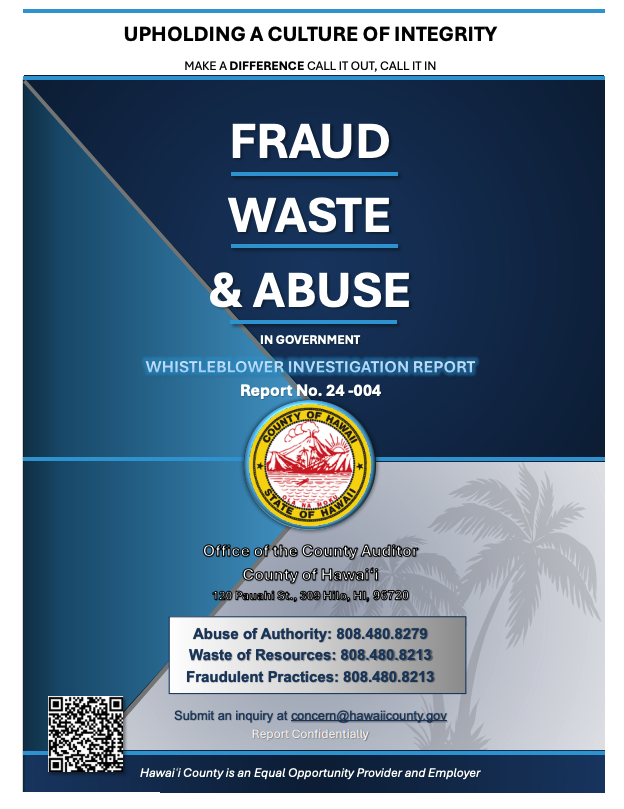
The impetus for Bill 21 was a 2024 whistleblower case investigated by Hawaiʻi County Auditor Tyler Brenner.
The case began with a fraud, waste and abuse hotline tip in February 2024 that raised questions about a hiring in a county department where a supervisor was alleged to have failed to disclose a family relationship with a job candidate.
“That same supervisor administered a field test prior to interviews without clear procedural guidance, and only the relative received a complete and exceptional score,” Brenner told the council at its April 1 meeting this month. “As a result, they were the sole candidate that advanced to interview. This raised concerns about how easily the process could be manipulated in the absence of proper controls.”
When Brenner first presented his findings to council members last July, he told them that the county did not have rules in place to prevent nepotism and unfairness in the hiring process for government employees.
The auditor also pointed out that the state in July 2023 enacted a nepotism law. The legislation was part of the recommendations of the so-called Foley commission, named for retired Hawaiʻi Judge Dan Foley.
Formally called the Commission to Improve Standards of Conduct, it was formed by the Hawaiʻi House of Representatives in 2022 after two state lawmakers were charged — and later convicted — in a bribery scheme tied to cesspool legislation.
Both Brenner’s office and the Hawaiʻi County Board of Ethics recommended that the county adopt the language of the State Ethics Code.
“It’s understandable that people want to see that those who they care about succeed, and at the same time, we have a shared responsibility to ensure that public employment is rooted in fairness, transparency and trust in the process,” Brenner told the council.
Brenner declined to comment on the whistleblower case Thursday except to say that it is no longer being investigated.
Council members worked on how to define who would be included in the definition of “immediate family member,” as there are varying cultural interpretations on how to define an ʻohana. The state law, for example, says “immediate family” includes people who become members through the Hawaiian hānai custom (informal adoption).
Bill 21 would define “immediate family member” to include not only spouses, siblings, children, grandchildren and parents of county employees and officers but also grandparents and stepchildren, foster and adopted kids; half-siblings and first cousins; and a sibling’s spouse, child, parent or in-laws.
Also included would be anyone who lives in the same home as the county employee or officer.
No employee or officer is allowed to take an official action affecting a business or other private undertaking in which they have a substantial financial interest, or in which they serve as a legal counsel, advisor, consultant or representative.
That prohibition also applies if an employee “knows or has reason to know” that an immediate family member has a substantial financial interest.
There was no testimony in opposition to Bill 21. Renee Schoen, a deputy with the Hawaiʻi County Office of the Corporation Counsel, testified in support.
Kawehi Inaba told the council that she was recruited by the mayor for the Leeward Planning Commission and did not pursue the position, but that she was “happy to serve.”
She also said she did not see how there would be a conflict.
“There’s no room for that stuff in what we both do,” she said, referring to her son. “I’m going to hold one-seventh of a vote. He’ll be holding one-ninth of a vote. The idea of how we would both be able to or how together we would create conflict, I don’t see that.”
‘Ohana Vs. Duty
Robert Harris, executive director for the Hawaiʻi State Ethics Commission, said Thursday he applauded the Hawaiʻi County for recognizing that public trust “is earned through transparency, merit-based hiring, and accountability. These values are at the heart of ethical government, and this legislation reflects that commitment.”
“This measure doesn’t stop county employees from loving their family — just from hiring them,” Harris said. “The County of Hawai‘i is drawing a clear line between ʻohana and official duty.”
It’s not clear if other neighbor islands might follow suit.

The Maui County Charter does not mention nepotism, but it does require that people who serve on boards and commissions not have conflicts of interest. The Maui County Board of Ethics also investigates conflicts of interest.
The Kauaʻi County Charter also does not mention nepotism specifically, but it similarly has a section on disclosures and conflicts. And the Kauaʻi County Board of Ethics similarly investigates complaints of violations of the county’s code.
The charter for the City and County of Honolulu, however, prohibits nepotism, and the Honolulu Ethics Commission enforces those laws.
On a related note, the Hawaiʻi House of Representatives approved a resolution April 3 urging the county ethics commissions to adopt standards similar to those used and enforce by the Hawaiʻi State Ethics Commission. The rationale for the resolution is “to improve honesty and integrity in government.”
Resolutions do not have the effect of law.
An identical House concurrent resolution — a measure that requests action on behalf of both the House and Senate — also passed the House but had not received a hearing in the Senate as of Thursday.
“A democratic system of government cannot function properly if the public believes its officials are corrupt,” the resolutions state.

