

Hawaiʻi Legislature Moves To Define And Criminalize Torture
Police and prosecutors testify the legislation is especially needed to protect minors.
A state legislative committee has unanimously approved a bill that defines and prohibits torture, making the crime — which is not addressed in current state law — a class A felony.
Senate Bill 281 states that Hawaiʻi’s criminal law does not adequately address extreme acts of cruelty and sadistic abuse.
Torture would be defined to include a range of physical and mentally harmful acts including strangling, burning, cutting, electrocuting and deprivation of food, water and clothing.
Police officers and prosecuting attorneys who testified in support of SB 281 Wednesday said children are especially the targets of behavior that far exceeds what is seen in typical child abuse and neglect cases.
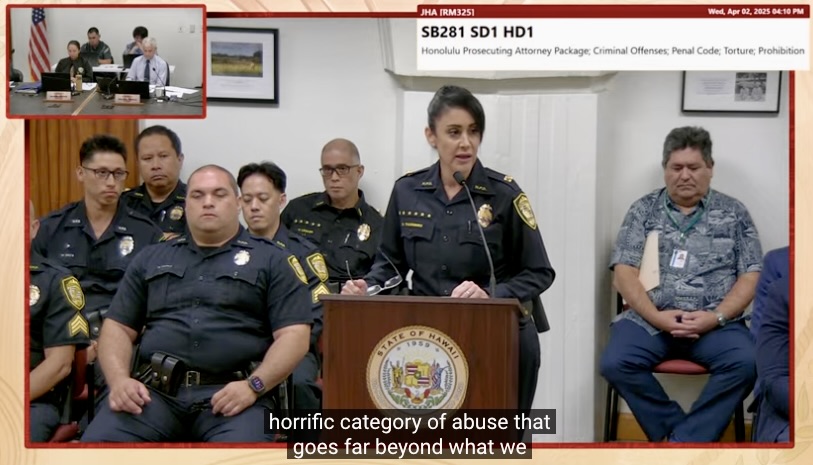
“It is prolonged, calculated and designed to inflict the maximum amount of suffering,” Honolulu Police Lt. Deena Thoemmes told the House Judiciary and Hawaiian Affairs Committee on Wednesday before the approval vote. “It is not just about physical injury. It’s about control, domination and cruelty. And too often, by the time these cases come to me in the homicide detail, it’s already too late.”
Thoemmes shared graphic details from her experience working on child abuse cases.
“I’ve walked into scenes where lifeless bodies of children bear the unmistakable signs of prolonged abuse — bones protruding from starvation, bruises in various stages of healings, bed sores, remnants of duct tape on their skin where restraints were hidden under their clothing,” she said.
“I have seen bruises on the inside of a child’s lips, a sign that someone held their mouth shut to silence their cries, burns on the soles of their feet, injuries to their wrists and ankles from being bound, hair forcibly removed, each injury telling a story of suffering that no child should endure.”
The only opposition to SB 281 came from the state Office of the Public Defender. Jon Ikenaga, the state public defender, said he did not oppose the full bill but rather objected to specific language regarding someone who exhibits a pattern of knowingly causing serious or substantial bodily injury to another.
Under existing law, such a violation is already a class B or C felony. In his written testimony, Ikenaga called this section of the bill “legally confusing” and something that does not make clear exactly what behavior is being prohibited.
In oral testimony, William Bento, an attorney with the public defender’s office, reiterated that concern but also said the office did not oppose “the intent or purpose” of SB 281.
Bento also highlighted another section of the legislation regarding bodily harm, this part referring to victims being in the control or custody of a perpetrator through legal means — such as through a court order — or illegal means such as kidnapping.
He gave the example of someone harmed while in prison. That goes beyond the stated purpose of the legislation, he argued, which is to punish people “who have committed acts with evil intent.”
In the latest draft of SB 281, torture would mean when a person knowingly harms a minor or vulnerable person through the following acts on three or more occasions within a period of two years:
- strangling;
- biting, branding, burning, cutting or electrocuting;
- suspending by the wrists, ankles, arms, legs, hair or other parts of the body;
- depriving of “necessary” food, water or clothing;
- restricting “necessary” bodily functions required for personal hygiene;
- forcing someone to remain in an area where urine or feces are present;
- forcing ingestion of mind-altering drugs that were not prescribed; and
- exposing someone to extreme temperatures without adequate clothing.

Rep. David Tarnas, chair of the House Judiciary Committee, said he would make “technical amendments for clarity, consistency and style” to the bill but did not indicate if he would incorporate the concerns of the public defender.
While it first needs approval of the full House, Tarnas said he expected that House and Senate negotiators would need to work on SB 281 when it is taken up during conference committee later this month.
One specific area, he said, was the addition of language to the bill by the Senate meant to clarify the “common state of mind” of someone who has exhibited a pattern or practice of physically abusing others.
Tarnas said he hoped to hear directly from the senator who requested the “state of mind” clause, Joy San Buenaventura, an attorney.
Tarnas thanked the police, prosecutors and public defenders for testifying on SB 281.
“This is a very serious matter,” he said before taking the vote. “I appreciate you bringing this to our attention and we appreciate your good work. This is very difficult work, and I’m sure you have nightmares about it, and so I just want to acknowledge your good work. We’re going to try to move this bill forward so you have more tools to use in the work that you’re doing.”

