Hawaiʻi May Cut Grass On More State Land To Prevent Spread Of Wildfires
The state land department is asking for $10 million more to battle wildfires.
Hawaiʻi’s wildland firefighting teams may soon have the authority to cut vegetation and establish firebreaks on significantly more state lands to reduce the risk of wildfires spreading into urban areas.
State law currently limits those efforts to forest reserves and lands under the control of the Department of Land and Natural Resources.
Senate Bill 223 would expand the state’s authority to take fire-prevention measures on all state lands and nearby areas to prevent what happened to Lahaina in 2023, when a fire that started on private land owned by Kamehameha Schools raged out of control and destroyed the town, killing more than 100.
A conference committee will convene Wednesday to hammer out a final draft of the bill.

The state resources agency said enacting the measure would require a significant increase in funding and personnel. The Division of Forestry and Wildlife is requesting $10 million to conduct the additional fire prevention, control, and reduction work across the state mandated under the new bill.
Lawmakers have yet to determine how much money to set aside for these additional wildfire prevention efforts.
Sen. Brandon Elefante introduced SB 223 after working with Aiea community members on issues related to overgrowth of vegetation. He said he believes that it is crucial to take care of the land, especially after the 2023 fires.
“Part of being good stewards is taking care of any type of overgrowth that one may have on their land,” Elefante said.
State Fire Protection Forester Michael Walker told lawmakers at a March hearing that DLNR would initially prioritize funding shovel-ready projects in hazardous fire areas, although the department did not point to any specific projects in its subsequent written testimony to lawmakers.

The state’s wildfire prevention efforts have been historically underfunded but saw an increase during the current fiscal year. In prior years, the forestry division got $3.2 million annually for fire suppression work, according to DLNR’s written testimony. That jumped to $18.8 million this year.
But state officials, citing the per capita spending rate for wildfire prevention in other states, say that’s still not enough.
The state Division of Forestry and Wildlife has been funding community fuel reduction projects by allocating $1.5 million from its operating funds. The division and the Hawaii Wildfire Management Organization are working together to fund projects within fire prone communities adjacent to state lands. SB 223 would continue those community-based projects.
“While this program is in its infancy, the division views it as a promising program to protect communities and watersheds,” Walker said during a hearing in March.
More Work To Combat Invasives
UH wildfire researcher Clay Trauernicht said Hawaiʻi isn’t doing enough to combat its serious wildfire risks. He thinks that the state needs to play a bigger role in ensuring public safety.
Trauernicht said that many overgrown properties were agricultural land during the plantation era and are now used for tourism or real estate developments.
“DLNR has done a fairly good job on their own land, but it’s all these landowners of former agricultural lands, not state lands, that pose enormous risk,” said Henry Curtis, executive director of Life of the Land, an environmental group.
As a result, land maintenance was neglected and grazing operations shrunk, leading to a substantial increase in buffelgrass, guinea grass, and haole koa – invasive species that help spread wildfires.
Those grasses are “just evolutionarily designed to burn over and over, so it just sets us up to have really frequent and sometimes large fires,” Trauernicht said.
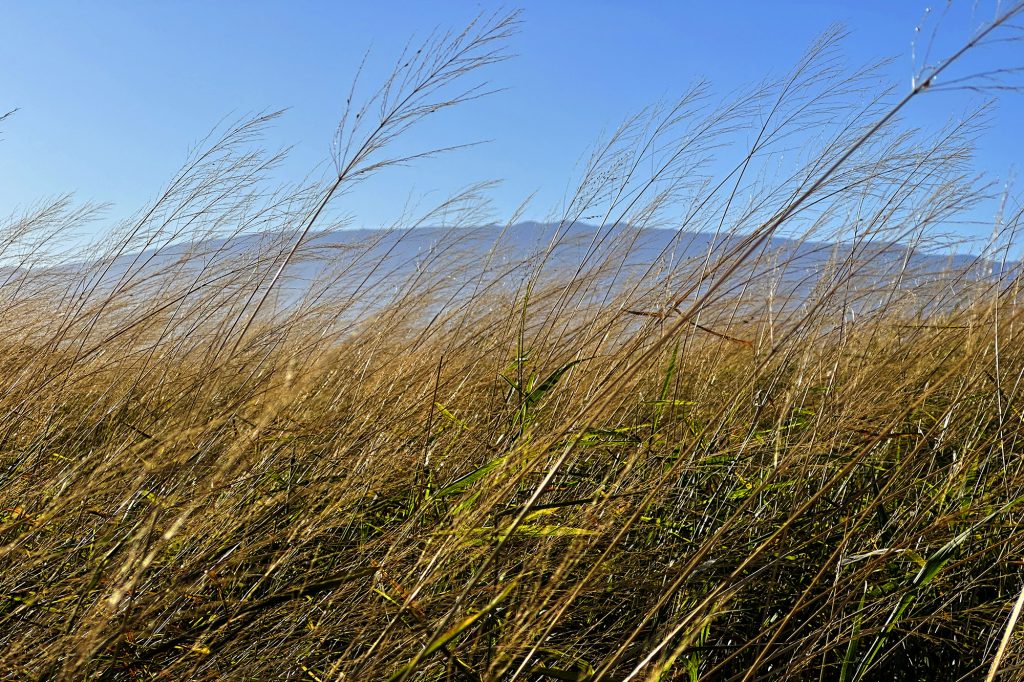
A quarter of Hawaiʻi’s lands are already covered by invasive plants.
About half a percent of Hawaiʻi’s total land area burns each year, a higher rate than other states, according to DLNR’s 2023 hazard profile. Additionally, more than half of communities in Hawaiʻi fall in the wildland-urban interface, also known as WUI, where the forests and wild lands meet or merge with developed areas.
The Hawaiʻi Wildfire Management Organization estimates that 94% of homes in Hawaiʻi fall within that interface.