

It’s Your Money: Blocking Religious Clubs At Schools Could Cost Hawaiʻi $100k
A lawsuit filed last year claims the education department violated a religious organization’s First Amendment rights by preventing the group from using school facilities.
For over a decade, the Child Evangelism Fellowship of Hawaiʻi has hosted religious clubs at public schools across the state. The after-school meetings, called Good News Clubs, offer free lessons on the Bible and Christianity and are open to all students.
“Our vision is that every child on every island can hear the Gospel by the age of twelve,” CEF’s website says.
But some schools have blocked the Good News Clubs from hosting meetings on their campuses since 2013, setting up CEF’s claims that it faced religious discrimination from the Hawaiʻi Department of Education.
Now, the state plans to pay $100,000 to CEF, according to a settlement lawmakers are currently considering. The settlement also directs schools to provide CEF the same access to their facilities as other after-school groups such as the YMCA or Cub Scouts.
If schools deny CEF’s request to use their campuses, principals must provide a written explanation of their decision within 21 days of receiving the application.
According to the lawsuit, at least 10 public schools denied CEF’s requests to host Good News Clubs on their campuses beginning in 2013. The most recent denial came from Pearl City Elementary in December 2023, a month before CEF filed its lawsuit.
While more than a dozen schools accepted CEF’s requests, others said they couldn’t host the club on campus because it was religious.
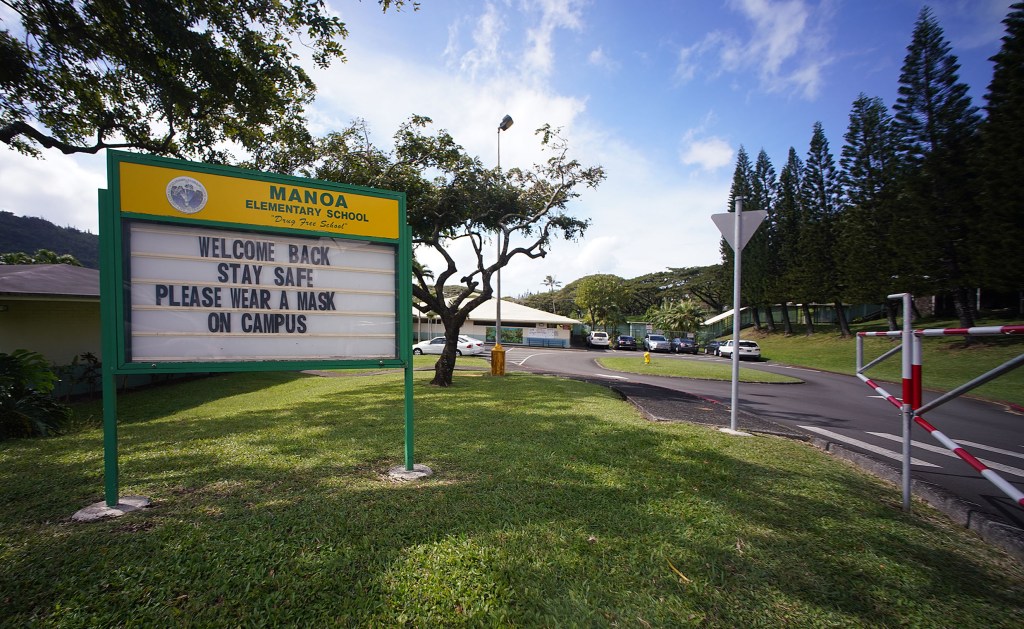
DOE’s guidelines around community organizations’ use of school facilities were unclear and implemented inconsistently across the state, said Daniel Schmid, who represents CEF in the lawsuit and serves as the associate vice president of legal affairs at Liberty Counsel, a Christian nonprofit focused on policy advocacy and litigation.
In some cases, schools charged CEF a few hundred dollars to use their facilities, Schmid said, while others let the Good News Clubs meet on campus for free.
“It just wasn’t uniform across the board,” Schmid said.
According to the lawsuit, the education department put CEF in the same category as churches and businesses, meaning schools could charge the foundation for custodial services and rental fees. Other after-school activities and sports teams were placed in a different category that exempted them from paying school rental fees.
By treating CEF differently from other after-school clubs, DOE discriminated against the foundation and violated its First Amendment rights, Schmid said, adding that the education department can’t deny CEF access to its schools simply because the foundation is religious.
“There was no reason to discriminate against CEF but for its viewpoint,” Schmid said.

The education department did not respond to requests for comment.
The $100,000 settlement is one of 31 claims involving multiple state agencies that together could cost taxpayers more than $7.9 million this year. The appropriations bill has passed through both the House and Senate and is waiting for a hearing in a conference committee.

Hawaiʻi Board of Education policy states that public schools can’t promote religion or provide religious instruction during class. But schools can allow students to pray or discuss religion outside of class as long as they’re not disruptive or coercing their peers, according to the policy.
Schmid said the Good News Clubs don’t violate BOE policies since they run after school and don’t force religion on anyone. The clubs are run by local churches, not the education department, he said, and students need their parents’ permission to participate.
Since Liberty Counsel filed the lawsuit, one school – Kohala Elementary – has reversed its decision and allowed a Good News Club to operate on campus. CEF currently hosts clubs at seven elementary schools on the Big Island and Oʻahu, said state director Matt Walton, and the organization is looking to expand to more schools next year.
Civil Beat’s education reporting is supported by a grant from Chamberlin Family Philanthropy.

