

After Fumbling Fire Priorities Last Year, Hawaiʻi Lawmakers Make Amends
After the 2023 fires destroyed much of Lahaina, Hawaiʻi vowed to improve prevention measures. More than two years later, the state has finally paved the way for that to happen.
As wildfire season looms over Hawaiʻi, West Oʻahu has called on the state’s utilities to remove and repair derelict infrastructure residents fear will ignite the overgrowth they have watched burn countless times in the past.
Driving the Farrington Highway corridor it’s easy to see why they are worried. Leaning power poles line the community’s single escape route, propping up sagging utility lines that cut through overhanging vegetation and occasionally bunch like bird nests.
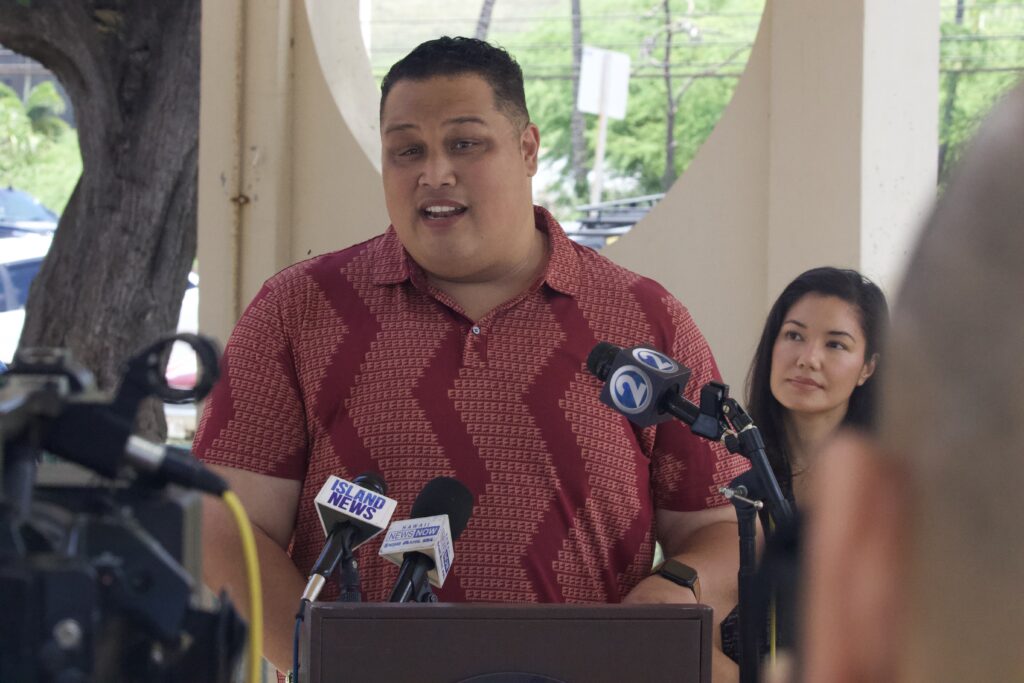
And though Hawaiian Electric Co. has said it’s keeping up to date on its maintenance and wildfire mitigation schedule, locals aren’t convinced — and Nānākuli Rep. Darius Kila says the lines are primed to start a wildfire, just as they did on Maui in 2023.
This may be the year that things change, as the state moves to finally hire a state fire marshal, a role legislators and officials expect to take on the lion’s share of wildfire mitigation work statewide. That will include engaging a swath of organizations to ensure the state is better prepared from the ever-present threat.

After the Lahaina fire razed more than 2,200 buildings and killed over 100 people, lawmakers came up with a long list of recommendations. But during the 2024 session, the state fumbled measures to better protect the islands.
“There were a lot of bills that had the word ‘wildfire’ in them, but I’m not sure everyone was ready,” Hawaiʻi Wildfire Management Organization co-Executive Director Elizabeth Pickett said. “Wildfire is a complicated subject and in the rush to do something, the bills just weren’t quite ready to meet the needs we have.”
This year, the Legislature passed House Bill 1064, which included the revitalization of the Office of the State Fire Marshal and other measures to address shortcomings identified by the Attorney General’s Office in January, in the last of its post-fire reports.
Hawaiʻi has thrown money at additional fire prevention efforts, including better wildfire forecasting and increased funding for the state wildland firefighting crews, among other things. But much of the prevention work like that needed on the west side of Oʻahu will fall to the future Hawaiʻi state fire marshal, a role expected to be filled some time next month.
While progress until now might have seemed relatively slow, many of those most deeply involved in wildfire safety say the government seems to be making important progress.
“Like most wicked problems, they’re not easy to solve,” said Kazuo Todd, chairman of the State Fire Council and the Big Island’s fire chief. “It’s a long slog but I think the right steps are being taken and we’re moving in the right direction.”
Righting Old Wrongs
The state pinned its hopes on the state fire marshal to address a laundry list of issues lawmakers identified following the 2023 fires, hopeful that reviving the office would lead to stronger prevention efforts statewide.
But a legislative blunder led the state to set aside just $172,000 to revive a two-person office with massive responsibility, including wildfire education, prevention and fire code development, among other things.
Now, with the passing of the new law, the fire marshal’s office will finally be able to “be a center point for the state to come together, take guidance and move forward,” Todd said.
The state will also inject about $4 million over the next two years to revive the office, which includes money for the marshal, a deputy, three fire investigators, two fire inspectors and an office assistant.
Lahaina Fire Forward Looking Report Priorities and Recommendations
1. Action Planning and Accountability
2. State Fire Marshal
3. Wildfire Education Programming
4. Communication Systems
5. Utilities Risk Reduction and Planning
6. Fire Weather
7. Evacuation
8. Codes and Standards
9. Wildfire Response Preparedness
10. Vegetation and Land Management
County Priorities and Recommendations:
1. Coordinated Action Planning and Accountability
2. Risk Assessment and Data Driven Investment
3. Wildfire Response Preparedness
4. Incident Management
5. Wildfire and Wildland Urban Interface Education
6. Communication Systems and Planning
7. Evacuation
8. Codes and Standards
9. Utilities Risk Reduction and Planning
10. Vegetation and Land Management
The state fire marshal’s office will complement the State Fire Council, which replaced the marshal in 1979 after lawmakers determined there were too many overlaps with the county departments. The State Fire Council in 2021 recommended the state consider revitalizing the office, and supported the recent measure.
The marshal’s office, which will be part of the Department of Law Enforcement, will fill key gaps, such as conducting fire code inspections on state-owned buildings, which have long been outside the jurisdiction of county fire prevention bureaus.
The marshal will also be responsible for implementing key priorities laid out in the attorney general’s third report on the Lahaina fires.
Enforcement is expected to be a primary responsibility for the marshal, along with fire safety education that is envisioned to be shared with all state and county agencies.
“With the fire marshal, that’s what you get,” said Derek Alkonis of the Fire Safety Research Institute, who co-authored the report. “You get a unified, consistent message throughout all the departments on the expectations for fire safety. That just doesn’t exist in the state right now.”
‘It’s A Start’
Besides establishing the new fire marshal’s office, the Legislature made other pots of money available for wildfire prevention and bolstered spending for agencies that address natural resources issues.
One of those is the state Division of Forestry and Wildlife, which has also been making good use of more than $20 million in state funds recently made available.

The forestry division is updating equipment, including buying brush trucks and bulldozers to cut fire breaks and upgrading radio equipment. The division oversees more than 1 million acres of state lands.
There’s also a sizable amount of work to manage fire prone vegetation and build fire and fuel breaks, state fire protection forester Michael Walker said, which needs to be done by the end of the year. That is particularly true on Maui, including lands in Kamehamenui, which the state recently reclaimed from a tenant rancher.
Walker said the division’s $7.5 million annual operating budget puts the agency “in a good spot, and I’m hoping it will continue that way.”
The state also set aside funds for a community fire prevention program as communities around Hawaiʻi started looking at their surroundings differently following the 2023 Lahaiana fire. Many more are now seeking accreditation as Firewise Communities, a program that allows neighborhoods to seek funding for mitigation work and sometimes lower their insurance rates.
Hawaiʻi has 31 communities fully enrolled, while 13 are in the process and five have expressed interest in the program, Pickett of the wildfire management organization said. Before Lahaina burned, just five communities were enrolled.

The state’s new “green fee,” approved in the last days of this year’s session, could also be a source of money for wildfire prevention. The state allocated an additional $1 million to a community-focused wildfire risk reduction program.
It’s the first time the state has made funding available to the community directly for wildfire prevention, according to Pickett.
“It’s a start,” she said. “But it barely scratches the surface of what Hawaiʻi needs to get safer.”
The state money is coming at an opportune time. Recent funding freezes by the U.S. Forest Service have affected Hawaiʻi’s wildfire prevention and mitigation efforts and are stoking confusion among state fire officials, who are now uncertain for the future of some federal grant programs, including the Community Wildfire Defense Grants Program, a $4.6 million initiative to collect native seeds and breed plants that are less fire prone.
“There’s rising community motivation and willingness but they’re going to need funding,” Pickett said. “They were lacking the money. Finally with these bills, they can actually do the work.”
Civil Beat’s coverage of environmental issues on Maui is supported by grants from the Center for Disaster Philanthropy and the Hawai‘i Wildfires Recovery Fund and the Doris Duke Foundation.
Civil Beat’s community health coverage is supported by the Atherton Family Foundation.
Civil Beat’s reporting on the Hawaiʻi State Legislature is supported in part by the Donald and Astrid Monson Education Fund.

