Failed ‘Assault Rifle’ Ban Was The Victim Of Convoluted Politics
Hawaiʻi has some of the most restrictive firearms laws in the nation, but senators balked in the 11th hour at a ban on semiautomatic rifles and large-capacity magazines.
Hawaiʻi lawmakers have passed an array of bills over the years to tighten the state’s firearms laws, considered among the strictest in the nation. In 1992, they banned sales of semiautomatic “assault pistols” such as the civilian version of the MAC-10. In 2018, they responded to the deadliest mass shooting in American history by banning bump stocks. This year, they shored up their prohibition of ghost guns, which can be created with a 3D printer and assembled at home.
But this year, lawmakers also failed to restrict sales of semiautomatic rifles with large magazines. Though popular with gun enthusiasts, such weapons have been used in many mass shootings on the mainland.
The ban on those guns was effectively blocked at the last minute by Democratic Sen. Lynn DeCoite, who said she wanted to exclude rural residents, subsistence hunters and conservation workers who use those weapons to combat invasive species such as axis deer and feral pigs.
Experts in firearms laws say the language DeCoite offered in her proposed amendment would have diluted the proposed restrictions in Senate Bill 401 so completely that the new law would have been largely unenforceable.
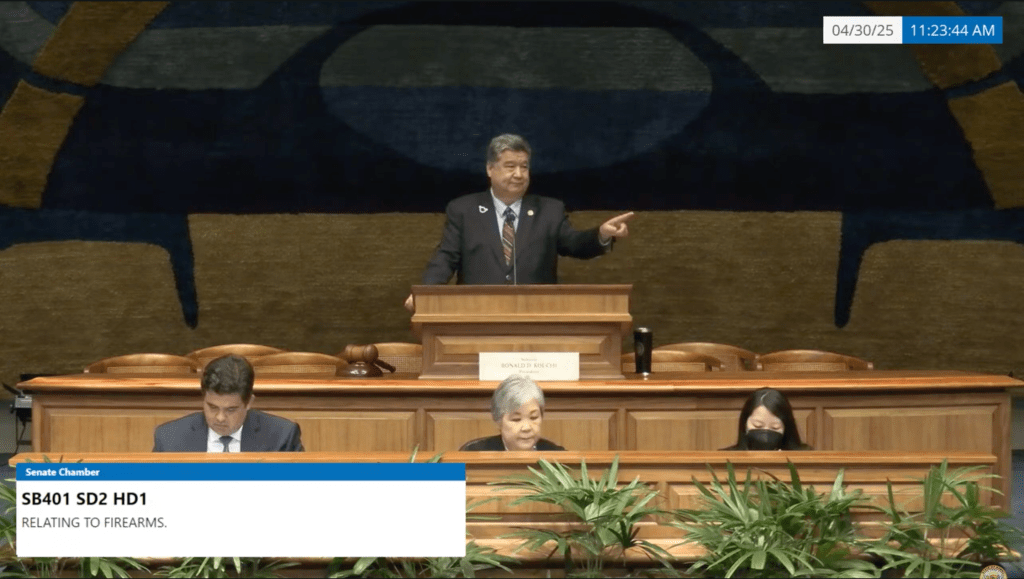
Senate Judiciary Chair Karl Rhoads, a leading advocate for the bill, said as much during the debate before the pivotal vote on the Senate floor. “This amendment creates a huge carve-out for the sale of assault weapons,” he told his colleagues. “If we pass it, it basically eviscerates the underlying bill.”
According to Republican Sen. Brenton Awa that was the whole point. “Essentially what this amendment does, if you don’t get caught up in everything that’s in it, is allows us to kill the bill,” he said.
None of the other senators bothered to argue with Awa, and minutes later he proved to be correct. The amendment passed 13-12, with Senate President Ron Kouchi from Kauaʻi casting the tie-breaking vote. He then announced the bill was shelved for the year.
That vote was a strikingly rare example of Senate Democrats joining with their Republican colleagues to muster a majority. It also suggests Hawaiʻi’s longstanding political consensus on firearms may be fracturing as senators from mostly rural districts join forces with a handful of Republicans to push back on the issue.
Rhoads, who has repeatedly advanced gun-control bills, said he won’t try to revive the measure next year, in part because it will be an election year.
“My instinct,” he said, “is that it’s a waste of time.”
Making People ‘Become Criminals’
SB 401 targeted what it defined as “assault rifles” — semiautomatic rifles fed by detachable magazines that have one or more military-style features such as a folding stock or a flash suppressor. After Jan. 1, no one would have been allowed to sell or import such weapons, along with “assault shotguns” with similar features.
The bill also would have outlawed all detachable rifle magazines that can hold more than 10 rounds.
People who already legally owned and had registered such firearms would have been allowed to keep them. Anyone with large-capacity magazines could keep those, too, if they were modified to hold no more than 10 rounds.
House Judiciary and Hawaiian Affairs Chairman David Tarnas, a Democrat, told his colleagues the bill was a measured attempt “to support gun safety.”
“It still would allow hunters and farmers and ranchers to purchase semiautomatic rifles for hunting” and to control animals, he said, “but it would provide for the ability for the public to feel more confident that we don’t have a lot of semiautomatic rifles that have these military attachments.”

Glennon Gingo, a hunter and board member of the Hawaii Rifle Association, countered that SB 401 would have banned a great percentage of modern sporting firearms used for hunting, target shooting and other activities.
Instead, he said lawmakers should put their energy into law enforcement and mental health care.
“If we need to fund those departments to make our community safe, let’s do it, but don’t go after law abiding gun owners, OK?” he said.
“We want people to be safe, especially our children,” Gingo added. “We’re all in it together, so we don’t have to make these arbitrary laws when we already have some of the strictest gun laws in the country.”
DeCoite, who represents rural Molokaʻi, Lānaʻi and parts of Maui, said she was concerned with the possible impact of the bill as it arrived on the Senate floor. She said the provision banning high capacity magazines would have made people “become criminals with the firearms they presently own.”
She wanted an amendment to allow people who own large-capacity magazines to keep them, a proposal she said was rejected because Rhoads refused to consider any changes to the bill.
The size of rifle magazines is important for large landowners who are trying to eradicate or cull huge herds of axis deer and other invasive species, she said. In the split second that it takes to reload, she said, the herd will flee.
“Let us stop the financial bleeding caused by invasive species, and let us ensure our laws are not enforced at the expense of those who protect the land,” DeCoite told her colleagues in a floor speech before the crucial vote.

A Proposed ‘Ban’ With Large Loopholes
If lawmakers’ aim was to limit the public’s access to assault weapons, experts who have studied firearms laws saw some problems in both the bill as it arrived in the Senate and the amendment offered by DeCoite.
One issue, according to Stanford Law School Professor John Donohue, is that the restrictions on assault rifle sales wouldn’t have taken effect until next year, giving people time to stock up.
“We know from prior experiences what happens is there is a massive gun-buying effort before the deadline,” he said.
Donohue said research shows banning high-capacity magazines does reduce the number of mass shootings, defined as those in which four or more people other than the shooter die, as well as the death counts in those crimes.
But he said DeCoite’s last-minute amendment to allow licensed gun owners to keep their high-capacity magazines was a problem if the objective was to limit the number of fatalities in a mass shooting.
Grandfathering high-capacity magazines already in the possession of gun owners would have made it almost impossible to enforce any restrictions, he said, because police would have no way to prove when gun owners acquired magazines.
Andrew Willinger, executive director of the Duke University Center for Firearms Law, said another problem with DeCoite’s amendment is it would have exempted people if they used assault rifles or large-capacity magazines for certain purposes.
Those purposes included invasive species control or hunting that is a constitutionally protected Indigenous right. Willinger said he has never seen language in a firearms law based on the intended use of a firearm.
“People buy guns for all different purposes,” Willinger said. “They might purchase an assault rifle for both a self-defense reason and for a hunting reason, right? And then how do you parse that, and how do you figure out why somebody’s buying a gun?”
In an interview with Civil Beat, DeCoite suggested there should be a line of questioning at the time of sale to try to determine why a purchaser wants to buy an assault rifle.
As for the language grandfathering in large-capacity magazines, she acknowledged there is no way to know when someone acquired a magazine because it doesn’t have a serial number.
“We have to try and fix that,” she said.
Poison Pill Amendment?
In casting the vote that inserted DeCoite’s exceptions into the bill, Kouchi not only helped kill the ban, he voted against the wishes of most of the 22 Democratic senators.
That sort of public division among Democrats in the Hawaiʻi Legislature is rare, and assault rifles present a politically touchy issue.
Gov. Josh Green had publicly endorsed SB 401, and a poll by Everytown for Gun Safety last year found 75% of registered voters in Hawaiʻi also support a ban on semiautomatic assault rifles. Everytown lobbies nationally on gun control measures, and did so for SB 401.

Kouchi serves as the Senate president at the pleasure of the Senate Democrats, and it is extraordinarily rare for him to vote against his Democratic majority. When asked if he had ever done so before, he replied: “I don’t know, I guess. I just looked at what that bill was and what the issue was, and cast my vote.”
Kouchi said he had hoped the House would also approve DeCoite’s amendment, allowing the bill to pass. But DeCoite said she was unable to get any Democrat in the House to introduce her floor amendment.
That’s when the the politics became even more convoluted.
DeCoite said she finally had to ask Awa, the Senate Minority Leader, to request that House Minority Floor Leader Diamond Garcia introduce her amendment in the House.
Garcia said he did so as a courtesy, but he opposed SB 401 and wanted the bill to die. As soon as he learned DeCoite’s amendment had passed in the Senate, Garcia told the House clerk to withdraw the House version of DeCoite’s floor amendment, ensuring SB 401 would fail.
The chain of events drew a sharp response from Everytown for Gun Safety. Krystal LoPilato, director of policy advocacy for the advocacy group, said in a written statement that Kouchi had “blessed an amendment the morning of the final floor vote without an accompanying amendment in the House.”
“Introducing any amendment at the 11th hour without an accompanying House amendment, had only one purpose: to kill the bill,” LoPilato said in her statement.
In response, Kouchi told Civil Beat, “I voted the way I did, you know, and stand by my vote. That’s the only comment I really have.”
He said he supported the amendment because “I have a large hunter and fisher group on Kauaʻi, and they are putting food on their table as part of the subsistence in meeting some of the challenging economic times.”
He said there were also concerns that some law-abiding people might be unknowingly turned into “felons” because they own large-capacity magazines that would have been banned if the bill passed.
DeCoite said she has already reached out to Senate Democrats to begin discussions on how to follow up on the issue next year.
Civil Beat’s community health coverage is supported by the Atherton Family Foundation.
Civil Beat’s reporting on the Hawaiʻi State Legislature is supported in part by the Donald and Astrid Monson Education Fund.