

Early College Grads Get Degrees. But Do They Land Jobs?
Many students who earned college credits to get early degrees went on to have fulfilling careers, but data isn’t yet available on how the graduates fare after college.
Since 2018, Hawaiʻi’s early college programs have helped thousands of students get a head start on earning degrees, some even finishing just a year or two after high school.
Research has established that college graduates tend to have better career outcomes. And data in Hawaiʻi shows that those who earned credits early are far more likely to complete their degrees on time. But what does that mean for their job prospects after finishing school?
Anecdotally, the results are good – some early college graduates went on to careers in education and law. But data isn’t yet available on how those graduates fare after college. Those metrics are expected to come out later this year.

Still, lawmakers tried to force the issue after years of not being able to get a clear picture of job outcomes for Hawaiʻi’s college graduates. The Legislature moved a bill that would have required the University of Hawaiʻi to collect and report on graduate outcomes. The data would have then been used to construct a dashboard for all of this information.
“We keep asking every time we appropriate all this money to the university and we want to know the data, how many graduates go into their profession,” Sen. Donna Mercado Kim said during a hearing on the bill earlier this year. “And they keep saying, ‘we’ll get you that data’ or whatever. But shouldn’t that data be already provided?”
The measure ultimately failed in the final days of the legislative session.
Too Early To Tell
Nicole Atwood, the early college program manager at the University of Hawaiʻi, said the early college programs aren’t specifically focused on career development.
“We’re aware of workforce outcomes and so that’s why we’re trying to be thoughtful about what courses are being offered that are aligned to these higher demand areas,” Atwood said.
UH and the state Education Department have targeted technical fields as well as health care, skilled trades and education.
Before state funding for early college programs was approved in 2018, participation was sporadic. That funding boost led to an influx of students participating in career programs – enough to actually be studied.
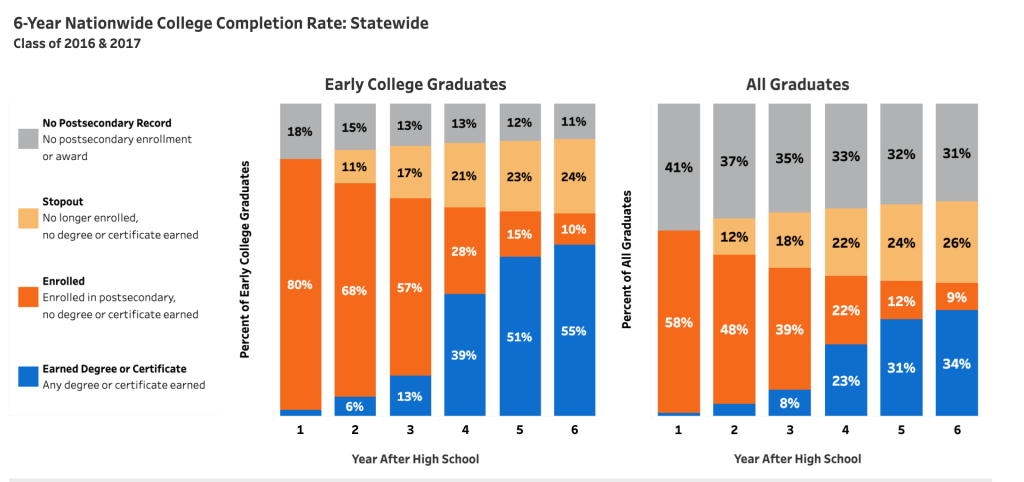
Researchers and officials have been tracking those cohorts since then.
“If we pulled some of this employment data too early before we saw this massive influx of kids into Early College, we wouldnʻt be able to report anything meaningful to people, because then the size would be too small,” Atwood said.
Hawaiʻi P-20, a partnership between the the state’s early learning office, the DOE and UH, plans to release data on career outcomes for early college graduates later this year.
‘A Running Start In Life’
Jade Wall, a public school special education teacher, recalled her days in high school spent commuting between Kaimuki High School and Kapiolani Community College. She was a part of the Running Start program, where high school students spend part of their day taking college classes.

“It gave me a running start in life, in higher education, and to gain the tools, knowledge, and skills early on to succeed in college,” said Wall.
Earning those college credits early gave Wall the freedom to pivot between potential career paths early in her academic journey.
Wall transitioned from law and politics to education, when she realized that the latter was where she saw the great potential for impact. After completing her bachelor’s degree at Corban University in Oregon, she moved back to Hawaiʻi to earn her master’s in education at UH Mānoa.
Now, she has eight years of experience in the DOE, and is continuing more of her studies at UH Mānoa.
Hollie Radar recalled experiencing a shift of interest in the middle of a lecture on the immune system. Radar wanted to go into the medical field, but couldn’t see how much of a difference she could make if there would always be sick people in the world.

“There will never be an end to my clientele and I thought that it would be through policy in which I could make a longer lasting impact,” Radar said.
She wanted to get into a field that advances social justice, After earning an associate’s degree, she’s now a paralegal at the Legal Aid Society of Hawaiʻi, which helps vulnerable populations in the state.
Early college programs buy students “a little more time to explore and see what they’re really interested in,” said Kimberlee Baxter, Chaminade University’s Early College coordinator. “I think, so often, students major in something and feel stuck in that major because they’re, well, ‘I’ve already invested two years into it in college, and it’s too late’, right?”
Baxter adds it could also allow students more flexibility to pursue study-abroad opportunities and others that may be beneficial to students and their careers.
But that decision – to go to college early or stay on a normal track for high school – is ultimately up to the student. Managing a high school courseload on top of college classes and a job can be tough for many.
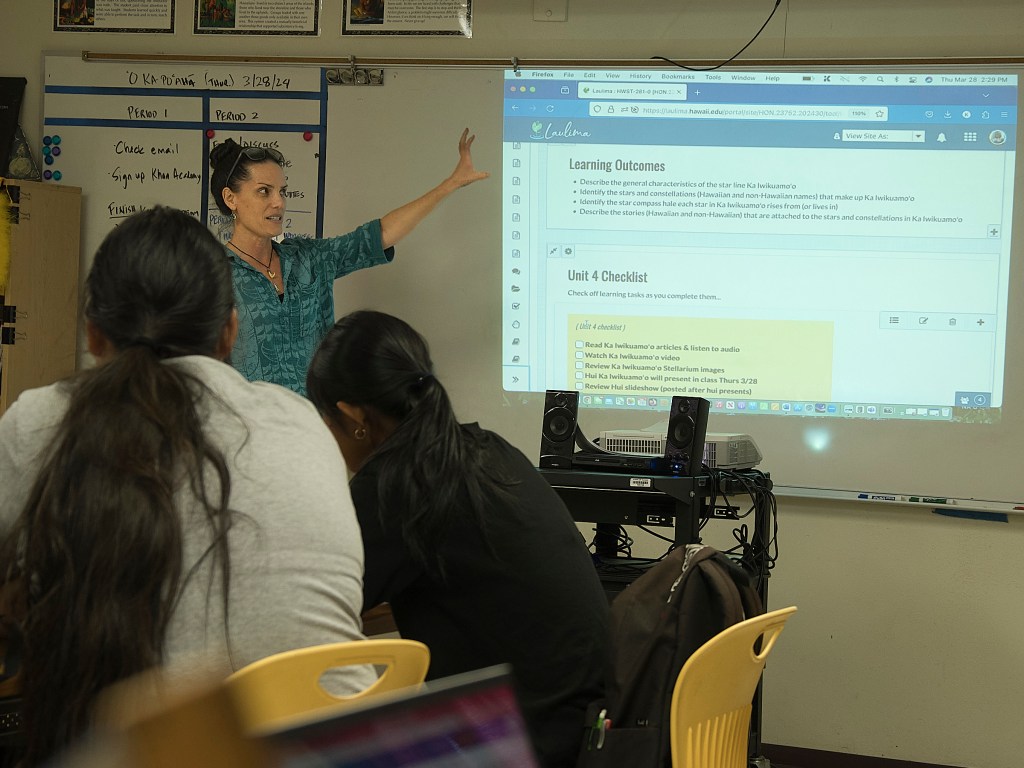
“My role is really just supporting and kind of guiding them through their decisions,” said Jaena Kruse, a college and career counselor at Farrington High School.
Kruse said she knows of Farrington alumni who have cut down the amount of time they’ve spent in college and are pursuing master’s degrees. The high school’s first early-college graduate back in 2020 is now an entrepreneur.
Rick Yamashiro, a counselor at Campbell High School, said students who took dual-credit courses have a better chance at attaining advanced degrees quicker “to improve as a professional through education.”
“They took that chance,” Yamashiro said. “It paid off.”
Civil Beat’s education reporting is supported by a grant from Chamberlin Family Philanthropy.

