

Transgender Troops Fight Trump’s Ban As A Matter Of Life Or Death
The U.S. Supreme Court recently cleared the way for transgender troops to be removed from duty.
Laila Ireland remembers watching the 9/11 attacks on TV at Leilehua High School. Influenced by her family’s legacy of military service, she felt it was her duty to join the Army.
“I told myself, I’m going to war,” recalled Ireland, who was assigned male at birth before she transitioned.
She enlisted and spent years fighting for the rights of transgender service members.
Now, the Trump administration seeks to undo much of that work by banning transgender people from the military and cutting their benefits.
Thousands of troops and veterans risk losing financial coverage, mental health resources and medical care such as hormone therapy. An exact count of transgender troops isn’t available, but a 2018 estimate by the Palm Center as part of research into LGBTQ issues put the number at more than 8,000 active forces.

Ireland is retired but relies on her husband’s spousal coverage, and his job is at risk. Air Force Staff Sgt. Logan Ireland, who is stationed at Joint Base Pearl Harbor-Hickam, has openly served as a transgender airman for more than a decade.
In the wake of recent executive orders, Ireland’s husband Logan became one of the lead plaintiffs in a lawsuit fighting the Trump administration’s ban. Last week, the U.S. Supreme Court ruled in a separate case that the ban stands for the time being while Ireland’s case and others proceed through the lower U.S. District Courts.
The impact of the court’s decision could be felt quickly in the islands, where the military population makes up close to 10% of the 1.5 million population. It’s not known how many troops in Hawaiʻi are transgender but the military also forms a key component of Hawaiʻi’s economy.

The fate of transgender service members in Hawaiʻi and across the U.S. is still undecided. They remain active while awaiting guidance from the Defense Department, which will dictate how and when they would be removed.
Those seeking transgender care could still go to clinics outside the military or those administered by the U.S. Department of Veterans Affairs.
But Hawaiʻi has a shortlist of gender-affirming care providers, and advocates worry that those services are already flooded by others seeking such care. Service members would also need to deal with gaps in insurance coverage faced by civilians if seeking treatment and support outside of those once provided through their military benefits.
Defense Secretary Pete Hegseth issued a directive after the Supreme Court decision that would begin forcing as many as 1,000 service members who openly identify as transgender out of the military while giving others 30 days to self-identify.
Active duty trans service members like Logan Ireland had the option of leaving the service voluntarily by the end of March and receiving double the pay they would if they are involuntarily separated from the military.
They could choose to stay in the hopes of retaining their benefits if they are able to remain in the service, but run the risk of involuntary separation and losing out on both their benefits and the extra separation pay.
Laila Ireland feels the distinction is irrelevant.
“They’re taking away VA health care for trans people… Either way, you’re losing,” she said.
Fighting For Rights
The Irelands met in the service and married in 2016 in Hawaiʻi. Logan Ireland was transitioning at the time.
For Laila Ireland, confusion around gender norms started in early childhood.
About 10 years after enlisting, she described her struggles with identity to a therapist. The therapist slid her a note with the word “transgender” and told her to do some research.
“It was like light bulbs going off everywhere,” she said. “I’ve always felt myself to be a girl, a female.”

In 2011, Ireland fought for the repeal of the “Don’t Ask, Don’t Tell” policy, which allowed LGBTQ troops to serve in the armed forces if they didn’t disclose their sexual orientation. She also played an active role in the implementation of an appeal to fully open service for gay members.
Ireland was coming to terms with her identity as transgender woman around that same time but was dismayed to learn that the open-service policy excluded transgender individuals.
Transgender troops make up a small portion of 2 million-strong military, but advocacy groups say that the military is one of the largest employers of transgender people in the U.S.
In 2013, Ireland helped found SPARTA, a nonprofit organization advocating for the rights of transgender service members and veterans. The group helped fight for the 2016 decision to allow transgender troops to serve openly.
But just one year later, in 2017, Trump issued his first ban on trans service members during his first term. While his attempts were blocked by the courts and eventually undone by Joe Biden’s administration, Trump’s re-election last year was a massive blow to the Irelands and their community.
Ban Faces Legal Fight
Logan Ireland has performed multiple tours of duty in the Middle East and was supposed to be on a temporary assignment in New Jersey until the end of March.
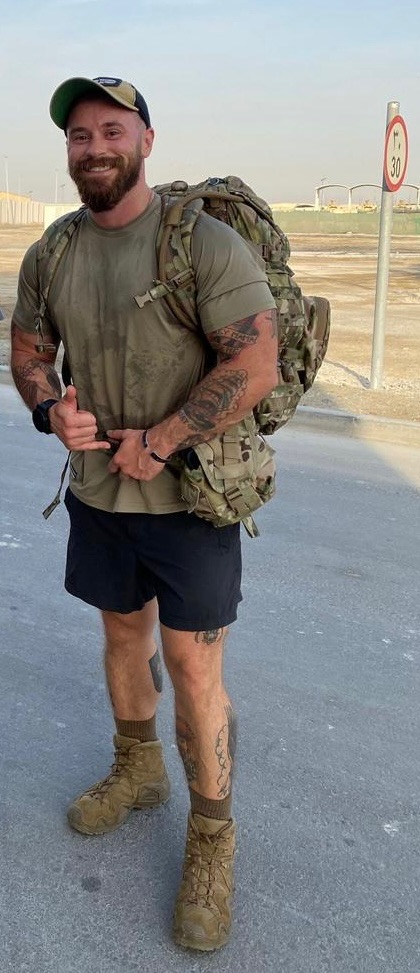
Following Trump’s Jan. 27 executive order, he was placed on administrative leave and told that he could only continue serving if he did so as a woman. Having undergone a surgical transition to life as a man, that would be impossible, he wrote in court filings.
His lawsuit seeks relief from the Trump administration’s “discriminatory directives,” based on a constitutional right to service that the plaintiffs argue shouldn’t be impacted by their transgender status.
“Logan bleeds blue,” Laila Ireland said. “He is a patriot through and through. He loves his job. He loves the service he contributes to this country.”
In addition to Logan Ireland’s legal efforts, advocacy groups Lambda Legal and the Human Rights Campaign Foundation filed a federal lawsuit challenging Trump’s executive order.
The ban is “devastating for the thousands of qualified transgender service members who have met the standards and are serving honorably, putting their lives on the line for their country every single day,” GLAD Law, which advocates for the LGBTQ community, said in a statement.
White House Wants ‘Cohesion’
If access to military-funded health care is lost, transgender troops will be forced to search for other providers.
Not all service members would have access to the in-state insurance necessary to reduce the costs of care. Ireland worries that local sources of care might also be overwhelmed by an influx of traffic.
Ireland fears that trans people, who depend on gender affirming care such as hormone replacement therapy will take delicate medical procedures into their own hands.
The White House executive order says that transgender service members are a threat to their units’ cohesion and combat effectiveness. A White House statement also said that the medical constraints associated with transgender people are incompatible with active duty.
Ireland thinks that removing transgender troops is illogical.
“We all see each other as people,” she said. “We often see each other as equals, because you’re doing your job. I’m doing my job.”
The military’s own 2016 internal study and a complementary report found “that the needs of the military would be best met by permitting transgender people to serve on equal terms with others.”
During her service, Ireland rarely felt like she couldn’t express herself to her fellow troops.
“The soldiers that I was stationed with really allowed the space for me to be myself in confidence,” she said.
Access To Care Is ‘Life or Death’
For other trans service members like veteran Amadeus Hill, adversity in the service was much more explicit. After coming out as a trans man in the Air Force, he faced extreme backlash.

In a unit full of mostly Southerners, he said he was exposed to bigotry and racism on a daily basis.
However, like Ireland, he feels that most service members evaluate their unit members by the merit of their work, and that unit cohesion – as the White House describes it – is a non-issue.
Hill remembers coming out as transgender for the first time, around 2022, to a nurse in a military hospital, where he was dealing with mental health issues.
“For the first time in a long time, I felt joy,” he said.
But Hill struggled to find access to care even before Trump took office. At one point, he had to resort to getting testosterone injections at a local hosptial that cost $100 each week before his VA benefits kicked in.
“It felt like life or death,” he said, comparing the feeling to a diabetes patient who needs their medication.

