

How UH Is Trying To Hold Onto Hawaiʻi’s High School Grads
Federal data shows a decline in students staying home for college. The University of Hawaiʻi is trying to reverse that trend.
Samantha Sebastian left Oʻahu for the University of Notre Dame with hopes of finding a competitive academic environment and more opportunities than Hawaiʻi could provide.
Most of Sebastian’s high school classmates thought that any mainland university was an upgrade from the University of Hawaiʻi. They believed that UH could not give them a college experience in a new, bigger environment where they could grow socially and independently.
“They had this view that UH was just a school to apply to for safety,” said Sebastian, who graduated in 2022 from Hawaii Baptist Academy, a private school in Honolulu.
Local students have increasingly been moving out-of-state for higher education, according to data from the National Center for Education. That raises concern about a brain drain from the island state, which already suffers from an overall population decline due to a high cost of living and a housing crisis.
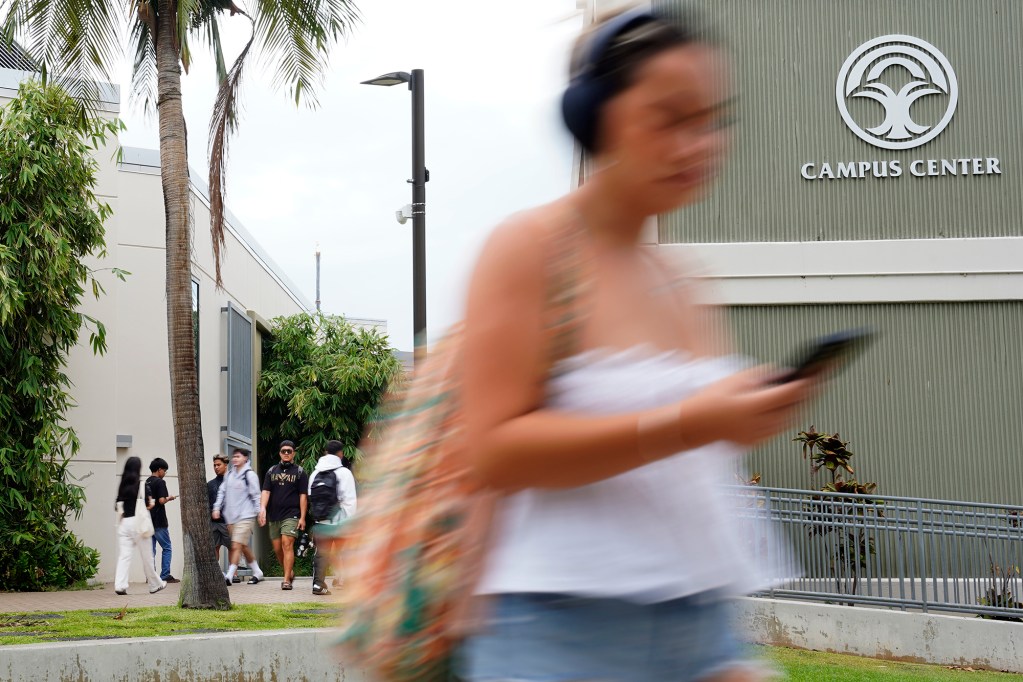
The state-run University of Hawaiʻi, which has 10 campuses including community colleges, has managed to buck that trend and retained more residents in recent years.
Nikki Chun, UH vice provost for enrollment management, attributed the increase to the elimination of an application fee for residents and a change in UH’s merit scholarship program. As of last fall, UH offers a $3,000 per year scholarship to Hawaiʻi resident students with a GPA between 3.0 and 3.59. That is in addition to merit scholarships of $4,000 a year for GPAs of 3.6 and up.
For a long time, residents “have been choosing (UH) Mānoa,” Chun said. “But I think perhaps they were led to believe that it was not a top choice.”
Seeking More Opportunities
High school graduates everywhere often strive to attend more prestigious out-of-state universities. In Hawaiʻi, the decision to leave the islands for the mainland is also influenced by a lack of job opportunities in the islands and a perception that the quality of education at UH is substandard.
That’s despite the university’s reputation as a top research university — the Carnegie Foundation lists it among the top 146 research universities in the country — as well as generally high rankings among institutions nationwide.
Danford Chang, a college counselor at Hawaii Baptist Academy, acknowledged that students who go to the mainland are guaranteed a wider variety of opportunities, such as more degree programs and employment options.
“There are certain opportunities that a lot of our kids are leaving the islands to do,” he said.
Chang said parents of private school students who have paid tens of thousands of dollars for their children’s education hope that will pay off with acceptance at an Ivy League or other prestigious school. However, he tries to dispel the myth that UH is not up to academic par and emphasizes to students that it is more important to find a college that is the best fit.
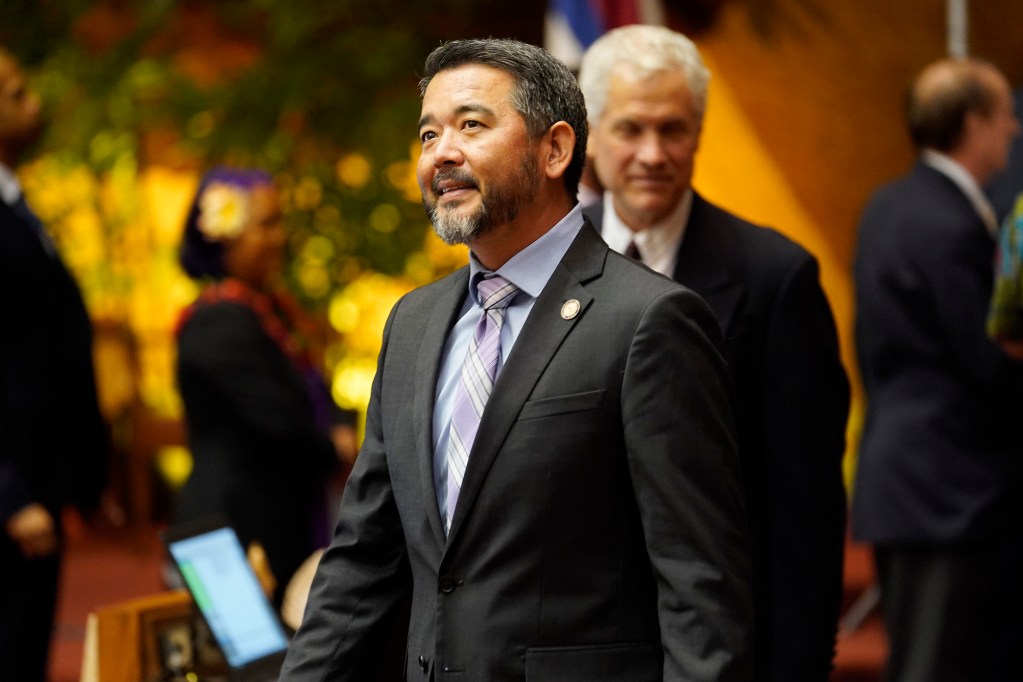
Rep. Andrew Takuya Garrett, the House Higher Education Chair, noted that people take different paths to find success, but he would like to put an end to any stigma against staying home to attend UH Mānoa.
Garrett, a UH graduate, said that some think that staying in Hawaiʻi means that they have settled for an inferior education.
“We have to challenge this notion,” he said, “that somehow students have to go away to find success.”
Brain Drain?
Federal data shows that enrollment of Hawaiʻi residents at in-state institutions peaked in 2010 at 8,849 but fell over the years to 5,748 in the fall of 2022. Meanwhile, migration of students out of state increased from 3,292 in 2006 to 4,236 in 2022.
UH statistics show a similar trend but also record an uptick in local students starting in 2023. Data on Hawaiʻi resident enrollment also could include non-local students who changed their permanent address to Hawaiʻi after obtaining residency here.
Both Hawaiʻi residents’ and overall enrollment at UH Mānoa decreased from 2015 to 2019. However, enrollment numbers significantly increased last year, making it the first fall semester with Hawaiʻi resident enrollment over 9,000 — or more than 58% of undergraduate enrollment — according to the Mānoa Institutional Research Office.
It’s the largest number of Hawaiʻi residents at UH Mānoa since at least 2016.
JoonYup Park, an economist at the UH Economic Research Organization, said the increase in local student retention in Hawaiʻi colleges between 2006 and 2010 could have been due to the Great Recession when students would stay home to save money. Once financial pressures decreased, more students had the means to afford out-of-state tuition.
Park found that more adults ages 18 to 24 left the state than came in during recent years.
Park said more competition and a limited variety of industries in Hawaiʻi could be factors that influenced the increase in migration of local students to the mainland in search of college or career opportunities.
He said the trend toward outmigration was tempered by a net gain in Hawaiʻi-born individuals ages 25 to 44 — the prime working-age — who have returned.
“It’s not brain drainage,” Park said, “but it’s more like young brains going out to get more education and then bringing more improved brains back to the island.”
Housing And Social Life
In interviews, students cited poor housing conditions and a general lack of social life as reasons for wanting to move away for college.
Housing is not guaranteed for freshmen at UH Mānoa and those trying to get into the dorms are often faced with a waitlist. Some facilities are outdated. The Hale Noelani complex has been closed and uninhabitable for several years.
UH Mānoa student Kevin Aquino spent his first year living at Johnson Hall B. Aquino. Now a junior, Aquino described the accommodation as hot and smoky.

Most of the dorms don’t have air conditioning. But Aquino said it was the condition of the communal bathrooms that eventually drove him to move back in with family.
Janitors would clean the communal restroom about three times daily, he said, but students did not clean up after themselves. Also, it took about three months until a bathroom stall’s door was fixed.
“The dorms in general are not bad,” Aquino said, “it’s just how the students make their environment there.”
Legislative Action
State lawmakers have responded by allocating more than $59 million over the next two years to improve housing at UH Mānoa. Garrett agreed that new student housing facilities are essential to improving student retention and recruitment.

Sebastian, who left Hawaiʻi for Notre Dame in Indiana, said her main concern was UH Mānoa’s social environment.
She appreciates Notre Dame’s abundance of social networking opportunities and activities on campus. Often, she stumbles upon a social event or walks into an acoustic music performance hosted every Thursday at the campus’ student center.
Sammie Lin, a junior at UH Mānoa, has had the opposite experience. Lin said local students usually just eat or study with their friends and she finds it difficult to meet up with people on campus due to differing schedules and lack of activities that they find mutually interesting.
Even though there are occasional events and over 200 student organizations on campus, Lin thinks the university does not effectively promote them. Students can see updates on UH’s Instagram account, but not every student checks it regularly.
She also said thinks it’s harder to find future career opportunities and university-related social networks.
“You have to be extra driven and create that community for yourself,” Lin said.

