Lahaina Wildfire Debris Heading To Final Central Maui Site In June
Officials say they have worked to minimize traffic and address health concerns. But a December deadline for removal looms large.
Starting in early June and continuing all day, every day, for five months, up to 50 tractor-trailers will pull up to a temporary landfill in Olowalu to be loaded with the ash and debris from the Lahaina wildfire.
That’s according to the U.S. Army Corps of Engineers and Maui County, under a plan in which the trucks will travel about 19 miles to a permanent disposal site in Puʻunēnē in Central Maui. The route will take them along the coast via the narrow, winding Honoapi‘ilani Highway, then up Kūihelani Highway just north of Maalea, where the trucks will use a former cane haul road for the rest of the trip.
With each truck expected to make four round trips a day, that means they will go back and forth 200 times, all during daylight hours. And, by the end of the year, all 400,000 tons of debris now at the Olowalu site will be moved to the Central Maui Landfill, and the temporary landfill in Olowalu will be emptied and ready to be restored.
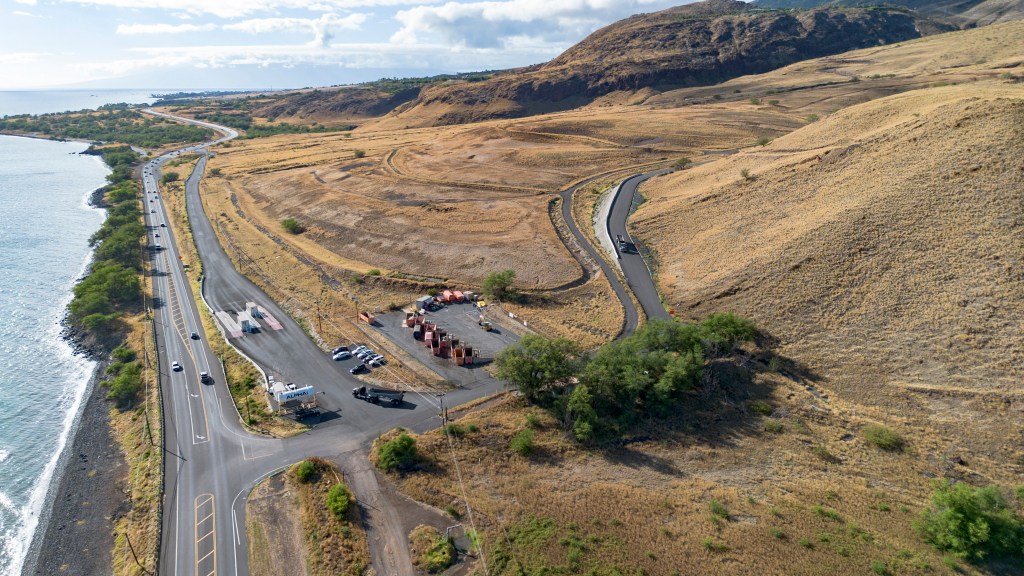
Those details are contained in the U.S. Army Corps of Engineers’ recently released plan for the federally funded operation, a joint undertaking of the Corps, Maui County, the Federal Emergency Management Agency and the state health and transportation departments.
Route Chosen to Minimize Traffic — But Expect Delays
An analysis by the Corps determined the operation would have little impact on traffic. Still, officials said drivers should plan for extra travel time and consider adjusting their commutes.
The trucks will use a privately owned former cane haul road to avoid traveling through major highway intersections in Kahului, according to Jordan Molina, Maui County’s director of public works.

The county struck an agreement with the property owner to use the road at no cost, Molina said in a written statement. Government agencies worked together to repair and modify highway intersections and the cane haul road in preparation.
At a community meeting in Lahaina last week, a resident asked why the trucks couldn’t avoid commuting hours. Lt. Col. Joseph Kendall said officials needed to work throughout the day to finish by the federally imposed deadline of Dec. 31.
If there aren’t any delays, the job could be finished earlier, by November, Kendall said. But the Corps’ plan says operations at both sites could be halted by high winds, strong storms or other inclement weather.
“There’s going to be environmental factors that will potentially force us to slide into” November and December, Kendall said.
Officials have identified two alternative routes in case of road closures.
Officials Say Debris Isn’t Toxic or Hazardous
Ash samples collected in Lahaina were found to contain elevated levels of arsenic, lead and other hazardous minerals, and people have expressed concerns about toxins leaching from the temporary holding pit into the groundwater supply or ending up in the Pacific Ocean.
The temporary site is just a few hundred yards from the country’s largest known population of manta rays and a world-famous reef system, including the oldest coral found near the main Hawaiian islands.
But the Corps said in a written statement that the debris at Olowalu is considered nonhazardous and nontoxic and that the agency has taken steps to ensure that it is transported and disposed of safely.
Workers also will lightly wet the debris and ash before loading it onto trucks to limit how much ash becomes airborne. They will wrap the waste like a burrito using “thick, industrial-strength plastic sheeting” to prevent anything from falling out while en route, according to the Corps and Maui County.
The material also will be sprayed with water at the permanent site and covered with soil every day, according to the debris transfer plan.
Air quality, groundwater and leachate will be monitored at the Olowalu site until all of the debris has been removed, according to the plan. Then the Corps will shift its focus to restoring the site “to its original contours.” The agency is working with stakeholders on that restoration plan.
How To Report Problems
The U.S. Army Corps of Engineers asks anyone who sees something concerning to report the incident and the truck’s license plate number via the Corps’ debris hotline at 877-214-9117.
More information, including a map of the haul route, is available at MauiRecovers.org/debristransfer.
Civil Beat’s coverage of Maui County is supported in part by a grant from the Nuestro Futuro Foundation and its coverage of environmental issues on Maui is supported by grants from the Center for Disaster Philanthropy and the Hawai‘i Wildfires Recovery Fund, the Knight Foundation and the Doris Duke Foundation.
CORRECTION: This story story has been updated to reflect when Maui officials say the operation will begin.