Maui Fire Survivors Uprooted Again As FEMA Starts Charging Rent
The Federal Emergency Management Agency is trying to reduce the load on the island’s housing stock but the continual need to relocate is frustrating residents.
Some Maui fire survivors are finding themselves uprooted again even as the Federal Emergency Management Agency starts collecting rent from nearly 1,300 households staying in homes provided through its direct housing program.
The agency has played a pivotal role in the community’s recovery efforts since the August 2023 fires displaced more than 12,000 people, but it is now relocating hundreds of families into short-term rentals to reduce the already severe strain on the island’s housing stock.
At the same time, nearly everyone has appealed the market rates FEMA began charging on March 1.
Diana Tevaga, who grew up in Lahaina, has already moved at least half a dozen times since the August 2023 fire destroyed the apartment she shared with her mom and “fur baby.” Now she is among those facing yet another move.
“Each move has deepened the instability,” she said in an email Wednesday. “I went from a secure, affordable, long-term rental in my hometown near work to something completely different. The disruptions have taken a toll on my sense of safety, stability and overall health.”

Although grateful for the resources and guidance provided by government officials, volunteer organizations and charitable groups, she said the recovery process has been difficult to follow — especially while navigating constant fear and frustration.
“I have loved ones trying to rebuild and others still unhoused as renters,” Tevaga, 42, said. “We are all trying to find a way forward, but it is hard when systems keep shifting underneath us.”
FEMA spokesperson Nicole Timon-Shipman said the agency is committed to helping survivors eventually return to normalcy.
In recent weeks, about 300 out of the 814 households that had been living in long-term rental units as part of FEMA’s direct-lease program were notified that the agency would be moving them into short-term rentals.
Once affected households were informed of their new address, they had 14 days to begin the process of moving out, Timon-Shipman said, and they were required to vacate their old unit within 48 hours of being provided with keys to their short-term rental.
Survivors had been able to stay rent-free in units that FEMA directly leased from landlords or in one of the 167 modular homes at the agency’s Kilohana Temporary Group Housing Site in Lahaina. Timon-Shipman said all of the Kilohana units are now occupied, and federal policy had required FEMA to begin charging rent 18 months after former President Joe Biden first declared the Lahaina wildfire a disaster.
Still, 98% of those recently required to begin paying rent appealed their monthly rate with FEMA, saying they could not afford to pay the entire amount, another indication of the ongoing challenges still faced by those most affected by Hawai‘i’s deadliest natural disaster.
Moving On
From the beginning of the recovery following the Aug. 8, 2023, wildfires, FEMA said it intended to house survivors in empty vacation rentals and vacant second homes. But its lease program lacked sufficient safeguards to prevent some property owners from evicting long-term tenants to go after the higher rents paid by the government to house survivors. FEMA has said it was paying property owners an average of $6,000 per month.
While the cost of living and average monthly rent on Maui has skyrocketed in recent years, it is unclear how much of that is because of FEMA’s direct-lease program versus the overnight loss of more than 2,000 homes from Maui’s housing stock due to the fires.
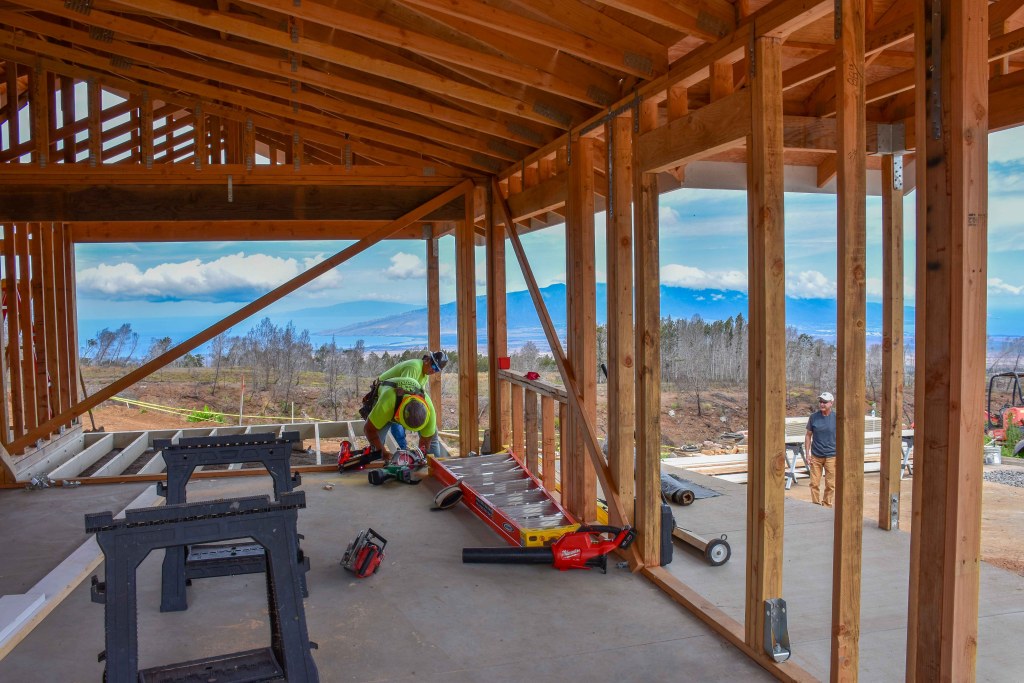
Meanwhile, options to move on for survivors remain limited. Rebuilding has been slow. As of May 7, 149 residential building permits were being processed and 355 had been issued, but only eight homes had actually been rebuilt in Lahaina, according to data from 4Leaf, a county contractor. Another 230 homes were under construction.

The short-term rentals where survivors now are being relocated include a mix of condominiums, single-family homes and ‘ohana units, Timon-Shipman said, primarily in in Kīhei and West Maui.
Jordan Hocker, community education and outreach coordinator with the local nonprofit Maui Housing Hui, was conflicted about the change.
“Many of those families are still in survival mode,” she said. “People not only lost their homes, but they lost their jobs, and they lost their businesses.”
While Hocker said she hoped that returning roughly 300 units to the long-term rental market would provide some much-needed relief for Maui residents who have struggled to find an affordable place to live, she doubted it would be enough to bring down rent prices.
“I think asking fire survivors to move again feels a little like kicking them,” she said.
Tevaga said she had finally achieved some level of stability when she moved into the one-bedroom unit outside of Lahaina where she currently lives as part of FEMA’s direct-lease program.
She described the emotional cost of having to relocate again as “enormous.”
“I fear that survivors are once again being moved without real solutions in place,” she said.
FEMA hand-delivered a letter to Tevaga on March 22 informing her that she would soon need to vacate so that her one-bedroom could be returned to the long-term rental market. During a recent meeting, she said FEMA officials told her that she was required to accept any unit the agency offered to her unless she had “legitimate safety concerns.”
Tevaga, who currently lives in a smaller apartment on the first floor of the home, said the two-bedroom, two-bathroom unit above her had also been part of FEMA’s direct-lease program. That unit, now vacated, was recently listed on Zillow for $5,000 per month, she said.
Although being displaced from her home by the fire has been incredibly difficult, she has tried to adapt and has appreciated being able to avoid the burn zone as she attempts to heal emotionally.
“I do not know if or when I will return,” she said, “but Lahaina will always be a part of me.”
‘Recovery Has Not Been Free’
Rent payments to FEMA as part of its direct housing program are put into the federal government’s disaster relief fund, which is managed by FEMA and funds the agency’s disaster response and recovery efforts, Timon-Shipman said.
“Notably, 91% of households currently in FEMA Direct Housing were renters before the disaster and are already accustomed to making monthly rent payments,” she said.
The amount of rent FEMA charges a household is based on the U.S. Department of Housing and Urban Development’s 2025 Fair Market Rent on Maui and the household’s income, according to Timon-Shipman. That’s currently $1,750 for a studio, $1,762 for a one-bedroom, $2,309 for a two-bedroom, $3,103 for a three-bedroom and $3,584 for a four-bedroom.
An image posted to Instagram by the Maui County Office of Recovery in April provided instructions on “How to Pay Your FEMA Rent” over the phone, online or by mail and warned that payments not made within 30 days may result in penalty fees, loss of reduced rental rates and even revocation of the right to remain in a FEMA temporary housing unit.
After most of the nearly 1,000 households that were required to begin paying rent as of March 1 appealed for a rent reduction, however, Timon-Shipman said the agency approved 88% of those requests. The minimum possible rental amount is $50 per month, she said, reserved only for households who provided documentation that their income met or was below HUD’s very low income limit.
Hocker pointed at how more than a third of fire survivors fell below the poverty line, according to a University of Hawai‘i study last year. She said that just underscores how difficult the recovery is for many survivors, particularly affording rent on Maui.
“When you compound that with emotional distress and trauma, I’m not the least bit surprised that people aren’t back up financially where they were,” she said. “Their entire lives were upended.”
The initial rental rate quoted by FEMA would have been the equivalent of nearly half of Tevaga’s income, she said, explaining why she filed an appeal. Her request was acknowledged on April 22, she said, but she still felt like the response dismissed her concerns.
“It is also important to understand that recovery has not been free,” she said. “Survivors like me, who are just trying to do what is right, have had to replace everything we lost: basic necessities, clothing, and household items. That comes with a financial cost that adds up quickly. Any temporary rent relief did not mean we were necessarily able to save money. Many of us were using those funds to rebuild our lives piece by piece.”
Haunted By Memories
Recovery feels far away for Tevaga, who said she is still haunted by memories of how helpless she felt as she sat in standstill traffic watching the wind fuel fast-approaching flames and whip dark smoke into a frenzy, the heartbreak she experienced when she realized there was no way to contact loved ones to make sure they were safe, the guilt that overwhelmed her when she learned that a neighbor never made it out of her apartment.
“Every survivor carries a different version of grief, and it is something that bonds us even when words fall short,” she said. “Recovery is neither short-term nor simple.”
Civil Beat’s coverage of Maui County is supported in part by a grant from the Nuestro Futuro Foundation and its coverage of environmental issues on Maui is supported by grants from the Center for Disaster Philanthropy and the Hawai‘i Wildfires Recovery Fund, the Knight Foundation and the Doris Duke Foundation.