

Accountability Proves Elusive In $25,000 Damage To This Popular Oʻahu Reef
No one was held responsible for the 2024 Kewalo Basin incident, highlighting some of the difficulties in reef damage enforcement.
A year ago today, a large four-pronged anchor dropped from a boat gouged the reef in the Kewalo Basin several hundred feet off Kakaʻako Waterfront Park, leaving a scar in the coral that would take upward of $25,000 to repair.
Dive operators nearby saw it and reported it. The following day, they took video of the damage. Yet no one has ever been held responsible.
That’s because the burden of proof to charge perpetrators with destruction of the reef is nearly impossible to meet, essentially requiring footage of a vessel actively causing damage — a bar not only hard to clear but often dangerous, too.
“It’s very easy for someone to cause damage and get away with it,” said Dylan Brown, the executive director of Ocean Alliance Project, a Hawaiʻi coral conservation nonprofit, who was among the first to learn of the destruction.

Hawaiʻi Administrative Rule Chapter 13-9-70 states that “it is unlawful for any person to take, break, or damage any stony coral” and that anyone who breaks this law can be charged with a misdemeanor and/or face civil or administrative penalties. But it all comes down to whether the evidence will stand up in a court of law.
The night of the incident, operators from Waikīkī Dive Center received an ominous call, “Stay southeast of the pipe, do not come northwest of the pipe,” the man said over the radio, referencing a rusty underwater pipeline, known as the Kewalo pipe, that serves as a popular dive site on Oʻahu for local dive companies.
The following morning they found the damage. Brown, one of the dive masters on that morning trip, documented what they saw and filed the official complaint with the Department of Land and Natural Resources’ Division of Aquatic Resources.
“We were sure we had more than enough to catch them,” Brown said, “but I found out very quickly just how wrong I was.”
Devil In The Details
To tie an individual vessel to a specific event, an observer ideally would get the registration number on the ship’s hull and capture video of the vessel in the act of causing the damage.
But the proximity to the boat needed to achieve this, Brown said, can be extremely unsafe for divers or nearby vessels to collect. Divers generally avoid getting too close to avoid propeller strikes or collisions with the vessel.
Private and commercially owned boats do get held accountable for reef destruction throughout state waters. In 2022, for instance, the Division of Aquatic Resources recommended a fine of $43,417 for reef damage off the Big Island involving half the amount of coral colonies as the Kewalo Basin incident.
However, that is far more likely when the ship is still present at the scene of the damage.
Kim Fuller, an Oʻahu district biologist with the aquatic resource division, advised anyone who witnesses suspicious behavior on the water to report directly to DLNR as quickly as possible. The more information the better: photos, videos, GPS location.
Once an incident is reported, a joint investigation is opened by the agency’s Division of Conservation and Resource Enforcement and its Division of Aquatic Resources, which is responsible for quantifying the cost of damage to natural resources.
According to a DLNR press release, “(t)he violation is a petty misdemeanor offense, subject to a criminal fine of a minimum $250 for a first offense, $500 for a second offense, and $1,000 for a third or subsequent offense. In addition, administrative fines of up to $1,000 per specimen may apply.”
The evening of June 25, 2024, divemaster Kate Heffner from Waikīkī Dive Center, was taking customers out for a night dive, her third of the week. They paid little attention to a large commercial-looking vessel to the northwest that had been around for a few days until they received the radio call advising them to stay away from the boat’s work area.
Heffner remembers that the whole thing made her uncomfortable: “I didn’t even really want to dive anymore if it was going to be dangerous.”
The following morning, she returned to the site with her morning trip. As she and Brown descended into the water column with their customers, they knew something was amiss.
“I noticed it was unusually bright coming from the direction of where the boat had been,” Heffner said.
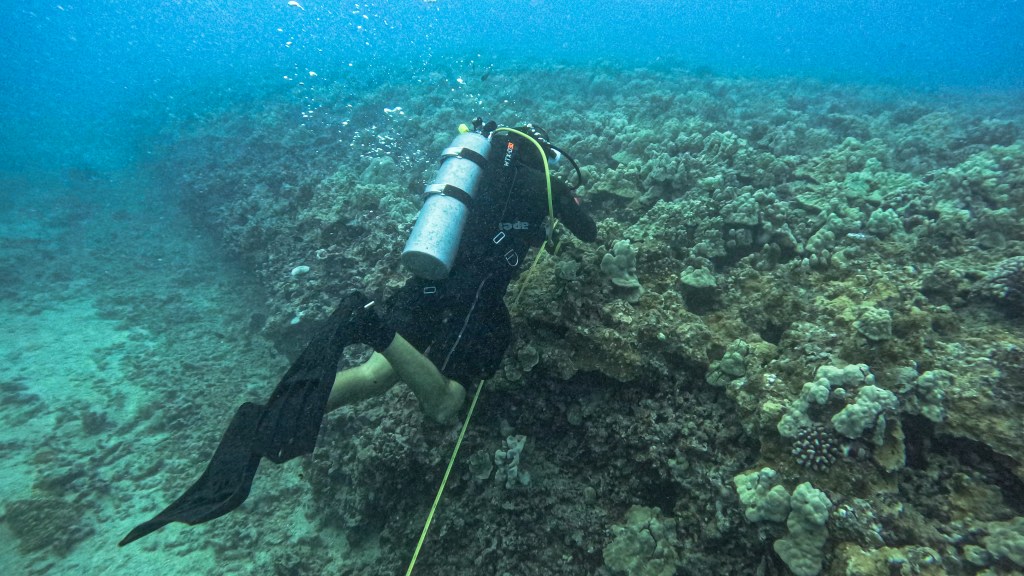
Swimming closer, they discovered that the bright color was the exposed skeletons of damaged coral. Some colonies were flipped over completely, leaving them at risk of smothering in the sand.
The divers said they felt certain the culprit was the ship they had seen the night before. Heffner had done around 200 dives on this section of reef and Waikīkī Dive Center runs trips near there daily. Had it happened before, she or one of her colleagues would have noticed.
Brown set about documenting the damage at the site with underwater video. Then, they put a call out on social media to see if anyone had photos of the boat from the night before.
That documentation along with subsequent surveys by Division of Aquatic Resource biologists confirmed damage consistent with a boat anchor. Fuller said it appeared that a ship had first anchored in a sand patch before dragging the anchor into and along the nearby reef.
In an official statement released by DLNR a few weeks after the damage, Fuller said they found “two scars that looked like they were likely from an anchor drag” about 80 feet long and 6 feet wide. Approximately 200 coral colonies were affected, with 74 of them propped back up by the biologists on their initial survey.
Neither the eyewitness accounts nor the footage from Brown’s group were enough to implicate any specific boat in the highly trafficked area beyond a reasonable doubt, according to a statement from the division shared earlier this month with Civil Beat via email, which also stated that the investigation is now closed without resolution.
The company the divers had reported denied that it had anything to do with the incident according to Brown. David Forman, the co-director of the environmental law program at the University of Hawaiʻi Manōa, said that with the company denying responsibility, DLNR likely did not have the resources to continue to pursue the case.
“They’re asked to do so much with so little,” Forman said.
Race To Repair The Reef
Time is an important factor when it comes to coral restoration. Once coral tissue dies, Brown said, you can only replace it by transplanting coral from elsewhere. If you are able to get quickly to an area where coral has been disrupted, it is possible to prevent much of that tissue death.
This can help save hundreds of years of growth, which is particularly important for coral species that have to reach a certain size to reproduce. A coral polyp grows at a maximum of 2 centimeters per year. This means it took a 200-centimeter coral colony 100 years or longer to reach that size.
Last June, at least 100 years of growth in Kewalo basin was disrupted within seconds at the drop of an anchor.

Alika Garcia, the executive director of Kuleana Coral Restoration, first heard about the damage from Brown and wanted to help, so he reached out to the aquatic resource division to offer the nonprofit’s coral recovery services pro bono.
The project needed a special use permit from DLNR, which would take time, along with permission from the Division of Aquatic Resources. But the National Ocean and Atmospheric Administration was able to provide its own special use permit to Kuleana, expediting the process.
So, within two weeks of the initial reef destruction, divers with Kuleana Coral began working on the 80-foot gashes.
Garcia and his team — three to five people, depending on the day — started by collecting coral debris in a process known as “caching”. After selecting a central location protected from currents as the cache site, they piled in their specimens.
Working below the ocean’s surface, the divers then triaged which coral had the highest likelihood of survival.
“We have a rating system, corals with a score of four and five are more likely to recover. One to three probably won’t make it,” Garcia said. “The faster you get out there, the more you can save; after a couple of weeks they start to decline.”
Once the coral “patients” were sorted, divers transported them in baskets to a boat where the first part of the surgery was performed. Large rescued colonies received a stainless steel rod, not unlike those used in some human surgeries. Aquatic resource biologists and Kuleana divers worked together to drill holes in the base of the coral, where the steel rod was attached using a two-part epoxy.
“The Kewalo incident demonstrates what’s possible when community, government, and nonprofit actors mobilize together.”
Alika Garcia, executive director of Kuleana Coral Restoration
The coral was then left to rest overnight so the epoxy could set. Divers then returned the coral to the water and repeated the drilling process underwater. This time they created holes in the seafloor where they then used epoxy to attach the coral colonies to the substrate.
Other pieces of coral too small to withstand such an intense surgery required a different method. For them, the team instead used a traditional concrete powder mix to reattach them to a base. To keep the concrete powder from making a mess in the water, the divers added xanthan gum, a natural thickening agent.
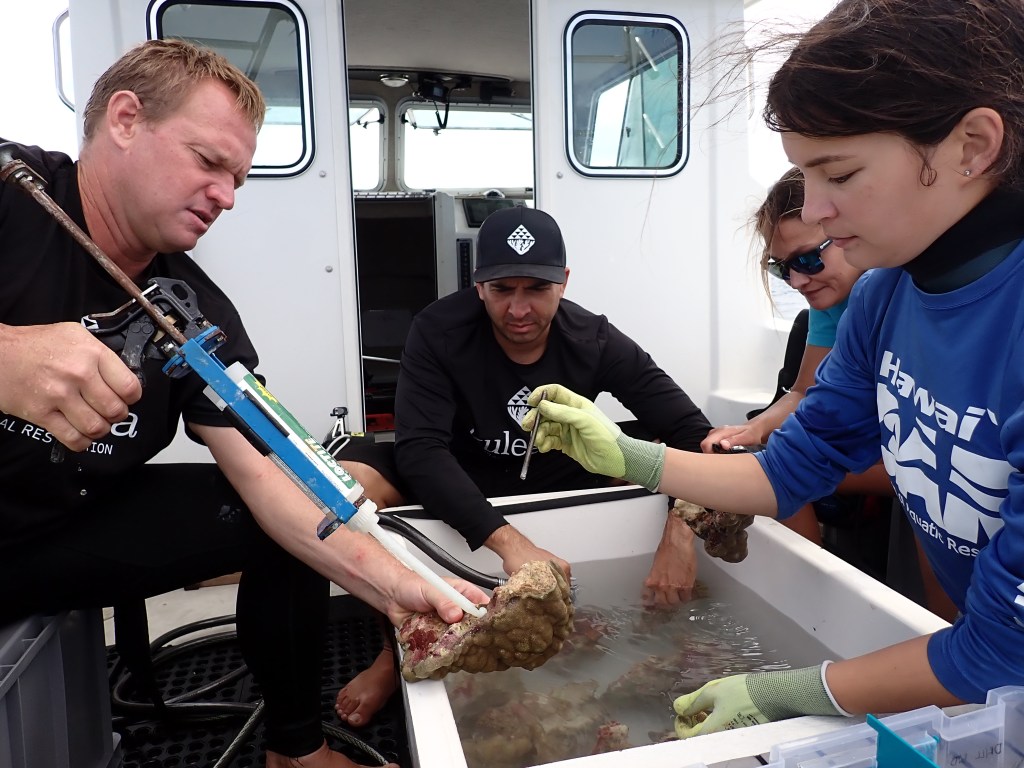
Including surveys of the site before and after the work, the entire operation took the team just eight days, costing approximately $25,000 in labor and materials.
The funding for Kuleana’s work, including this project, comes from the Sheba Hope Grows initiative, a coral recovery initiative started by Sheba cat food company. Garcia said that support allows his team to “respond immediately to events like this, even when no responsible party is identified or held accountable.”
A year later, the damage is almost imperceptible to those who do not know it is there. Just west of the Kewalo pipe, rolling hills of reefs hide the scars the anchor left behind. Coral regrowth and algae cover the once obvious bare skeletons of the damaged colonies.
The reattached pieces are healing from their wounds, nestled in their carefully chosen beds clustered among the sprawling reef.
“The Kewalo incident demonstrates what’s possible when community, government, and nonprofit actors mobilize together,” Garcia said, “and we know even larger events lie ahead.”
Civil Beat’s coverage of climate change and the environment is supported by The Healy Foundation, the Marisla Fund of the Hawai‘i Community Foundation and the Frost Family Foundation.

