Emotions Are High As Maui Considers Phasing Out Short-Term Rentals
Dozens of people turned out to testify on Mayor Richard Bissen’s effort to convert short-term rentals into long-term housing in a bid to ease the affordable housing crisis.
This story has been updated to clarify that the mayor has proposed extending the timeline of implementation.
More than 50 people spoke passionately for and against Mayor Richard Bissen’s controversial plan to convert thousands of short-term rentals into long-term housing for locals during Monday’s meeting of the Maui County Council’s Housing and Land Use Committee.
More than 100 others had signed up to testify, packing the council chamber, gathering on the lawn outside and queuing up online to share their views remotely via video chat. But the clock ran out as organizers ended the meeting on schedule after about six hours.
The heavy turnout underscored the high tensions over Bill 9, which the mayor first introduced last May. While opponents raised concerns about the potential economic repercussions of quickly eliminating thousands of vacation rentals, supporters emphasized the urgent need to free up more units for local families on an island with a longstanding housing shortage.
The island’s housing shortage has been brought into sharp focus after the 2023 wildfire that destroyed much of Lahaina, including thousands of homes.
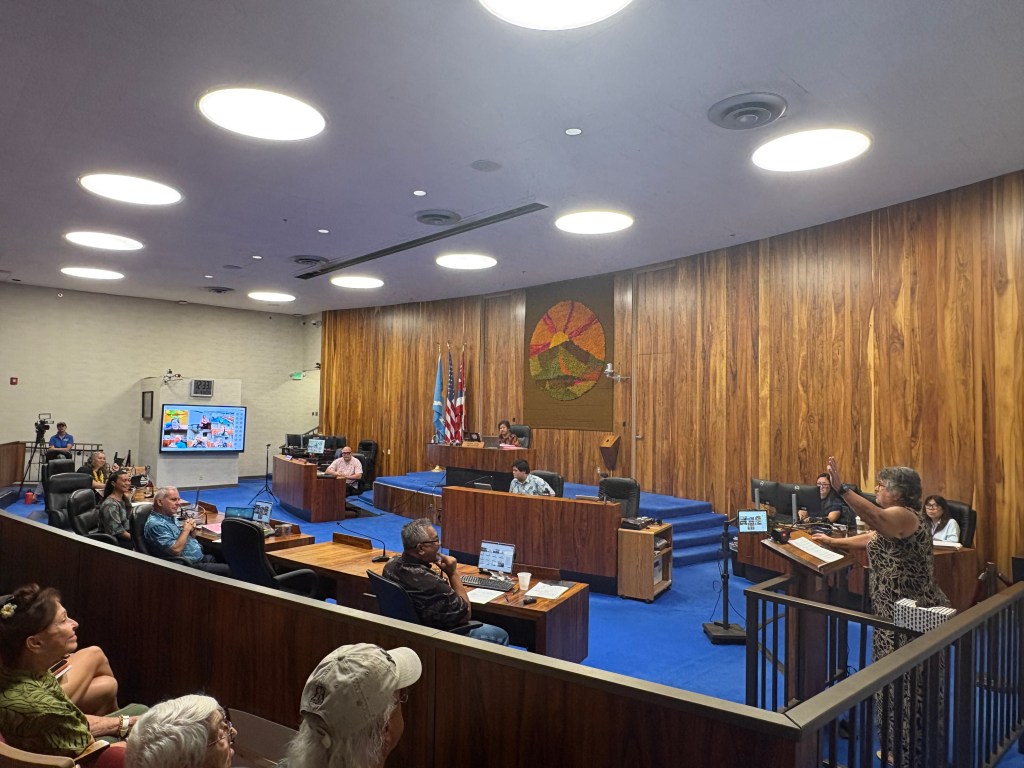
Prior to the testimonies, Bissen said he did not want to divide the community, but local government leaders have a responsibility to address a “crisis that has been building for decades.”
“The status quo is failing our people, and this housing crisis demands bold, decisive and forward-thinking action,” he said. “While Maui County may be financially sound and well-resourced, can we truly say we are thriving as a community if our own people — our ʻohana and our keiki — are being priced out of their own community? Even the chance to give our people hope is worth more than preserving a system that has pushed them to the margins.”
As proposed, Bill 9 would end the exemptions that allow many apartment-zoned units to operate as vacation rentals for 2,200 units in West Maui on July 1, and for the remaining 5,000 such units, mostly located in South Maui, on Jan. 1, 2026.
But Bissen has proposed an amendment that would push back the implementation timeline up to three years, and the council has not yet approved the legislation.
The mayor’s proposed budget for the upcoming fiscal year also does not account for the significant reduction in tax revenue that economists and others have said would result from converting the properties in question — known as the Minatoya list– into long-term rentals.
Elizabeth Ray, who stood with her 5-year-old daughter, said her family was one of many on the island that had become homeless, and it was frustrating to know that there were thousands of apartment-zoned units that were often vacant or only available to tourists.
“How can you ignore that pure aloha that we breathe? I get it — your nails, your manis, your pedis and your martinis, while you sit up in your pools, overlooking the ‘aina and its people,” she said. “But greed makes you a fool. Please house our people.”
Steve Hogan was one of numerous people who own or manage affected properties and oppose the mayor’s plan. Hogan, like other short-term rental property owners, argued that converting these units would devastate Maui’s tourism-dependent economy and fail to introduce significantly more affordable options to the local housing stock.
“Supporters of this bill have stated that we’re prioritizing profit over people, which is not true,” he said. “We are prioritizing wisdom over wishful thinking, math over emotions, and we are considering all the people decimating some parts of the community in unrealistic hopes of helping another part.”
Mike Keesler, who lives in Kahana and owns a vacation rental in Lahaina, said he and other vacation rental owners would be financially devastated if the legislation were approved.
“If this passes I myself may not be able to stay on Maui, as I will not be able to afford it,” he said. “Local short-term rentals are not faceless corporations or absentee investors.”
But others like Richard Hudson argued that the community should not be responsible for protecting property owners who “made bad investments” and may subsequently have to move off the island.
“As a board, is it your responsibility to be their mommy and daddy and to get them out of a situation that they got themselves into?” he said. “If you invest in anything and it doesn’t sell you take your lumps and move on. You don’t go ‘Oh I made a bad investment, help me out!’”

Paele Kiakona, one of the founders of the local advocacy group Lahaina Strong, noted in his testimony that vacation rentals use 200% to 400% more water than nearby owner-occupied units, and the unavailability of water is often cited as a major obstacle for building new affordable housing.
“So through this phase out, we would not only add thousands of units to the housing market, bringing prices down all around, but we also create an opportunity to free up hundreds of thousands, if not even millions, of gallons of water per day,” he said. “That means we now free up water to be able to build more affordable housing.”
Bissen acknowledged a study released in March by the University of Hawaii Economic Research Organization that warned Bill 9 could result in widespread job loss and a severely weakened economy.
But he argued that economic models like those used by the study’s authors, “cannot quantify the heartbreak of yet another local family forced to leave their homeland.”
The committee will reconvene at 9 a.m. on June 18 to continue the public hearing.
Civil Beat’s coverage of Maui County is supported in part by a grant from the Nuestro Futuro Foundation.
See Bill 9 below: