

Hawaiʻi Astronomy Stares Into The Abyss Of Federal Cuts
In addition to the TMT, proposed federal funding cuts threaten the world-class Keck and Gemini observatories, the solar telescope on Maui and UH’s Institute for Astronomy.
Deep budget cuts proposed by the Trump administration would deal a major blow to several important observatories in Hawaiʻi, beyond pulling support for a future Thirty Meter Telescope, threatening the state’s status as a world-class hub for ground-based astronomy research and education.
The administration’s proposed new budget for the National Science Foundation and NASA would sharply reduce maintenance or operational funding for the W.M. Keck Observatory as well as the International Gemini Observatory on Mauna Kea. It would also reduce funding for the Daniel K. Inouye Solar Telescope on Maui by nearly 40% next year.
Details about those cuts emerged days after news broke that the NSF would not commit critical funds toward controversial plans to build the Thirty Meter Telescope on the summit of Mauna Kea, Hawaiʻi’s tallest mountain, and planned to direct major funding to the Giant Magellan Telescope in Chile instead.
Douglas Simons, director of the University of Hawaiʻi Institute for Astronomy, said the federal budget proposals are “on the edge of being just completely catastrophic” for some of the astronomy facilities in the island state.
“You can’t hit a facility with a 40% cut and expect good things to happen,” he said. “I think that’s just common sense.”
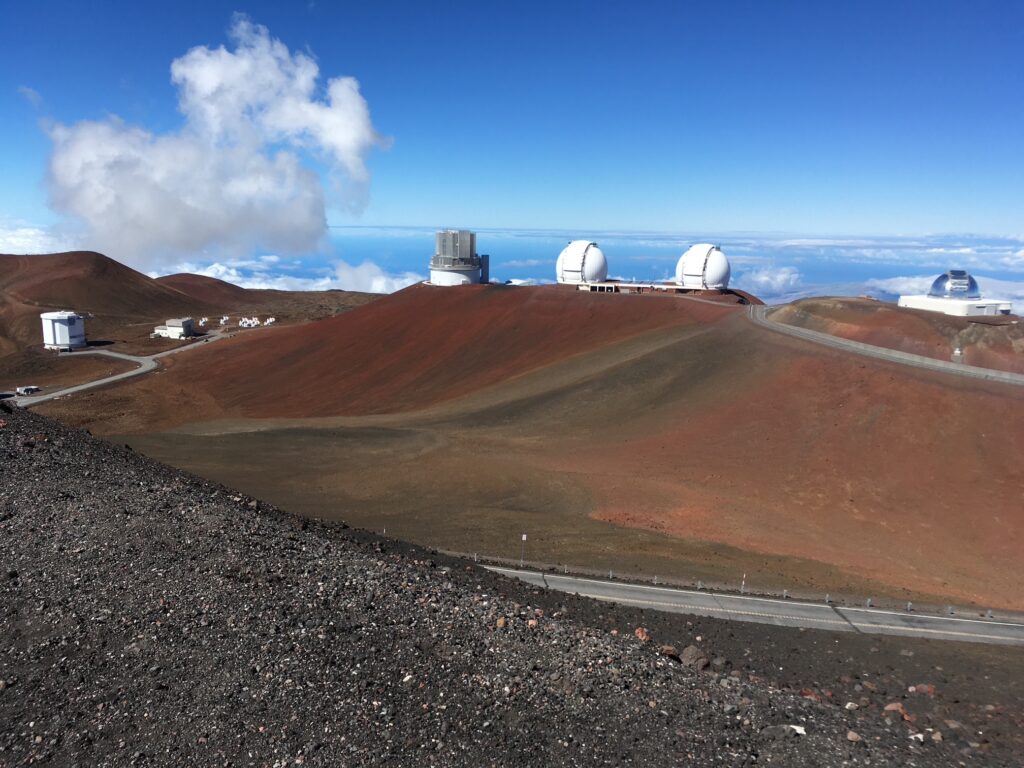
With its remote location in the Pacific Ocean, Hawaiʻi has been a premier site for astronomers worldwide, particularly on Mauna Kea, a dormant volcano on the Big Island known for its dry air and clear skies.
It’s also a major economic driver for tourism-dependent Hawaiʻi, in addition to providing educational opportunities as local institutions and students are often granted access to the state-of-the-art facilities. The University of Hawaiʻi Economic Research Organization has calculated that the field of astronomy has an approximate annual impact of $221 million and supports more than 1,300 jobs.
However, the industry has also faced criticism from environmental and Native Hawaiian activists upset over what they deemed the exploitation and cultural desecration of Mauna Kea. Tensions peaked in 2019 when mass protests halted the construction of the Thirty Meter Telescope.
Scientists had continued to promote efforts to develop the TMT, but the NSF said in its budget proposal released Friday that it would provide no additional funds for the project, throwing its support instead to the rival Giant Magellan Telescope in Chile.
A Blow To Science And Hawaiʻi’s Economy
U.S. Rep. Jill Tokuda, a Hawaiʻi Democrat, said the cuts — if they take effect — would cause job losses, affect research and deliver a direct hit to the local economy. “When you really step back for a second, we’re talking about taking away opportunities from our people,” she said Tuesday in an interview.
When asked if Congress will push back on the administration’s budget, Tokuda said she expects “anyone with a conscience and a commitment to their constituents will look at those details and realize that it does not work.”
“You can’t say that we need to be the first back to the moon or getting to Mars, and we support science, and cut NASA and cut NSF,” she said.
Simons said the budget documents seem to signal the United States no longer intends be the leader in ground-based astronomy, and will concede that role to governments in Europe and Asia that are pushing ahead with new projects.
“I can’t really fathom the U.S. strategic interests of having this sort of a huge impact,” he said.
The proposed NSA and NASA budget for astronomy seem to make little sense, he said, because they would slash operational funding for facilities that cost billions of dollars to design and construct. Plus, they are still producing top-tier research.

The cuts could force facilities to scale back their research, or even to close, he said. One example is the Daniel K. Inouye Solar Telescope, a $400 million project sponsored by the NSF that is almost ready to go into “full science operations,” Simons said.
The Institute for Astronomy is slated to receive 13% of the observing time on that instrument, and the loss of that would be a huge blow to the university’s solar astronomy program, he said.
Both the DKI solar telescope and the Gemini Observatory are slated for reductions in the NSF budget of 39.3% in operations and maintenance funding next year. That would cost the solar facility more than $8 million, and amount to a loss of $9.7 million for Gemini.
John O’Meara, deputy director and chief scientist for the Keck Observatory, said the administration’s proposed cuts to NASA would eliminate about $7 million that normally flows to Keck each year, or about one-sixth of the observatory’s operations budget.
That funding includes $3 million to fund the Keck Observatory archive in California and the staff associated with it. That archive is a partnership between NASA and Keck that makes the research done at the observatory available to the world.
Nobel Prize-Winning Research
Keck is famous for the role it played in identifying thousands of planets orbiting stars outside of our solar system, and led the world in research into how galaxies re-form and evolve over time.
Astronomers using the Keck observatory to study the cosmos have won two Nobel Prizes, including one in 2011 for discovering the expansion of the universe is accelerating, fueled by a mysterious “dark energy.” That work was done with the Hubble Space Telescope.
Andrea Ghez, a longtime researcher on Keck, won another Nobel Prize in 2020 for her research with others for providing proof of the existence of a supermassive black hole at the center of the Milky Way galaxy.
“We, and everybody who cares about astronomy should be talking to their members of Congress and saying, ‘You have the opportunity to undo these cuts,'” O’Meara said.
Nationally, the proposed cuts to the National Science Foundation would shrink that $9 billion institution by some $5 billion, meaning this issue is not just about the future of astronomy, he said.
But the proposed cuts can still be reversed, and “anybody who cares about science in the United States should be pushing on Congress for this,” he said.

