

Honolulu City Council Votes To Shake Up Its Leadership
New alliances are taking shape as Native Hawaiians occupy all three of the top positions.
Honolulu City Council members voted Tuesday to reshuffle their leadership in an apparent response to a recent dustup over sewer rate increases.
The council’s new vice chair is Andria Tupola, replacing Matt Weyer, who had held the post only since January.
The new floor leader is Esther Kiaʻāina, replacing Radiant Cordero. Cordero supported the change, describing it as “democracy in action.”
Councilman Tommy Waters remains the chair after the full council approved the resolution 9-0, with three members voting with reservations — Tyler Dos Santos-Tam, Augie Tulba and Weyer.
Tulba said that it was clear that the majority of the council had already lined up behind the change, and there was no point voting against the resolution if leadership was already fractured.
“I do think the public needs clarity,” Tulba said. “If this is a retaliation that needs to be said.”
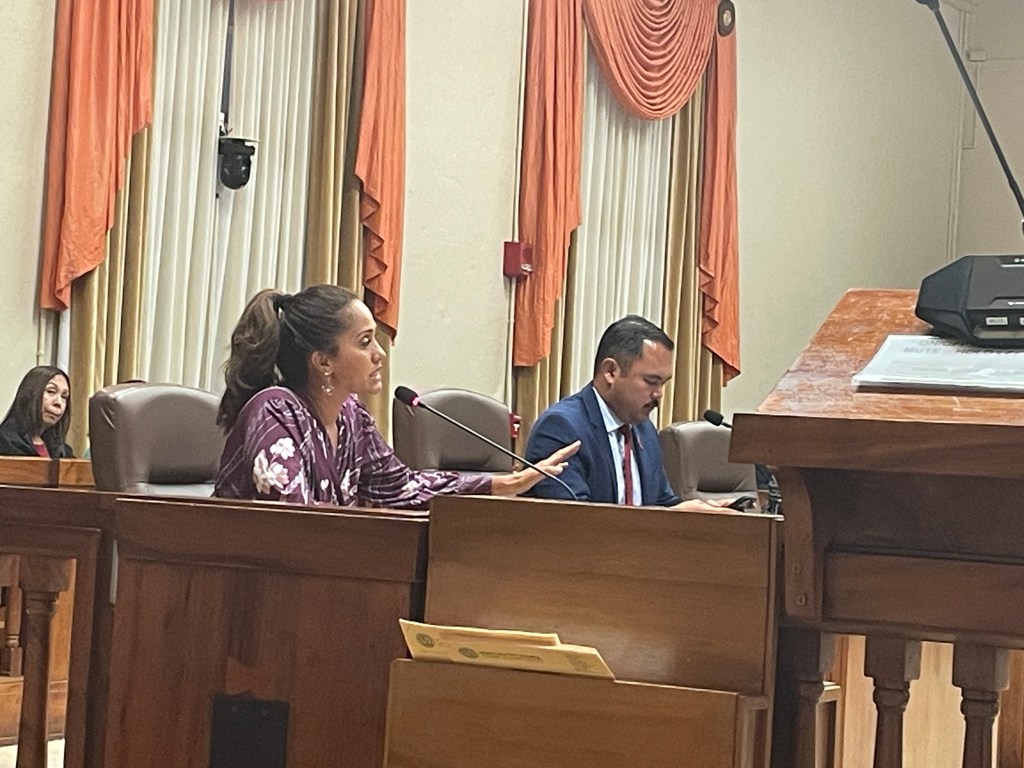
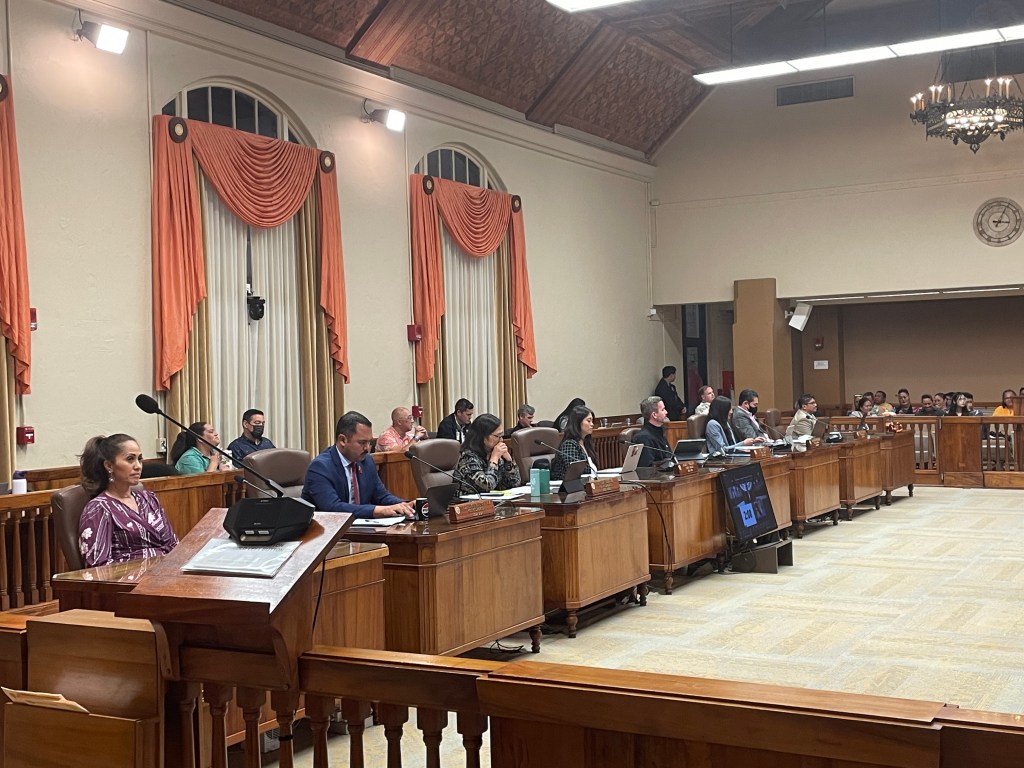
The passing of the resolution followed impassioned in-person and remote testimony and restored Native Hawaiians to the council’s top three leadership roles, with Kiaʻāina and Tupola swapping the positions they held previously.
Speaking after the vote, Kiaʻāina said that both she and Tupola had managed change before when they were dropped from their leadership positions “but we have to keep moving forward.”
“To anyone who thinks the change is rash,” Kiaʻāina said, “I ask them, where have you been?”
Tupola didn’t return a call seeking comment Tuesday afternoon and Waters declined to comment after the vote.
In opening remarks, Waters said that “reorganization is a difficult thing” and thanked Weyer and Cordero for their work on the council, but didn’t address the sewer bill issue.
Vote Sets Up Potential Majority Faction
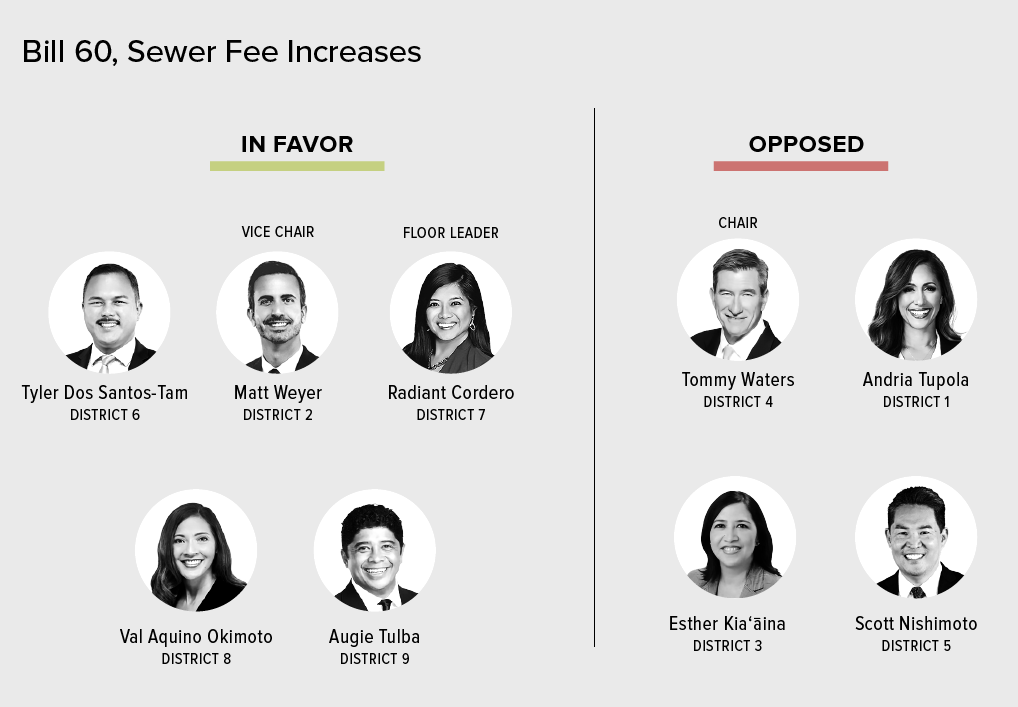
The resolution proposing the shakeup was introduced on June 6, just two days after the council voted 5-4 in favor of a sewer rate increase plan proposed by Dos Santos-Tam, the budget committee chair, that was opposed by Waters.
The chair had his own plan for lower sewer rate increases paired with an infusion of money from elsewhere in the city budget, but he interestingly called for a vote first on the Dos Santos-Tam proposal at the June 4 meeting. Tupola also had an alternative rates plan.
It may have been a test of loyalty. If so, Weyer and Cordero apparently failed it by joining Dos Santos-Tam, Tulba and Val Okimoto in approving the plan. Tupola, Kiaʻāina and Scott Nishimoto joined Waters in opposition.
Tensions between Waters and Weyer were evident before the sewer vote June 4 in a debate over Honolulu’s executive operating budget after Waters introduced several last-minute amendments to his budget floor draft.
The amendments would have reallocated funding from job vacancies across city departments to offset the costs of upgrades to the Sand Island sewage treatment plant.
Weyer said then that he “was shocked and disturbed” by some of the cuts that Waters’ budget draft included, and the chair’s amendments were not voted on.
It remains to be seen if Dos Santos-Tam will keep his role as budget chair. Dos Santos-Tam and other speakers Tuesday highlighted the need to focus on challenges facing the city, including cuts to federal funding of Oʻahu’s transportation system that just passed the U.S. House.
“This resolution has come with a lot of drama and spectacle, but that’s not what we need,” Dos Santos-Tam said. “We need to take action.”
The resolution that led to Tuesday’s shakeup was proposed by Nishimoto and Okimoto, which could indicate they may join a new majority faction on the nine-member council that might also include Waters, Tupola and Kiaʻāina.
While council positions are nonpartisan, the elevation of Tupola represents a bit of bipartisanship as she is a well-known Republican who ran for governor in 2018. Okimoto and Tulba are also Republicans, while the six other council members are Democrats.
Waters has managed the unusual feat of becoming a long-term council chair, having held the top spot since 2020. The vice-chair and floor leader positions convey far less power, but do provide elevated political prominence.
One major issue that lies ahead for the council is a proposed empty homes tax that has been supported by Waters, Cordero, Weyer and Dos Santos-Tam.
If those four continued to back the proposal, Waters’ task would be to convert one more council member to support it after three previous attempts — and now he might be trying to convince newfound allies.
The council chose to kick a vote on the empty homes tax proposal down the road in December while awaiting the results of a city-funded study.
The study released in April found that 1,500 to 2,100 vacant properties on Oʻahu could be assessed an additional 1% to 3% in annual property taxes. That could generate $30 million to $55 million, depending on how homes were assessed, according to the accounting firm Ernst and Young.

Many In-Person Testifiers Opposed The Change
The final resolution count showed a majority supported the change with 342 in favor, and 247 opposed. Some in-person testifiers voiced support for Weyer’s representation of the LGBTQ community and the North Shore. Others criticized Tupola for not being supportive of that community and aligning with some of the policies of the Trump administration.
Tupola sent out a message from her council email account Monday morning with a copy of the resolution asking for testimony “in support of my leadership and the work I’ve done for the community.”
That came in the form of endorsements from her Waiʻanae district, Native Hawaiians and members of the International Longshore and Warehouse Union.
During the council discussion, Tupola became visibly emotional.
“There were lot of things said about me today, and as a leader it’s good that I hear them,” she said.
Tupola said she would continue to support the diverse voices that make up the community and that she was committed to collaborating with other council members.
Weyer alluded to the email when he thanked people who turned out to urge a no vote on the resolution without being asked to. Afterward, he said was committed to continuing to serve the people of his district and the city.
Note: This story has been updated to reflect the final resolution count.

